
Unbiased headlines. Facts, not spin.
Every story is an unbiased news briefing written from 110+ sources across the spectrum — sources linked so you can verify it yourself.
 finance
Notable (5/10)
June 27, 2026 at 04:15 AM
finance
Notable (5/10)
June 27, 2026 at 04:15 AM
S&P 500 Heads Into Second Half With Gains Intact, but Analysts Flag Correction Risk and Uneven Rally
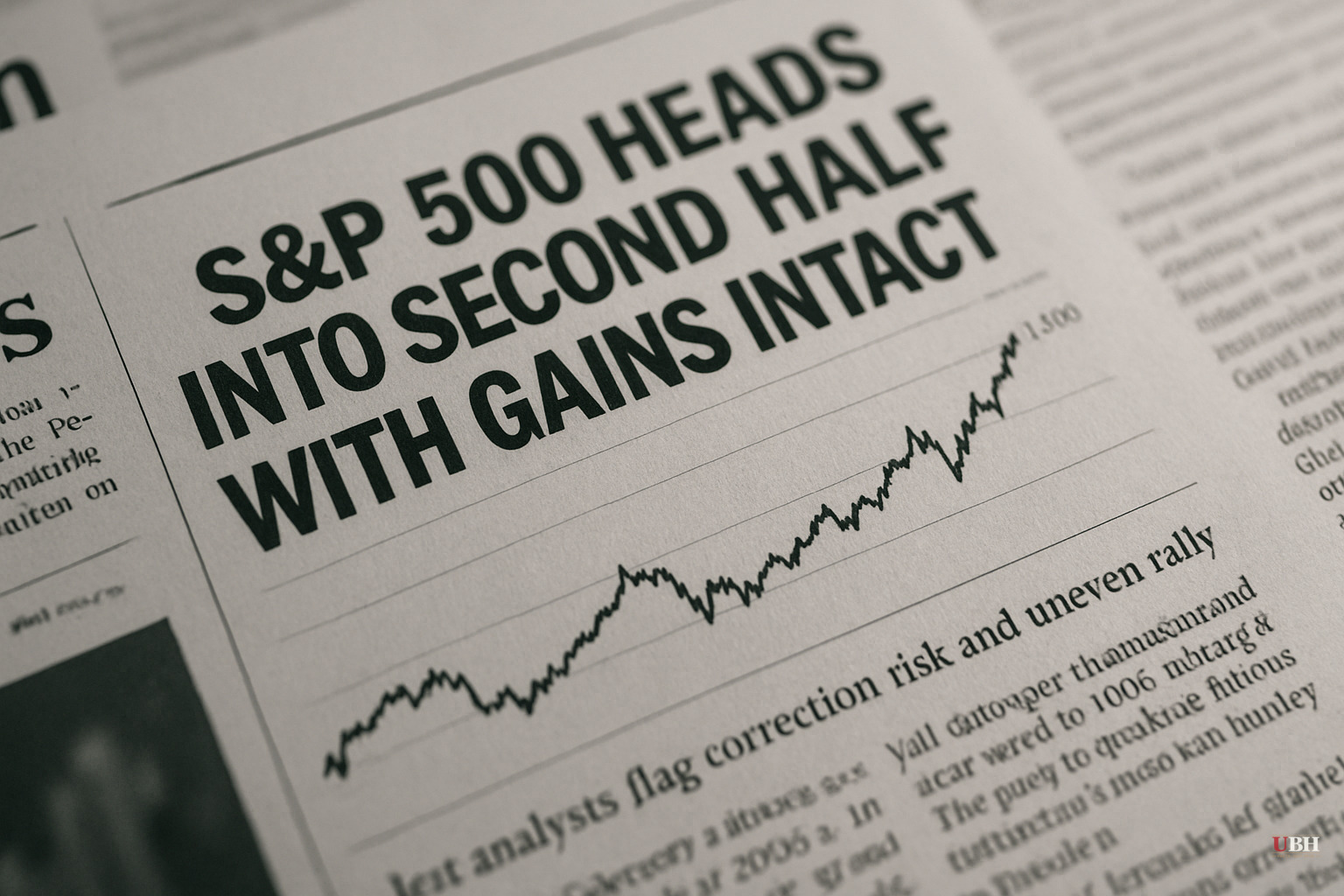
A Better Half Than Almost Anyone Predicted
Six months ago, the market picture looked rough. Tariff uncertainty, inflation fears, and geopolitical risk had Wall Street braced for a hard year. Instead, the S&P 500 is heading into the second half of 2026 with meaningful gains, and some of the biggest institutional names are now upgrading their outlooks.
JPMorgan raised its 2026 S&P 500 price target this week from 7,200 to 7,800, citing what it called a "Blue Sky" scenario. That implies roughly another 5% upside from current levels by year-end, according to CNBC.
David Miller, investment chief at Catalyst Funds, told CNBC: "I think there's a very good chance that equities can continue to rally from here in a pretty significant way through the end of the year."
A U.S.-Iran resolution appearing to be within reach has added to the optimism, removing one significant tail risk that had weighed on energy markets.
The PCE Number Deserves a Harder Look
Thursday's Personal Consumption Expenditures report — the Federal Reserve's preferred inflation gauge — showed inflation at its highest level in roughly three years.
The optimistic read, which CNBC's framing leans toward, is that consumer spending remains robust alongside the inflation print, suggesting the economy can handle a spike in energy prices as a one-time event. That may be correct.
The harder question is whether it is. The Fed has been here before, calling price spikes transitory. If energy costs stay elevated or spread further into services inflation, the "one-time spike" thesis falls apart. Rate cut expectations, which have been supporting equity valuations, get pushed further out. No rate decision is imminent as of June 27, but the PCE number will factor into the Fed's calculus when it next meets.
Holiday Week Means Thin Markets
U.S. markets face a holiday-shortened week ahead, with Independence Day falling on a Saturday this year and the Fourth of July weekend marking the country's 250th anniversary. Thin trading volume historically amplifies price swings in both directions. Gains look bigger, losses hit harder.
Layer in end-of-month and end-of-quarter portfolio rebalancing, and the setup for volatility is real. Managers who have ridden tech and AI names higher all year may trim positions simply for risk-management reasons, not because their long-term thesis has changed.
Tech Concentration Is the Unresolved Tension
The rally's biggest problem heading into the second half is that it has not been a broad one. Technology, specifically AI-adjacent stocks — what the industry calls "hyperscalers" — has done the heavy lifting.
According to CNBC's reporting, some investors are now pulling back on hyperscaler exposure until there is more confidence those companies can sustain extraordinary earnings growth. Software companies seen as most vulnerable to AI disruption are being picked through individually for winners and losers. Semiconductor stocks, particularly memory chips, have been the clearest beneficiary of AI spending, but even there, investors worry the run-up in recent weeks has been too fast.
Bankruptcy in any one of those crowded trades would not stay contained to individual stocks. That concentration risk is the legitimate concern that bulls have not fully answered.
The Seasonal Data Cuts Both Ways
History gives investors a mixed signal for what comes next. July is statistically the best month of the third quarter for both the Dow Jones Industrial Average and the S&P 500, according to the Stock Trader's Almanac data cited by CNBC.
For the Nasdaq, the picture flips. July historically marks the start of the worst four-month stretch for that index, with an average loss of 0.8% during midterm election years. With midterm elections approaching later this year, that seasonal pattern warrants attention.
Bank of America technical strategist Paul Ciana warned clients this week that correction risk is rising and urged them to take on some portfolio protection heading into Q3.
The Bear Case
The strongest bear case right now is not that the economy is collapsing. It isn't. The concern is that the market has priced in a lot of good news that has not fully materialized yet: rate cuts, AI monetization at scale, a clean soft landing, and geopolitical resolution. Each of those assumptions could be partially wrong without being catastrophically wrong. A market that has priced in "mostly good" is exposed when reality delivers "pretty good."
That is a legitimate worry, and it does not require believing a recession is imminent. It only requires believing that current valuations already reflect optimistic assumptions.
The bull counter is that earnings growth, particularly in tech, has repeatedly surprised to the upside, and that the U.S. economy has shown more resilience than skeptics predicted. Both things can be true simultaneously.
What to Watch
The open question going into the second half is whether the rally broadens out beyond tech. Many professional investors told CNBC they are hoping for exactly that. Hoping is not a strategy, and the data on whether small caps, industrials, and financials are genuinely picking up momentum will be the real tell on whether this market has legs across sectors or whether it remains a narrow AI trade that a single disappointing earnings cycle could unwind.
The next concrete data point: the June jobs report, scheduled for release the week following the holiday. Labor market strength or weakness will do more to shape the Fed's path, and by extension equity valuations, than any amount of optimistic target-raising from Wall Street desks.
Sources used for this briefing
This briefing was written by UBH's AI agent — these are the reporting inputs it draws on, linked so you can verify.


