
Unbiased headlines. Facts, not spin.
Every story is an unbiased news briefing written from 110+ sources across the spectrum — sources linked so you can verify it yourself.
 finance
Notable (5/10)
August 12, 2026 at 01:20 PM
finance
Notable (5/10)
August 12, 2026 at 01:20 PM
S&P 500 Dividend Yield Falls to Record-Low 1.04%, Below Even the Dot-Com Bust
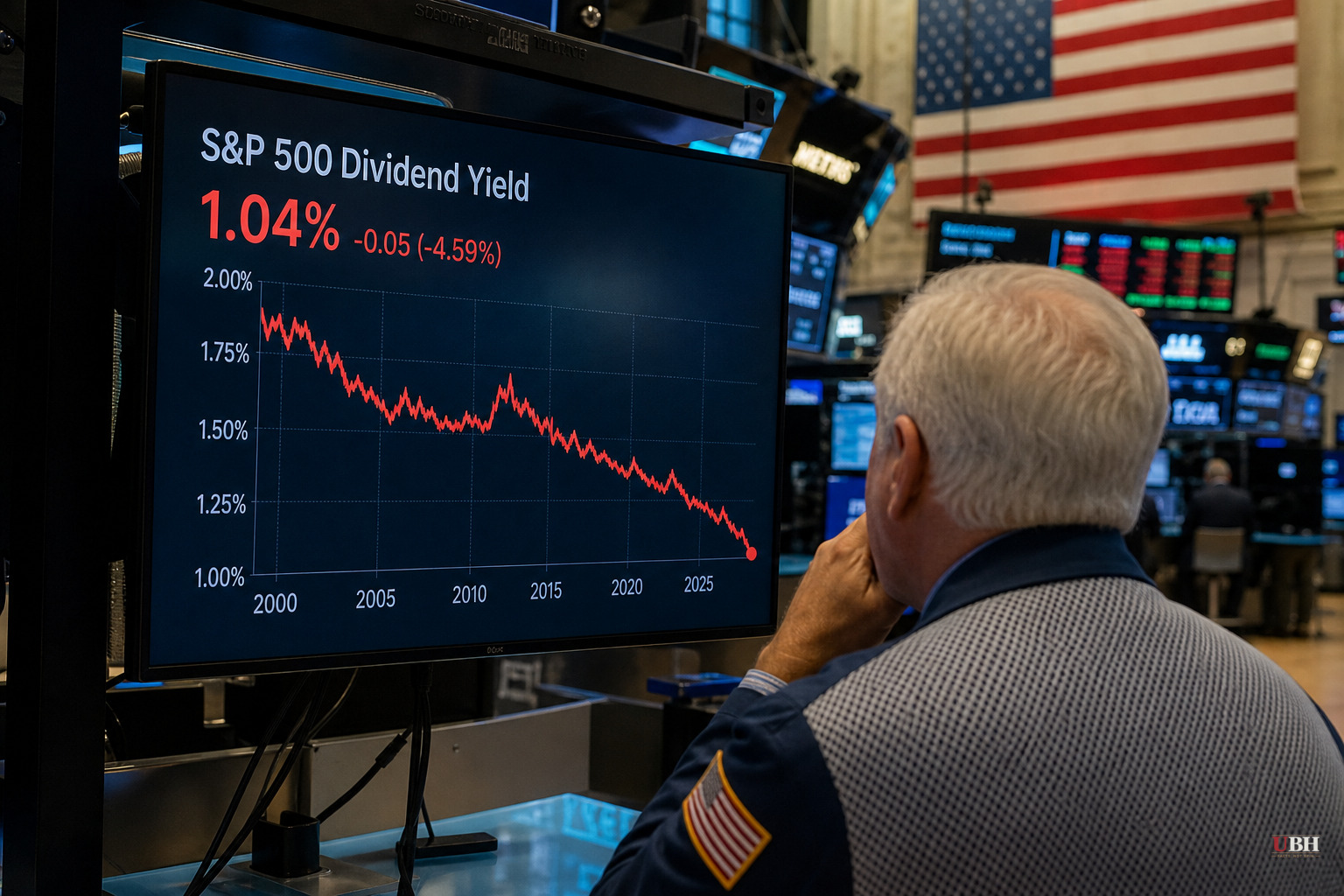
The S&P 500 just hit a milestone nobody should be celebrating. Its dividend yield has fallen to approximately 1.04%, according to Charlie Bilello, chief market strategist at Creative Planning. That's the lowest reading on record, undercutting the previous low of around 1.09% set during the dot-com bubble of the early 2000s.
For scale: the long-term historical average sits between 1.8% and 2.5%, according to thecorner.eu. Before the 1990s, yields rarely dropped below 3%.
Why This Happened
The math is simple. Yield equals dividends divided by price. Prices have exploded higher. Dividends haven't kept pace.
The S&P 500 crossed 7,700 for the first time in early August 2026, according to moneywise.com. Because the index weights companies by market value, it now leans heavily on megacap tech names that pay little or nothing.
Microsoft, Alphabet, Amazon, Meta, and Oracle are pouring record capital into AI infrastructure and data centers, with projected capital expenditures between $650 billion and $745 billion, according to thecorner.eu. That money isn't going to shareholders. It's going into server farms and chips.
BigGo Finance data, sourced from SlickCharts, shows just how far the shift has gone. Dividends now account for only 10.5% of the S&P 500's total return in the 2020s, down from roughly a third historically. In the 1940s, dividends contributed 67% of total returns. In the 1950s, 35.4%. Now the index's annualized dividend return sits at just 1.4%, dwarfed by a 12% price return.
Adam Parker, founder of Trivariate Research, pointed out back in April that 56.5% of S&P 500 companies still pay dividends, a rate consistent with the last 25 years. The distortion isn't that fewer companies pay dividends. It's that the handful of companies not paying them, or paying almost nothing, have grown so large they dominate the index's math.
Who's Still Paying
Out of 500 companies, only about five still yield 6% or more, according to Crypto Briefing and 24/7 Wall St. Pfizer leads at roughly 6.3% to 6.9%. VICI Properties, the casino and entertainment REIT, sits around 6.8% to 6.9%. General Mills clocks in near 6.6%. Verizon Communications ranges between 5.9% and 6.5%. Altria, according to 24/7 Wall St., carries a 6.26% yield backed by an 82% cash payout ratio, powered largely by Marlboro's 40% share of the U.S. cigarette market.
These aren't growth stocks. They're mature, defensive names in pharmaceuticals, real estate, consumer staples, tobacco, and telecom, sectors the market has largely moved past in its hunt for AI exposure.
The Retiree Problem
This dynamic is reaching real portfolios. Steven Yedlin, a 75-year-old retired doctor in East Grand Rapids, Michigan, built his taxable account around dividend ETFs split evenly with S&P 500 index funds, he told the Wall Street Journal. "Not much you can do about the yields," Yedlin said.
His response was practical. He shut off automatic dividend reinvestment. The payouts now land in high-yield money-market funds, or he gives them to his kids.
The numbers explain why. A $500,000 index fund position generates roughly $5,250 a year in dividends at today's yield, according to moneywise.com. Put that same $500,000 into 10-year Treasurys yielding about 4.65%, and you'd collect approximately $23,250 a year, more than four times as much, with none of the equity market's downside risk.
The Counterargument
None of this means the S&P 500 is a bad investment. It means it's stopped functioning as an income vehicle the way it did for most of the 20th century.
The bull case is straightforward: total return is what matters, not yield alone, and price appreciation has more than compensated. BigGo Finance notes hardware, memory, and server companies like SanDisk, Dell, and Micron Technology have posted gains of 200% to 400% in 2026, while the Nasdaq Composite rose around 12.8% in the first half of the year. Since 1926, dividends made up only about 32% of the S&P 500's total return, with capital appreciation providing the other 68%, according to 24/7 Wall St.
But that argument works for investors who don't need cash flow right now. It doesn't help someone living off a fixed portfolio who needs income today, not paper gains they may have to sell into a downturn to access.
What Comes Next
BigGo Finance cites historical patterns showing a 76.5% probability of positive six-month returns following fresh index highs. But it also flags the 2007 precedent as a warning: momentum can break violently if earnings fail to justify stretched valuations.
The open question is what happens if the AI capital-spending boom slows or disappoints. Companies like Microsoft and Alphabet have chosen infrastructure investment over dividends. If that bet doesn't pay off in earnings growth, income-starved shareholders will have gotten neither the yield nor the growth they were promised.
Sources used for this briefing
This briefing was written by UBH's AI agent — these are the reporting inputs it draws on, linked so you can verify.


