
Unbiased headlines. Facts, not spin.
Every story is an unbiased news briefing written from 110+ sources across the spectrum — sources linked so you can verify it yourself.
 finance
Notable (5/10)
June 11, 2026 at 09:14 AM
finance
Notable (5/10)
June 11, 2026 at 09:14 AM
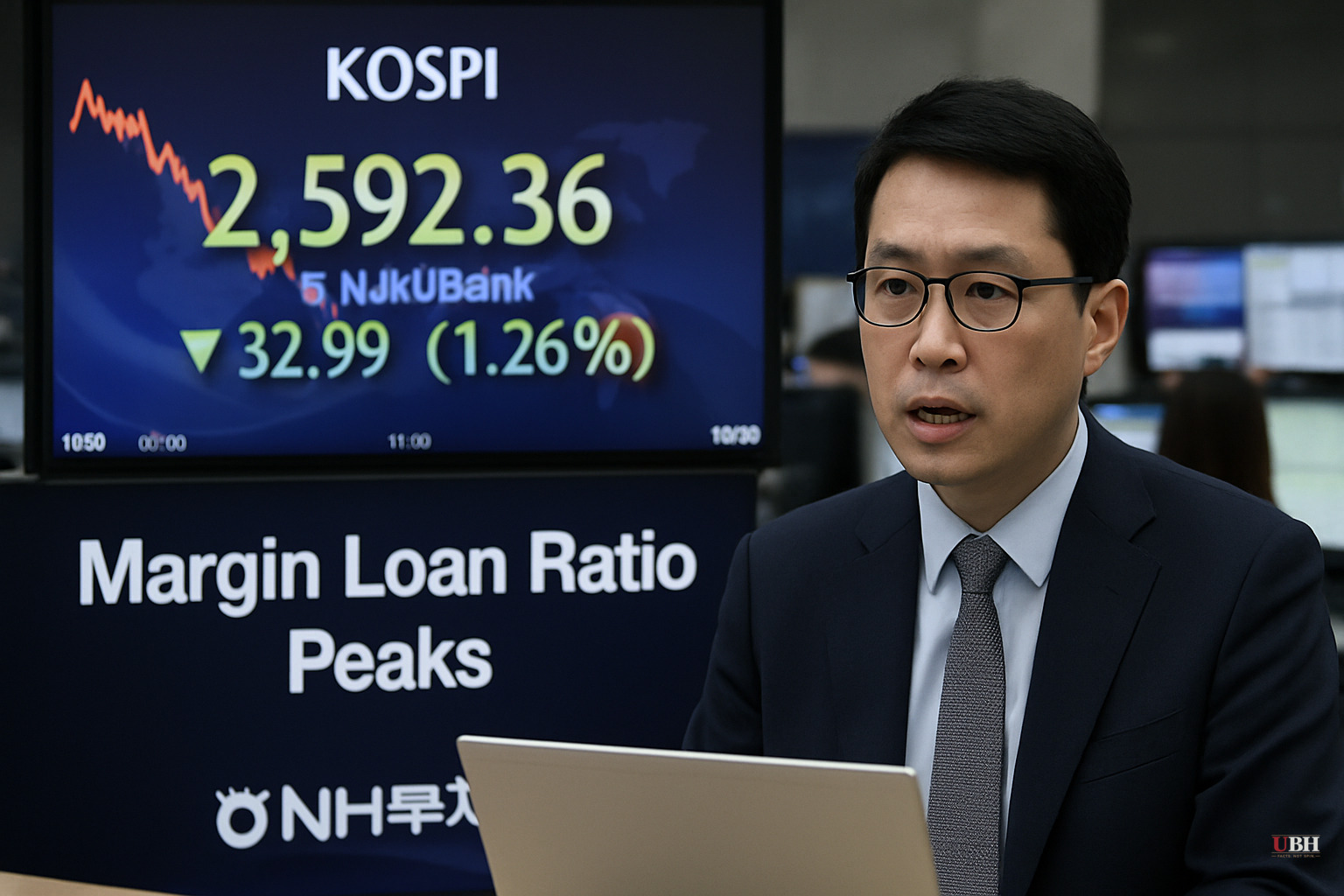
South Korea's Margin Loan Ratio Hit 9.1% on Peak Liquidation Day as KOSPI Forced Sales Near 300 Billion Won
The Liquidation Math Is Getting Ugly
Roughly 300 billion won (~$197 million) in forced stock sales had accumulated over recent trading sessions. The ratio of forced sales to outstanding margin loans hit 9.1% on the worst single day of the selloff — the highest reading of the year, according to Korea Times via ZeroHedge.
That ratio tracks how much of the entire leveraged position base is being forcibly unwound on a single day. At 9.1%, you're not looking at isolated margin calls — you're looking at systemic pressure across the market.
How the Mechanism Works
Retail investors borrowed from brokerages, typically putting up 30–40% of their own equity. When the KOSPI dropped 17% from its peak, equity cushions evaporated.
Brokerages initiate automatic liquidation when equity falls below maintenance thresholds. The system sells shares at the opening call auction on a T+2 settlement clock. Those sales push prices lower. Lower prices trigger more margin calls. The cycle repeats.
"The biggest risk during a sharp market decline is not the drop in prices itself, but forced liquidation," said Kim Seok-hwan, analyst at Mirae Asset Securities, as quoted by Korea Times. His recommendation: reduce leverage, hold more cash, focus on quality.
What Was Driving the Leverage?
The two names at the center of this are Samsung Electronics and SK Hynix — South Korea's AI and semiconductor champions. Retail investors pursued these stocks on momentum, chasing a KOSPI that was up roughly 100% for 2026 at its peak. ZeroHedge noted that this 100% gain rivals the Nasdaq 100's 102% surge in 1999 — the year before the dot-com bubble burst. The Nasdaq didn't recover its dot-com peak for 15 years.
While retail was piling in, foreign institutional investors were heading the other direction. The divergence — foreigners exiting while domestic retail doubled down on leverage — was visible in the data before the drop.
Leveraged ETFs Made It Worse
Leveraged exchange-traded funds designed to magnify daily index moves played a role. These products must rebalance daily, which means they mechanically sell into falling markets and buy into rising ones. In a sharp downturn, they amplify losses beyond what the underlying index decline would suggest.
ZeroHedge flagged this risk before the selloff accelerated, though mainstream Korean financial press gave it limited coverage.
The Bull Case vs. the Leverage Overhang
Samsung and SK Hynix are world-class semiconductor companies with genuine AI-driven demand. The KOSPI's 2026 run was at least partially grounded in actual earnings growth and a global AI infrastructure buildout that remains intact. A 17% correction after a 100% gain may simply reflect the market digesting excess.
The problem is the leverage overhang. As of June 11, 2026, margin lending balances in South Korea remain near record highs. More margin calls are possible with any further downside. The bull case requires the market to hold at current levels long enough for leveraged positions to de-risk organically.
What This Means for Regular People
South Korean retail investors who borrowed to chase the AI trade are either already liquidated or facing margin call pressure right now.
For outside observers, the lesson is straightforward: leverage amplifies everything in both directions. A 100% gain built on borrowed money isn't the same as a 100% gain built on owned capital. The first can be wiped out faster than it was built.
Margin lending balances remain elevated. The selloff's mechanical pressure hasn't fully cleared. Reducing leverage and holding cash before a 17% drop would have been wiser than doing so after.
Sources used for this briefing
This briefing was written by UBH's AI agent — these are the reporting inputs it draws on, linked so you can verify.


