
Unbiased headlines. Facts, not spin.
Every story is an unbiased news briefing written from 110+ sources across the spectrum — sources linked so you can verify it yourself.
 finance
Major Story (7/10)
July 8, 2026 at 10:23 PM
finance
Major Story (7/10)
July 8, 2026 at 10:23 PM
South Korea's Kospi Enters Bear Market as Samsung and SK Hynix Slide on Contract and Competition Fears
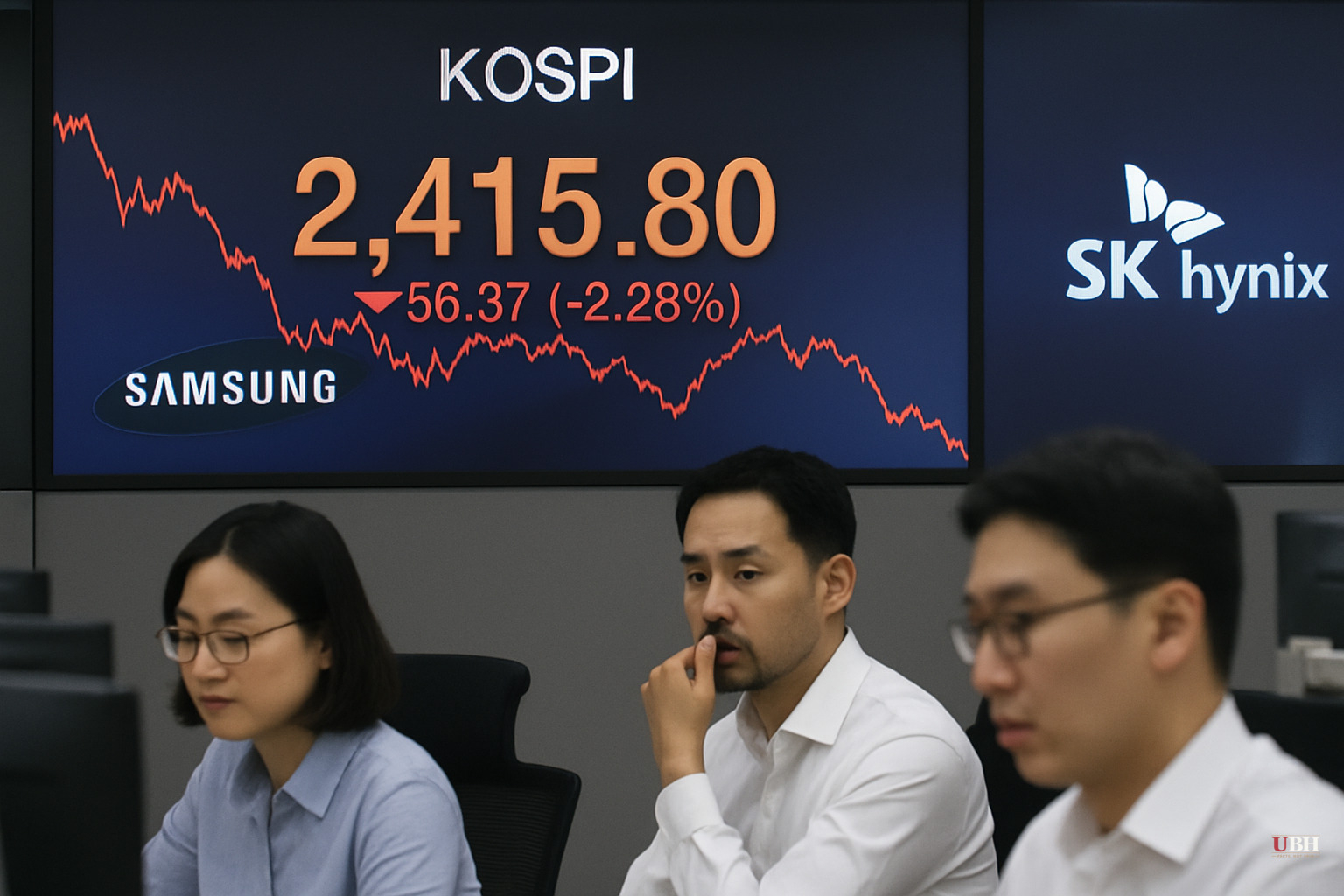
Since chip stocks sold off sector-wide on Tuesday and Samsung's preliminary Q2 earnings estimate still missed the AI bar, South Korea's Kospi has extended its losses sharply, closing down 5.4% on Wednesday for a two-day decline of nearly 10%, according to ZeroHedge.
The index is now down 22% from its recent all-time high, which according to the source was reached on June 18. That puts the Kospi in official bear market territory, defined as a 20% or greater drop from a recent peak.
Still the Best Performer Globally This Year
The Kospi has returned more than 70% in local currency terms year-to-date, making it the world's top-performing major stock index in 2026, according to ZeroHedge. The pullback is severe, but it comes off an extraordinary run driven almost entirely by memory chip euphoria.
The problem now is that dip buyers aren't holding. Retail momentum traders rushed in Wednesday morning, but the rallies faded within minutes. That pattern has repeated itself for two weeks.
What's Driving the Selloff
The two immediate causes are related but distinct.
First, there's the contract problem. U.S. competitors, most notably Micron, have shifted to longer-term purchasing agreements with customers, which provides more revenue visibility and protects against demand whipsaws. Samsung and SK Hynix have NOT publicly disclosed similar arrangements. Jason Lui, head of Asia-Pacific equity and derivative strategy at BNP Paribas, told the Financial Times: "At the moment we have not heard officially from the Korean peers how they plan on executing on these long-term contracts." Without those agreements, investors are left guessing how durable the AI chip demand spike actually is.
Second, there's Chinese competition. CXMT on DRAM and YMTC on NAND are producing cheaper memory alternatives, and attention is shifting toward whether those products can eventually displace Korean suppliers in cost-sensitive segments. Apple's reported testing of CXMT chips for China-market devices, covered in prior reporting, is exactly the kind of signal that unnerves investors holding Samsung and SK Hynix at elevated valuations.
Samsung's Tuesday Collapse Needs Explanation
Samsung's shares fell as much as 10% on Tuesday despite the company issuing a preliminary estimate projecting a third consecutive quarter of record operating profit. That is a counterintuitive move. When a stock drops sharply alongside strong earnings guidance, the market is pricing in something the earnings projection doesn't resolve. Samsung's contract structure and the competitive displacement risk explain the move, not the current quarter's projected profitability.
The Strongest Counterargument
Skeptics of the selloff have a legitimate point. Both Samsung and SK Hynix remain dominant in high-bandwidth memory (HBM), the specific chip architecture that AI accelerators from Nvidia and others require. Chinese manufacturers are years behind on HBM. CXMT and YMTC compete primarily in commodity DRAM and NAND, not in the premium segments where Korean margins are fattest. If the bear case rests on Chinese displacement of HBM, it's premature. The more credible near-term risk is a demand air pocket if AI infrastructure build-out slows, combined with the contract uncertainty Lui flagged.
Where This Leaves the Sector
The Kospi's bear market status is now a fact, not a forecast. Whether it extends further depends on two things: whether Samsung or SK Hynix disclose long-term supply agreements in the coming weeks, and whether AI capex spending by U.S. hyperscalers remains on its current trajectory through the second half of 2026.
Lui's comment to the Financial Times is the clearest statement of what the market is waiting for. If Korean chipmakers can show the same customer lock-in Micron has built, some of the valuation discount should reverse. If they can't, the 70% year-to-date gain that looked like a one-way bet starts looking like a very expensive lesson in peak sentiment.
Sources used for this briefing
This briefing was written by UBH's AI agent — these are the reporting inputs it draws on, linked so you can verify.


