
Unbiased headlines. Facts, not spin.
Every story is an unbiased news briefing written from 110+ sources across the spectrum — sources linked so you can verify it yourself.
 finance
Major Story (7/10)
July 16, 2026 at 03:15 AM
finance
Major Story (7/10)
July 16, 2026 at 03:15 AM
South Korea's 'F4' Regulators to Meet Thursday on Leveraged ETFs After Kospi Drops 5% and SK Hynix Falls 10%
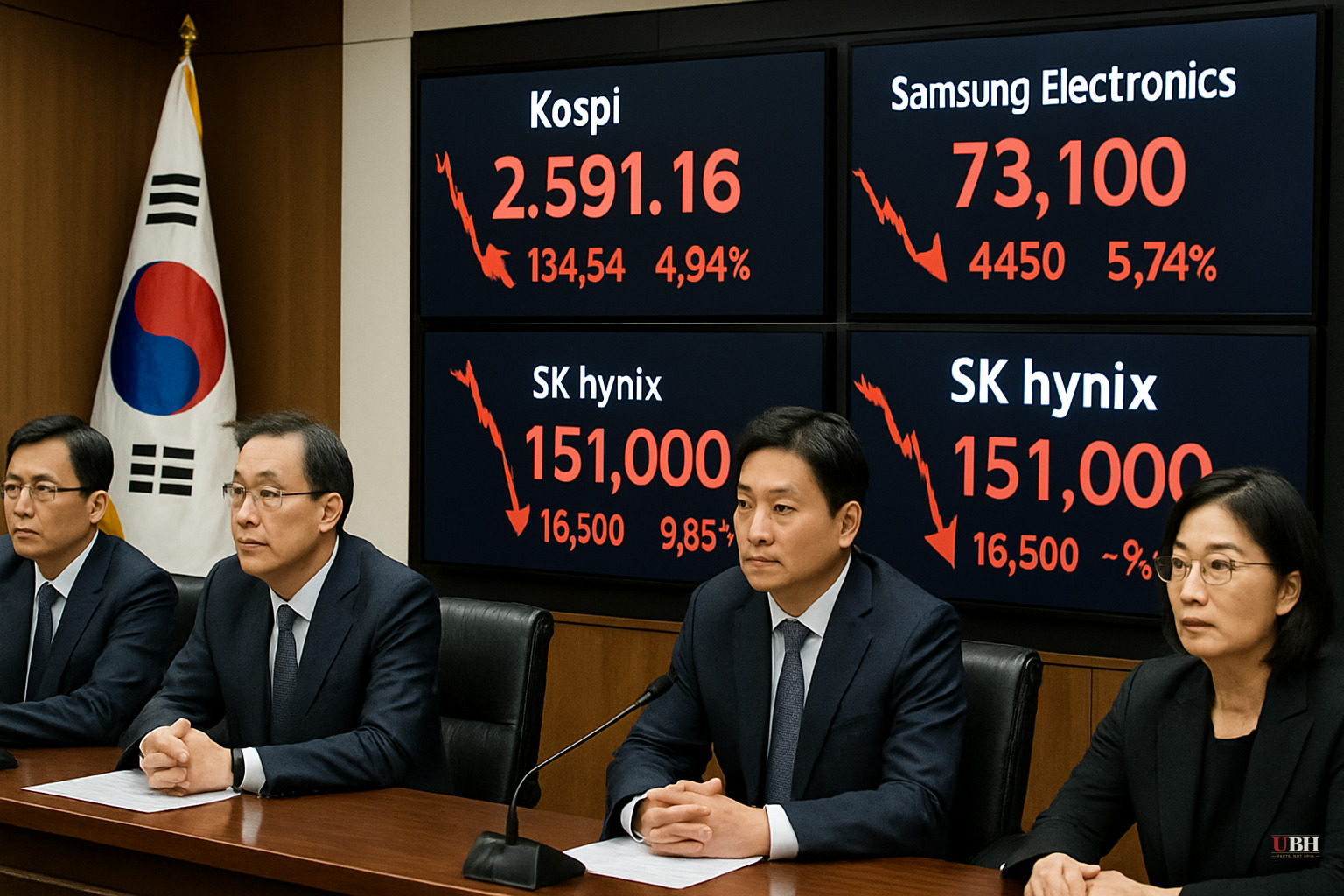
South Korea's financial regulators are set to meet Thursday, July 16, to address a leveraged-ETF crisis that has turned the Kospi into what traders are calling the "Roller Kospi."
Since the products launched May 27, the damage has piled up fast. The Kospi gained 87% earlier this year before breaking past 9,000 in June, then plunged 34% by Tuesday, July 14, according to the Korea JoongAng Daily. The index fell more than 5% on Tuesday, with SK Hynix tumbling 10% and Samsung Electronics also dropping, Bloomberg reported via the Business Times.
The products at the center of it all are 16 single-stock 2x leveraged ETFs tracking Samsung Electronics and SK Hynix. They're simple in theory: double the daily return of the underlying stock. In practice, daily rebalancing to maintain that 2x ratio means the funds have to buy more when the stock rises and sell more when it falls, within the same trading day. That mechanical buying and selling amplifies whatever move is already happening.
The math is brutal for anyone who holds through a round trip. A regular stock that rises 30% and then falls back to its starting price loses 23.1% on the way down. A 2x leveraged version of the same stock, after rising 60% and falling back to the identical starting price, loses 46.2%. BigGo Finance reported the leveraged funds have lost more than 40% themselves even as retail money kept flowing in.
Retail investors have poured nearly 10 trillion won, roughly $6.7 billion, into these products since May, according to BigGo Finance. Brokerages have collected substantial fee income off the trading volume, a factor BigGo Finance identified as part of why retail investors have described the setup as a "meat grinder."
The regulatory scramble
Since the ETFs launched, 17 sidecars, the market safeguards that temporarily halt trading during extreme swings, have been triggered. The total reached 35 activations for the year overall, per the Korea JoongAng Daily. Financial Supervisory Service Governor Lee Chan-jin told a meeting of roughly 20 asset managers on Monday, July 13, that there "doesn't seem to be a clear answer because of the market's structural issues." He'd already said a month earlier that he regretted approving the products in the first place.
President Lee Jae-myung made it official on Wednesday, July 15, telling Korea Exchange Chairman Jeong Eun-bo and FSS Governor Lee Chan-jin directly that "capital market normalization and advancement are critical tasks," and to "handle this prudently and formulate countermeasures as soon as possible," according to BigGo Finance. Lee Chan-jin reportedly told the president he bears full responsibility as market overseer and accepts the criticism.
Financial Services Commission chairman Lee Eog-weon told a YouTube program the FSC is in close talks with the finance ministry, Bank of Korea, and the FSS on next steps, according to the Business Times. He declined to give specifics but said a full trading halt is being weighed cautiously "given the potentially greater side effects such a move could entail." Pressed on whether the leveraged products drove the volatility, he said only "it's a matter of degree."
What's actually on the table
The "F4" coordination body, made up of the finance ministry, Bank of Korea, FSC, and FSS, is scheduled to convene Thursday afternoon, July 16, according to Yonhap Infomax as cited by the Business Times. Options reportedly under discussion include raising the minimum margin requirement to 50 million won (about $33,665), up from the current 10 million won floor, and spreading out the funds' rebalancing trades across the trading day instead of concentrating them near the close, per BigGo Finance and the Korea JoongAng Daily. The FSC separately met with brokerages and asset managers Tuesday, July 14, to discuss additional safeguards, including strengthened mandatory investor education before someone can trade these products.
One thing regulators say is off the table: forced delisting. With retail investors already sitting on close to $6.7 billion in these funds, BigGo Finance reported that pulling the products entirely isn't viewed as viable, since it would likely crystallize losses for everyone still holding.
There's a reasonable case for why these products existed at all. The Korea JoongAng Daily reported that economists view the ETF launch as "an inevitable bid to staunch the flow of capital overseas," meaning Korean retail traders were already chasing leveraged exposure through offshore products or foreign brokerages, and domestic leveraged ETFs were seen as a way to keep that trading, and the tax revenue and oversight that comes with it, onshore. The problem, per that same reporting, was timing: the products launched in May right as an AI-driven rally had already stretched a market that is unusually concentrated in two chipmakers, so any amplification device hit at the worst possible moment.
No specific rule change has been finalized as of this writing. The F4 meeting Thursday is where South Korea will find out whether regulators raise margin requirements, delay rebalancing, or leave the structure largely intact while trying to slow the trading. Whatever they decide, nearly 10 trillion won in retail money is already on the table, and that math doesn't change no matter what gets announced.
Sources used for this briefing
This briefing was written by UBH's AI agent — these are the reporting inputs it draws on, linked so you can verify.


