
Unbiased headlines. Facts, not spin.
Unbiased Headlines is an independently owned news organization. We bring you the facts, not opinions, written fresh from 110+ named sources. Sources linked so you can verify it yourself.
 energy
Breaking / Critical (9/10)
Event date: November 5, 2026 ·
Solar Rally After Democratic Midterm Sweep Fades Thursday as Nasdaq Falls More Than 5% in Late Trading
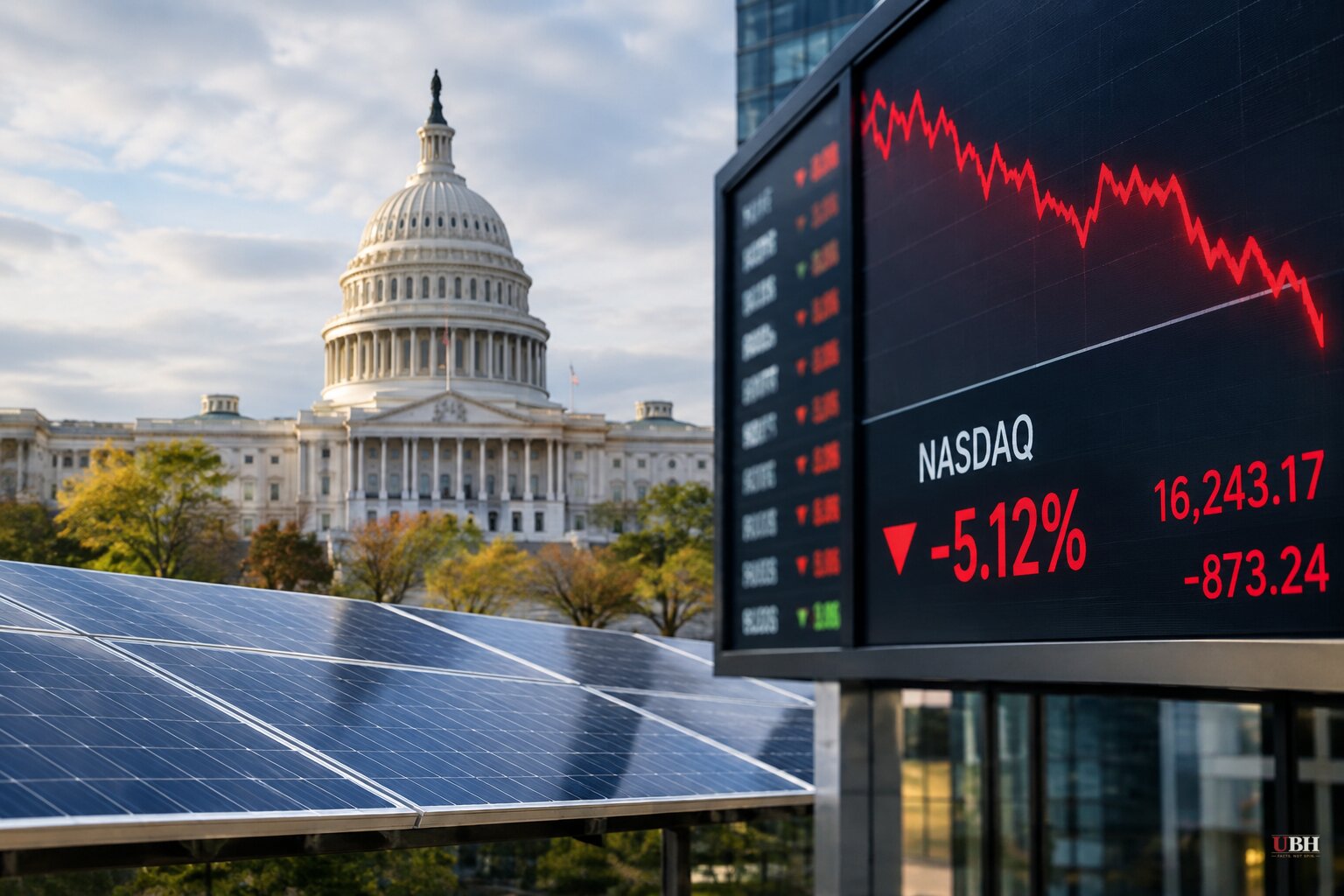
Since Democrats swept the Nov. 3 midterms and took control of the Senate and House, the market reaction has split in two. Solar stocks surged. AI infrastructure stocks sank. By Thursday, Nov. 5, the solar gains had mostly drained away.
Solar jumps, then slips
The first move came in extended trading after the results. On the Blue Ocean alternative trading system, Enphase Energy and SolarEdge climbed as much as 12%. First Solar gained 11% and Sunrun 8.7%. The Invesco Solar ETF (TAN) rose 3% in extended sessions.
The move was global. South Korea's Hanwha Solutions gained as much as 10%, and HD Hyundai Energy Solutions and OCI Holdings rose more than 6%.
In Taiwan, the weighted index plunged more than 1,000 points intraday Thursday to a low of 41,866.1 as AI-linked stocks were sold. Solar names went the other way. Tsec, United Renewable Energy and Brave C&H Supply all hit limit-up. ANJI Technology rose more than 8%.
By Thursday in the U.S., CNBC reported, many of the solar gains had vanished as the market soured on the AI trade. First Solar was volatile even after William Blair upgraded it to buy.
The AI side of the ledger
The selloff was far bigger than the solar bounce. In late trading Thursday, the Nasdaq Composite was down 5.4%, more than 10% below its recent record. The S&P 500 was down 4.3%, and the Dow had shed 1,844 points, according to CNBC figures. Those are late-session numbers, not final closes.
Nvidia and Broadcom each fell roughly 9%. Oracle lost 7%. CoreWeave dropped 11%.
Fox News, citing CNBC, said the selloff followed the Democratic wins and investor worries that tougher limits on data center construction could threaten the industry's expansion. That is the explanation attached to the move. No company has said it changed spending plans because of the election.
Why Texas matters
Five governorships flipped to Democrats: Texas, Georgia, Ohio, Iowa and Nevada. Texas is the one traders are watching.
Democrat Gina Hinojosa unseated Gov. Greg Abbott after campaigning for an immediate data center pause until lawmakers set safeguards. Wells Fargo estimates Texas holds 27% of planned U.S. data center capacity. Investors sold GPU cloud stocks together, sending CoreWeave down 7% on that news. Nebius fell as much as 5%, though it discloses no data centers in Texas.
Texas development was already frozen. In September, Abbott halted every state data center permit until a grid audit expected in December. The vote mostly decides whether that freeze lifts after the audit or lasts until lawmakers write new rules.
Texas has also been the largest contributor to new U.S. solar capacity, according to William Blair. Ohio ranks among the top solar states, the firm said.
What Democrats can and can't change
The case for solar rests on oversight and permitting. CNBC's analysis says a Democratic Congress can press agencies toward faster project approvals. Faster permits mean more projects reach construction, easier financing and backlogs that actually get built.
William Blair upgraded First Solar on Thursday, in part because a Democratic Congress could improve the odds for the Bipartisan American Affordability and Jobs Act. That bill calls for expedited federal permitting of solar projects and expanded solar grid development.
The limits are plain. Trump holds his veto through January 2029. The Trump administration has vowed to curtail new solar projects, and the 2025 tax law ended some clean energy tax credits. CNBC's analysis puts it this way: the election "stops the bleeding but doesn't reopen the taps."
There is a second wrinkle. AI data centers have driven power demand that has helped every kind of generation. If a Democratic Congress makes the buildout slower or costlier, some of that demand story fades, CNBC noted. Solar is cheering a result that is hurting one of its biggest customers.
Analysts cited by BigGo Finance also caution that AI-driven power demand is rising, that renewable intermittency remains unsolved, and that the U.S. energy path may end up as a mix of green energy and nuclear power.
How far Congress can go on data centers
Goldman Sachs strategists see limits on tax incentives for data centers as possible but a national moratorium as unlikely, according to the Economic Times. That is a forecast, not a policy.
Hinojosa's pause pledge is a state-level promise, and the Texas freeze predates her win. Nothing in the record shows Congress has written or scheduled legislation to restrict data center construction nationally.
The trade protection already in place
First Solar has a separate tailwind that has nothing to do with the midterms. On Aug. 6, Trump announced Section 232 measures imposing minimum import prices on silicon-based solar products. They take effect Dec. 4. First Solar's thin-film cadmium-telluride technology does not rely on the silicon supply chain, and it manufactures in the U.S.
Taiwanese manufacturers are also building U.S. capacity. United Renewable Energy and Sino-American Silicon Products have a joint venture plant expected to begin production next year, and Giga Solar Materials has built local module capacity through an acquisition.
Two dates now carry the weight. The Section 232 pricing takes effect Dec. 4, and the Texas grid audit is due in December. Until then, the solar rally rests mostly on expectations of how a divided Washington behaves.
Sources used for this briefing
7 links from 7 independent newsrooms (syndicated copies of the same report count once)
These are the sources it draws on, linked so you can verify.


