
Unbiased headlines. Facts, not spin.
Unbiased Headlines is an independently owned news organization. We bring you the facts, not opinions, written fresh from 110+ named sources. Sources linked so you can verify it yourself.
 tech
Notable (6/10)
Event date: September 7, 2026 ·
tech
Notable (6/10)
Event date: September 7, 2026 ·
Slovenia Becomes Sixth EU Country to Clear Tesla FSD, All Riding on One Sealed Dutch File
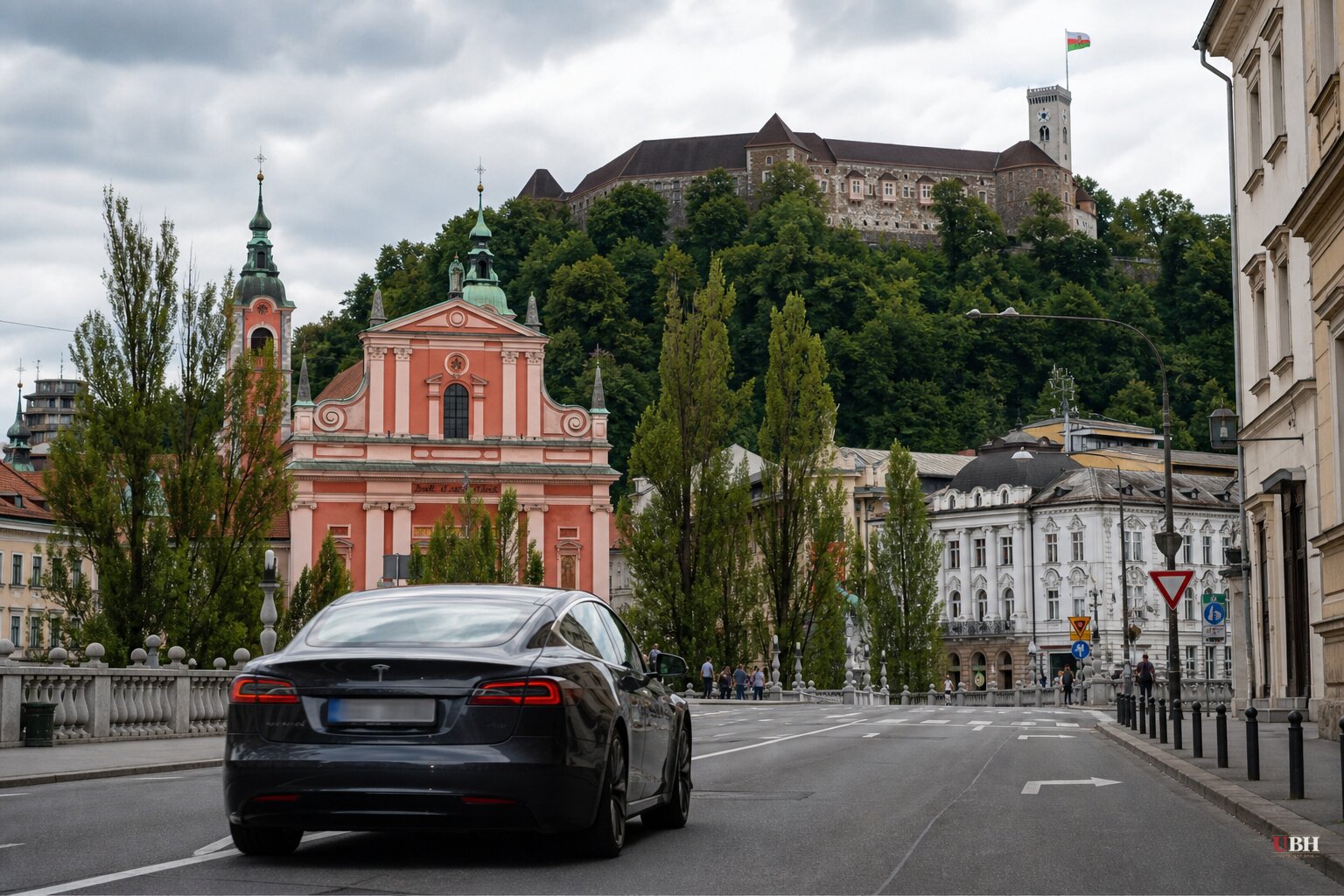
Slovenia cleared Tesla's Full Self-Driving (Supervised) system for its public roads this week, the sixth European Union country to do so. Tesla announced it on X on September 7, 2026, saying rollout would begin soon. CEO Elon Musk amplified the post, and Slovenia's energy and infrastructure minister, Jernej Vrtovec, reposted it with the words "Developing Slovenia." Reuters confirmed the approval on September 8.
None of the six countries independently tested the system. Every one of them, including Slovenia, adopted a certification issued by the Dutch vehicle authority RDW back in April.
How One Country's Approval Became Six
The RDW granted provisional type approval on April 10, 2026, under UN Regulation 171, the international standard for driver-control assistance systems that took effect in September 2024. FSD doesn't fully meet that standard on its own. Tesla needed Article 39 exemptions covering things like hands-free lane changes, system-initiated maneuvers without driver approval, higher lateral acceleration limits, and permission to match surrounding traffic speed instead of posted limits.
Under EU Regulation 2018/858, once one member state grants that approval, others can accept it without repeating the technical review. Lithuania did that in May, Estonia on May 29, Denmark on June 9, Belgium on June 10 or 11, and now Slovenia. Tesla Times and The Next Web both confirmed the pattern: mutual recognition, not fresh testing.
The actual Dutch safety file—the test data and reasoning behind the April approval—was sealed by RDW at Tesla's request as confidential business information. RDW general manager Bernd van Nieuwenhoven summed up the regulator's position bluntly, according to Tech Times: "Trust us on this, we tested it extensively." No underlying data has been made public. Six countries and roughly 40 million people are now operating under a certification that neither their own regulators nor the public can inspect.
What's Actually Being Approved
FSD Supervised is a Level 2 system on the SAE scale. It steers, changes lanes, and parks, but the person behind the wheel remains legally responsible for the car at all times, as The Next Web noted. Nothing about the Slovenian approval, or the coming EU vote, shifts liability from driver to Tesla. That distinction matters because the name invites people to assume more autonomy than the classification allows.
The October 6 Vote
The six national approvals are a warm-up for the European Commission's Technical Committee on Motor Vehicles, which is expected to vote October 6 on whether to open FSD Supervised to the entire EU. Passage requires a qualified majority: 55% of member states, at least 15 of 27, representing 65% of the bloc's population. Six countries with a combined population near 40 million don't get Tesla there alone, but autoevolution noted it raises the political cost of any country voting no once a neighbor already has it running.
France raised concerns in July about how FSD manages speed and has since begun road-testing two FSD-equipped vehicles following what Reuters described as a constructive exchange with Musk. Sweden has been skeptical on similar grounds. Finland and Greece are weighing approvals, Italy is reportedly watching Slovenia's move closely, and Germany and Spain may simply wait for the October vote rather than decide independently.
The Safety Numbers Don't Quite Match Up
Tesla has leaned on a safety dashboard to make its case, telling regulators FSD logged 4.1 times fewer collisions than manually driven Teslas across the five countries where it operated before Slovenia. The figures were three highway crashes and nine non-highway crashes in FSD mode versus 137 and 490 for manual driving, based on what Tesla described as more than 100 million kilometers of data collected between April and August, according to Reuters.
But the actual published dashboard, titled "Article 39 – FSD (Supervised) Dashboard," tells a different story about timing. Every dated measurement window in the document closes in 2025. Mileage data covers calendar 2025, acceleration metrics run June through September 2025, automatic emergency braking data covers January through October 2025, and lane-change figures stop in December 2025. The latest dated observation in the entire file is December 5, 2025—months before the European rollout Tesla says the dashboard supports.
The sample size is also notable. Tesla's own European FSD table totals roughly 755,922 miles across four road types, compared against 8.91 billion miles from manually driven Teslas with active safety features over the same period. That's 0.008% of the comparison group. A separate section of the same document claims more than 793,000 miles across eight countries. That number doesn't reconcile with the first, and the dashboard doesn't explain why.
Reuters has previously reported that Tesla presented European regulators with safety comparisons that experts said relied on invalid methodology and could give a misleading impression of the system's performance. Tesla did not respond to Reuters' detailed questions on that reporting.
None of this proves FSD is unsafe. Tesla and RDW's defenders would point out that mutual recognition is a standard, long-used EU legal mechanism, not something invented for Tesla, and that Article 39 exemptions come with specific conditions rather than blanket deregulation. But the gap between what Tesla is publicly claiming about its 2026 data and what its own document actually dates is a fact regulators voting October 6 will have to reckon with, whether or not the underlying Dutch file ever gets unsealed.
The business case for Tesla pushing hard is straightforward. Second-quarter deliveries hit a record 480,126, up 25% year over year, with revenue of $28.2 billion, up 26%, and trailing twelve-month revenue topping $100 billion for the first time. Paid FSD subscribers grew from 950,000 a year ago to 1.48 million. A favorable EU vote converts existing installed software into revenue within weeks, not model years, since the hardware is already sitting in cars across the continent.
Whether the Technical Committee on Motor Vehicles asks to see the sealed Dutch file before casting that vote on October 6 is still an open question. So far, no member state has forced the issue.
Sources used for this briefing
7 links from 7 independent newsrooms (syndicated copies of the same report count once)
These are the sources it draws on, linked so you can verify.


