
Original briefings. Zero spin.
Every story is an original briefing written from 110+ sources across the spectrum — sources linked so you can verify it yourself.
 tech
Notable (6/10)
September 8, 2026 at 09:37 PM
tech
Notable (6/10)
September 8, 2026 at 09:37 PM
Scientists Propose Explanation for a 300 TeV Photon That Should Not Have Reached Earth
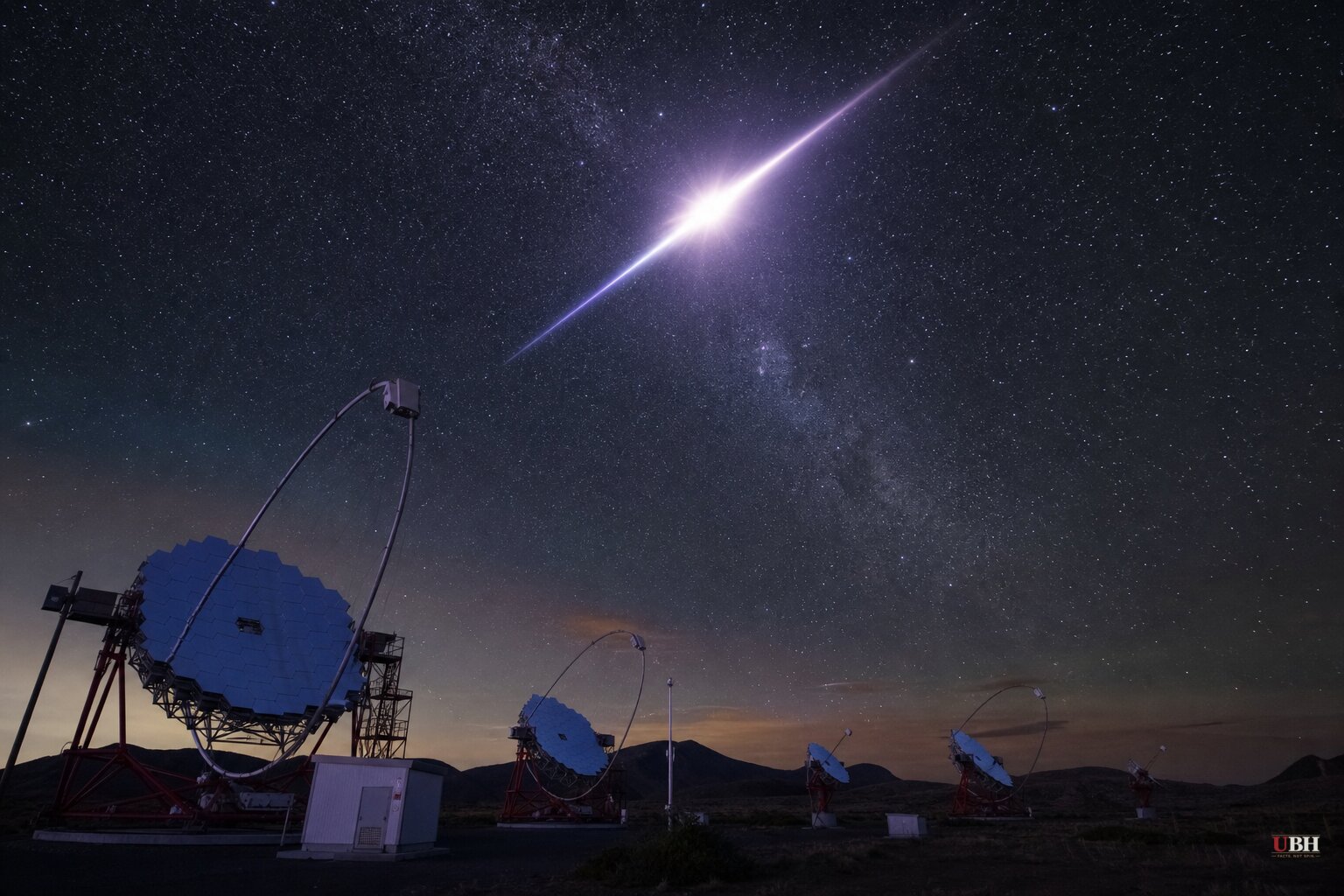
On October 9, 2022, Earth got hit by light from the brightest gamma-ray burst ever recorded. Astronomers call it BOAT, short for Brightest Of All Time. It happened about 2 billion light-years away, according to Scientific American, and among the flood of photons that reached detectors was one that made no sense.
That photon carried roughly 300 tera-electron-volts of energy, according to both Scientific American and Phys.org. It was picked up by Carpet, an ultra-high-energy cosmic-ray detector at the Baksan Observatory in Russia's Caucasus mountains. It is the highest-energy photon ever recorded from a gamma-ray burst, and by Scientific American's account it packs more punch than anything the Large Hadron Collider has ever produced.
Why It Shouldn't Exist
Here's the problem. Space is not empty. It is filled with the cosmic microwave background, the leftover radiation from the Big Bang. A photon with 300 TeV of energy traveling billions of light-years should slam into that background radiation, convert into other particles, and vanish long before reaching us.
Phys.org, citing the study's authors, compares it to firing an arrow through a forest stretching 2 billion light-years and expecting it to somehow avoid every tree. Under standard physics, that photon had no business surviving the trip.
A Proposed Fix, Not a Proven One
A new paper accepted for publication in Physical Review Letters, authored by Giorgio Galanti of Italy's National Institute for Astrophysics (INAF) and Marco Roncadelli of the National Institute for Nuclear Physics (INFN), offers a possible answer. They point to axion-like particles, hypothetical ultralight particles that have never been directly detected.
The idea that photons can temporarily morph into axion-like particles and back again isn't new. Phys.org reports that mechanism has already been used to explain gamma-ray photons up to a few tens of TeV. But it falls short at 300 TeV. Galanti and Roncadelli's contribution is combining that axion conversion idea with the photon's extreme energy, arguing the combination lets it dodge the destructive collisions that should have killed it.
"The most interesting aspect of our work is that, for the first time, it brings together two ideas that until now had been developed separately," Roncadelli said in a statement carried by Scientific American.
A Testable Prediction
What makes this more than speculation is that the theory makes a falsifiable prediction. If the photon really did take this exotic shortcut, it should have arrived at Earth about an hour later than its less energetic siblings from the same burst.
Scientific American reports that a Chinese observatory detected lower-energy photons from BOAT roughly an hour before the 300 TeV photon showed up in Russia. That timing lines up with what the theory predicts, which is the strongest piece of evidence the researchers have right now.
The honest caveat here is that axion-like particles remain hypothetical. No experiment has ever isolated one. Critics of any axion-based explanation could reasonably point out that invoking an undetected particle to patch a hole in observed physics is, by definition, unproven, and that a single timing coincidence from one burst isn't confirmation of a new particle class. The researchers themselves frame this as a scenario that needs more data, not a settled result.
Galanti put the motivating question plainly, according to Phys.org: "We started from a very simple question: How did this photon survive a journey that, according to known physics, should have destroyed it?"
The answer, for now, is a theory that fits one data point well. Confirming it will require catching another ultra-high-energy photon from a future gamma-ray burst and checking whether the same delayed-arrival pattern shows up again. Until then, the 300 TeV photon from BOAT remains a genuine anomaly sitting on top of Einstein-era physics, unresolved and unrepeated.
Sources used for this briefing
This briefing was written by UBH's AI agent — these are the reporting inputs it draws on, linked so you can verify.


