
Unbiased headlines. Facts, not spin.
Every story is an unbiased news briefing written from 110+ sources across the spectrum — sources linked so you can verify it yourself.
 finance
Major Story (7/10)
June 26, 2026 at 07:16 AM
finance
Major Story (7/10)
June 26, 2026 at 07:16 AM
SK Hynix Targets July 10 Nasdaq Listing at $166 Per Share Amid the Worst Asian Tech Selloff of the Week
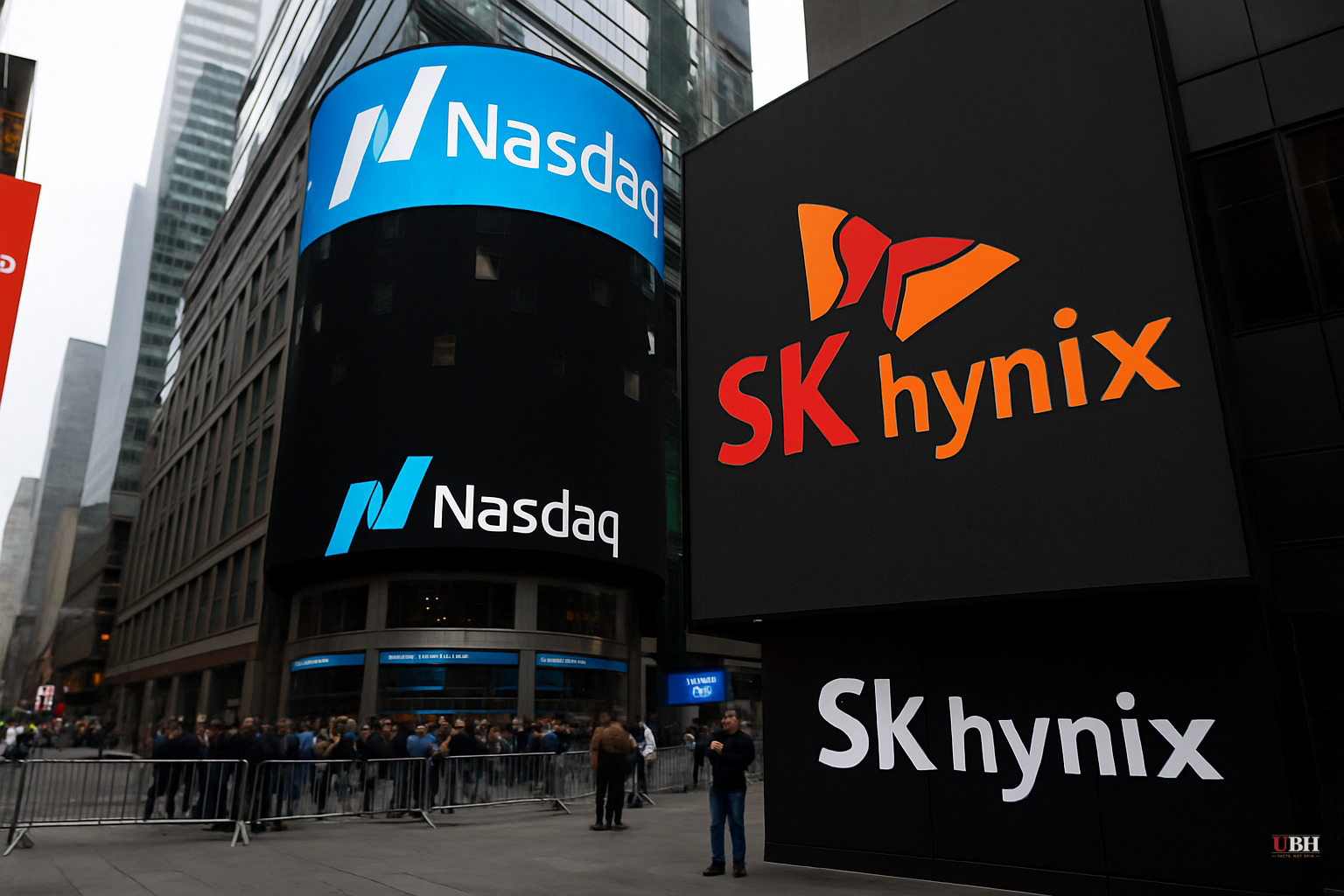
Since the Asian tech selloff that dragged the KOSPI down more than 8% earlier this week, SK Hynix has been at the center of two contradictory headlines: its Seoul-listed shares dropped roughly 10% on Friday, and yet the company is moving forward with a major planned semiconductor listing on a U.S. exchange.
The Offering, in Plain Numbers
Regulatory filings published this week show SK Hynix intends to issue 17.79 million new shares through American depositary receipts on the Nasdaq. The ADRs are priced at 255,000 won per share, equivalent to roughly $166, according to CNBC. The company's filing puts the total value of the offering at 45.45 trillion won, or $29.65 billion. The company has set a tentative start-trading date of July 10, with the caveat that the date remains subject to change.
Why HSBC Is Bullish
HSBC analysts, writing in a Thursday note reviewed by CNBC, upgraded their price target for SK Hynix from 2.9 million Korean won to 4 million won, a 38% increase. Their reasoning: Micron Technology has traded at an average 35% premium to SK Hynix over the past 13 years, driven by better U.S. investor access, more shareholder-friendly policies, and what HSBC describes as "higher beta supported by a smaller earnings base."
The HSBC team applied a 20% premium to a prior price-to-book ratio of 2.8x, implying 3.4x, to reflect the expected improvement in global investor accessibility after the ADR listing. Their argument is structural: listing where your biggest customers and competitors trade carries real value in valuation terms.
Rolf Bulk, head of semiconductors and infrastructure at Futurum Group, offered independent support for the thesis. Micron Technology's stronger-than-expected quarterly results, which lifted the broader sector on Thursday, showed that the AI memory chip market remains supply-constrained, which directly benefits SK Hynix. "This is a very positive read-across for SK Hynix, who are exposed to the exact same market dynamics," Bulk told CNBC.
The Case for Skepticism
The strongest counter-argument is timing and price. SK Hynix shares were trading at 2.65 million won in Seoul as of Friday, already below the implied ADR price at filing. The company shed 9% on Friday alone after surging more than 12% on Thursday following the Micron results and the ADR announcement. That kind of single-day reversal in a single stock illustrates how much noise surrounds this sector right now.
The broader context makes the case harder. The Nasdaq Composite has fallen for four consecutive sessions, according to CNBC. Apple, the world's largest company by market cap, dropped 6% after announcing price increases on MacBooks and iPads citing higher chip costs. Microsoft fell 3.5% after raising Xbox prices. The fear running through the market is not irrational: if semiconductor prices keep rising, the tech companies buying those chips will see margins compress, and demand could soften. That is bad for a chipmaker trying to price a large offering.
SoftBank Group plunged more than 13% in Tokyo on Friday, leading regional losses, partly because its chip designer Arm Holdings fell 3.2% overnight and partly because of reports that OpenAI may delay its IPO until next year due to difficulty securing demand at a $1 trillion valuation, according to Andrew Jackson, equity strategist at Ortus Advisors, as cited by CNBC. SK Hynix is not OpenAI, but both situations raise the same question: how much AI-infrastructure optimism is already priced in, and at what point does the market stop paying up for it?
What SK Hynix Says
The company's own regulatory filing frames the ADR listing in straightforward terms: it expects the U.S. listing to "expand its investor base, ultimately allowing its true corporate value to be properly evaluated." The filing adds that SK Hynix anticipates elevating its "status as a global company by broadening our touchpoints in the United States, the epicenter" of AI development.
That is a reasonable corporate argument. The valuation gap with Micron has persisted for over a decade and is at least partly structural. U.S. investors simply know Micron better. Closing that gap through a Nasdaq listing is not guaranteed, but it is a coherent strategy.
The Open Question
The unresolved issue is whether the $166 ADR price holds by July 10. The filing explicitly notes the price is tentative. With Seoul shares currently trading below the implied ADR valuation and the broader Nasdaq still under pressure from AI cost concerns, SK Hynix and its underwriters will have to decide in the coming days whether to proceed at the filed price, reprice lower to ensure demand, or delay. HSBC's 20% premium thesis depends on market conditions stabilizing. As of June 26, that condition has not been met.
Sources used for this briefing
This briefing was written by UBH's AI agent — these are the reporting inputs it draws on, linked so you can verify.


