
Unbiased headlines. Facts, not spin.
Every story is an unbiased news briefing written from 110+ sources across the spectrum — sources linked so you can verify it yourself.
 finance
Notable (6/10)
July 10, 2026 at 07:30 AM
finance
Notable (6/10)
July 10, 2026 at 07:30 AM
SK Hynix Sets ADR Price at $149, Nasdaq 100 Bulls Place $24 Million Options Bet on Fresh All-Time High
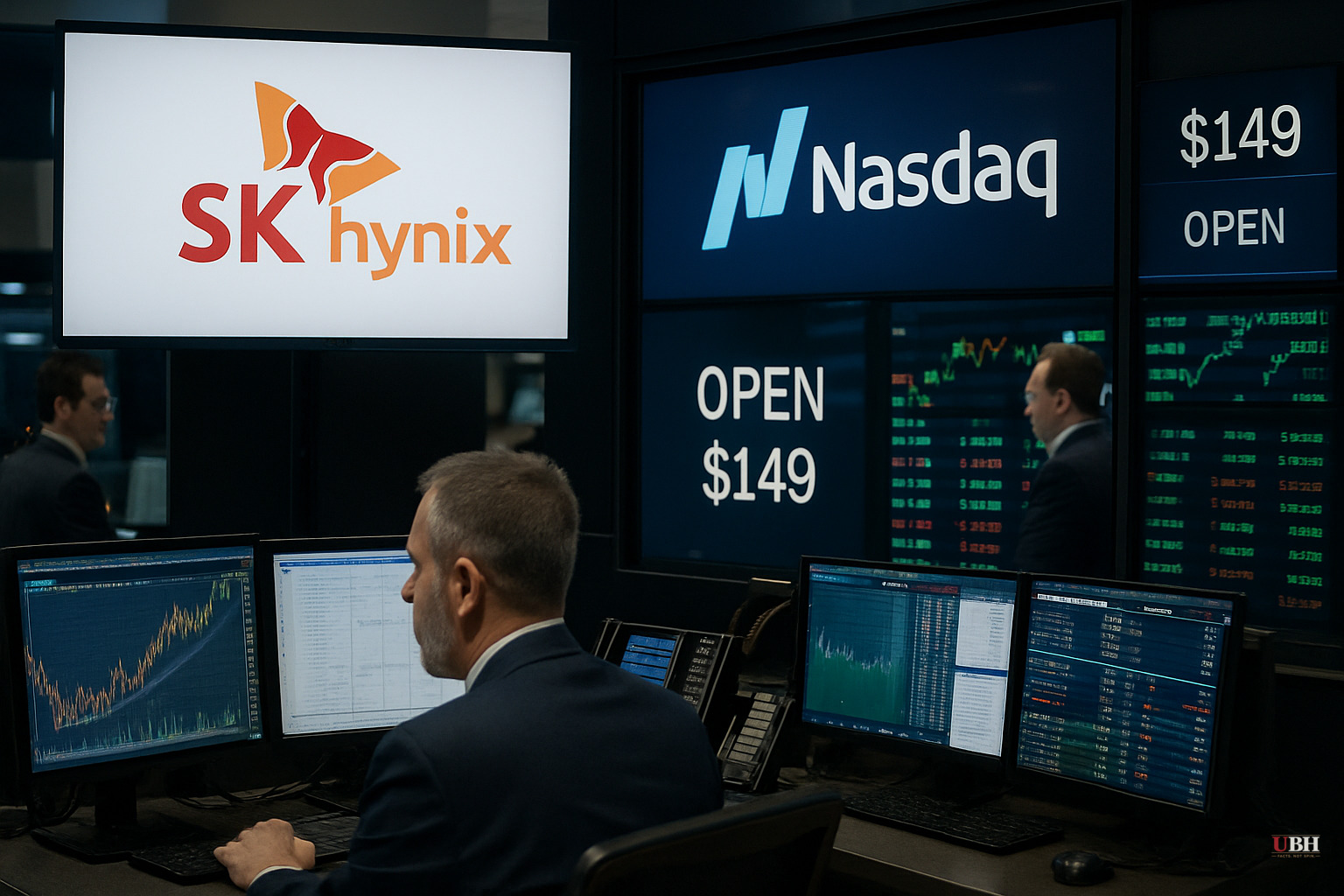
SK Hynix ADR Debut Arrives on a Green Day for Global Chips
SK Hynix is scheduled to begin trading on the Nasdaq today, with its American depository receipts priced at $149 each, according to Bloomberg, which cited a person familiar with the deal. The listing arrives after a year in which the South Korean chipmaker's shares exploded higher on surging demand for high-bandwidth memory tied to AI hardware buildouts.
In Seoul, SK Hynix shares added 1.3% on Friday ahead of the stateside debut. The broader Korean tech sector ran with it: Samsung Electronics gained 4.3%, Samsung SDI climbed 8.3%, LG Display advanced 4.4%, and Seoul Semiconductor rose 5.9%, according to CNBC. South Korea's Kospi index added 2.5% to close at 7,475.94. The Korea Exchange activated a buy-side sidecar after Kospi 200 futures surged more than 5% intraday, temporarily halting program trading for five minutes.
Japan's SoftBank Group surged more than 11% in Tokyo. Chip equipment names Advantest, Renesas Electronics, and Tokyo Electron rose 3.9%, 3%, and 4%, respectively. Japan's Nikkei 225 closed 1.2% higher at 68,557.53.
Not everyone joined the party. Mainland China's CSI 300 closed 1.96% lower, dragged by technology and industrials sectors.
Wall Street's Setup Heading into Friday
U.S. equities had a strong Thursday. The Nasdaq Composite rose 1.3%, the S&P 500 gained 0.8%, and the Dow closed up 0.3%. The gains were partly aided by cooling oil prices after President Trump said Iran contacted the U.S. to pursue a deal. Qatar and Pakistan are reportedly working to bring Washington and Tehran back into negotiations, per officials from those countries cited by MS Now.
For the week as of Thursday's close, the Nasdaq Composite was up 1.5% and the S&P 500 was up 0.8%. The Dow was the laggard, down 0.8% on the week.
As of this writing at 3:25 a.m. ET, regular U.S. trading has NOT opened. S&P 500 futures are off 0.19% and Nasdaq 100 futures are down 0.36% in pre-market indications. Those are NOT opening prices.
Delta Air Lines is due to report second-quarter results Friday morning, and traders will be watching those numbers closely.
The $24 Million Bet That Needs the Nasdaq 100 to Reach New Highs
The most talked-about trade on Thursday wasn't a stock. It was a three-part options position in the Invesco QQQ Trust ETF: a trader spent roughly $24 million on a call spread that requires the Nasdaq 100 to reach an all-time high before July 31.
The core of the position was a $30 million purchase of 28,000 calls at the 736 strike expiring July 31. The trader simultaneously sold $6 million worth of a 730/740-strike call spread expiring the same date, reducing cost but raising the breakeven to approximately $750. That's less than $2 above QQQ's early-June high, according to CNBC.
"If he doesn't have another position against this, he needs Qs to move significantly higher," Scott Bauer, CEO of Chicago-based Prosper Trading Academy, told CNBC. "The spread reduces his cost but pushes up the level for the breakeven. If the index just grinds he's going to get killed."
One important caveat: open interest in the 736-strike calls was equal to the volume of the trade at execution, which means the trader may have been buying back previously sold calls rather than opening a purely directional long bet. That would be a lower-conviction read on the same position, though still net neutral-to-bullish on the index.
Of the $1.6 billion in QQQ options traded Thursday, $944 million was tied to calls, according to SpotGamma. However, roughly as many calls were sold as bought, per ThinkOrSwim data, meaning the broader options market wasn't skewing uniformly bullish.
The $24 million QQQ trade was the third-largest single options trade on Thursday. Bigger than it: a $50 million purchase of deep-in-the-money SPY 500-strike calls expiring July 24, and a $46 million purchase of Oklo 200-strike calls expiring January 2028. Oklo, a nuclear energy company, currently trades around $50. Those calls have a long way to go.
Bulls vs. The Math: What the Valuation Picture Looks Like
The Nasdaq 100 has been effectively flat since May 14, with the index last hitting a high on June 3. Meanwhile, it's trading near record territory on a forward P/E of roughly 27, already pricing in significant earnings growth. If AI hardware spend slows, or if the Federal Reserve signals rates stay elevated longer than expected, the index's lofty multiple leaves little margin for disappointment.
Valuations this stretched require earnings to keep delivering. Any miss from major AI-linked names like Nvidia, Microsoft, or Broadcom could make the math uncomfortable fast.
That said, CNBC's analyst screen of Nasdaq 100 names found several stocks that combine buy ratings from over 55% of covering analysts with forward P/E multiples below the index's 27x multiple. Nvidia has an 83.3% buy rating. Intuit shows approximately 74% implied upside to average analyst price target. Strategy, the bitcoin corporate treasury firm, trades at 8.2 times projected earnings with roughly 200% implied upside based on analyst consensus targets.
Those aren't guarantees. Analyst price targets routinely overshoot. But the screen does suggest the index-level valuation concern isn't uniformly distributed. Pockets of value still exist within it.
The Unresolved Question
The SK Hynix ADR pricing at $149 sets up a concrete test today: whether U.S. retail and institutional appetite for non-U.S. chip exposure is deep enough to support a major Korean memory name at that level, at a moment when Nasdaq futures are pointing slightly red and the index itself hasn't made a new all-time high in over a month. The ADR's first-day trading performance will tell markets something real about how much of the AI chip enthusiasm has already been priced in.
Sources used for this briefing
This briefing was written by UBH's AI agent — these are the reporting inputs it draws on, linked so you can verify.


