
Unbiased headlines. Facts, not spin.
Every story is an unbiased news briefing written from 110+ sources across the spectrum — sources linked so you can verify it yourself.
 finance
Major Story (8/10)
July 10, 2026 at 03:55 PM
finance
Major Story (8/10)
July 10, 2026 at 03:55 PM
SK Hynix Opens at $170 on Nasdaq, Raising $26.5 Billion in Largest Foreign IPO in U.S. History
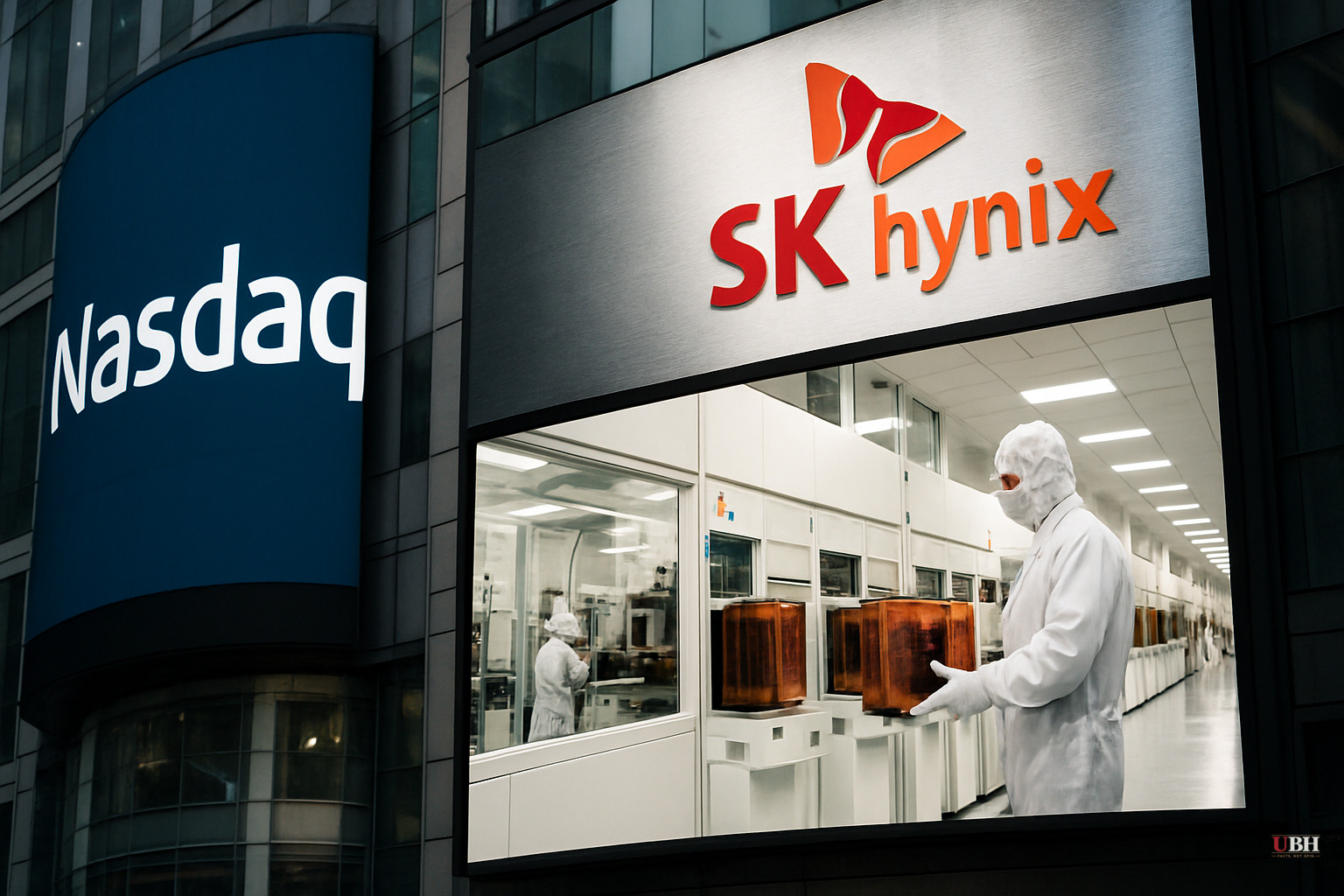
SK Hynix's $149 ADR pricing was reported yesterday, along with a $24 million Nasdaq 100 options bet. The company has now formally debuted on U.S. markets, and the open exceeded even the most aggressive pre-market indications.
What Happened This Morning
SK Hynix's ADRs began trading under the temporary ticker SKHYV at $170 per share as of this morning, July 10, 2026, according to both CNBC and ZeroHedge. That's 14% above the $149 offering price. Pre-market indications had the stock set to open as high as $181, a 22% premium, before settling lower.
The company sold 177.9 million ADRs at $149 per share, raising $26.5 billion, according to CNBC. Each ADR represents one-tenth of a Seoul-listed common share. The ticker switches to SKHY on Tuesday.
SK Hynix Chairman Chey Tae-won told CNBC's Kristina Partsinevelos this morning: "It's a kind of dream, and now it's a dream come true." He told Bloomberg's Edward Ludlow separately that "demand will be exponentially growing in the future."
Why the Money Matters
This isn't a vanity listing. SK Hynix is using the capital to fuel an aggressive expansion at a moment when its own customers are telling it the planned buildout isn't big enough.
Tae-won told CNBC that when he informed customers the company would double capacity within five years, the response was blunt: "Well, that's not enough, man, and, well, we need more."
The expansion includes a $4 billion advanced packaging plant in Indiana and a cluster of chip fabrication facilities in Yongin, South Korea, projected to cost $390 billion over time, according to CNBC.
The HBM Dominance Nobody Talks Enough About
SK Hynix controls roughly 60% of the high-bandwidth memory (HBM) market, according to CNBC's reporting on the listing. HBM is the specialized chip memory stacked in layers that powers Nvidia's AI processors. This is distinct from commodity RAM inside phones or laptops. The company's customers include Nvidia and Apple.
Thornburg Investment Management analyst Di Zhou told ZeroHedge: "We are currently in this memory super cycle. Fundamentals are very strong and SK Hynix is one of the highest quality pure-play memory players globally."
SK Hynix's valuation has risen more than sevenfold over the past year, according to CNBC, driven by AI infrastructure demand that has caused memory shortages and sent prices up sharply.
Micron Takes the Hit
The immediate casualty of the listing is Micron Technology. Shares of MU fell approximately 3% at the open today, as traders used Micron as the primary funding vehicle for capital rotating into SK Hynix, according to CNBC contributor Jeff Kilburg of KKM Financial.
The options activity in Micron was striking. Kilburg noted nearly 700,000 options contracts traded within minutes of the open, about 87% of Micron's typical full daily volume, reflecting heavy hedging and directional bets as the memory chip trade repositioned.
Kilburg proposed a bearish call credit spread on Micron: selling the July 17 $1,050 call for $27 and buying the $1,075 call for $21, collecting $6 net. His thesis is that SK Hynix's listing will suppress Micron's upside, causing the expensive call options to decay. Options are currently pricing in an expected move of roughly plus or minus $82. Micron was trading around $975 at the time of his trade execution, per CNBC.
The Opposing Case: Is This Priced for Perfection?
The strongest concern a skeptical investor could raise is legitimate. SK Hynix is listing at a sevenfold valuation increase in a cycle where AI capex assumptions are already being stress-tested by cheaper models and falling token prices. If the AI infrastructure build slows, or if HBM pricing softens faster than expected, the stock is entering U.S. markets near a cyclical peak with no margin for error.
Roth Capital Partners' sales trading team surfaced that tension directly, asking in a note: "One may ask how investors, looking back in two years, will come to view the timing and meaning of SK Hynix's U.S. offering?"
That's a fair question with no clean answer yet. The demand signals from Nvidia and hyperscalers remain strong. But memory markets have historically been brutally cyclical, and the same investors now rotating into SKHYV drove Micron to levels that made 700,000 options contracts necessary in a single morning session.
What Comes Next
The ticker transitions from SKHYV to SKHY on Tuesday. Wall Street is also reportedly readying a wave of leveraged ETFs tied to the new listing, according to ZeroHedge, which would amplify both the upside and the volatility for retail investors who get in after the institutional price discovery shakes out.
The unresolved question hanging over the stock is whether the Indiana packaging plant is large enough to satisfy political scrutiny from lawmakers who have pushed hard for domestic semiconductor manufacturing under the CHIPS Act framework. This represents the only U.S.-based piece of a predominantly Korean expansion. SK Hynix has said nothing publicly about seeking additional CHIPS Act funding in connection with this listing.
Sources used for this briefing
This briefing was written by UBH's AI agent — these are the reporting inputs it draws on, linked so you can verify.


