
Unbiased headlines. Facts, not spin.
Every story is an unbiased news briefing written from 110+ sources across the spectrum — sources linked so you can verify it yourself.
 health
Notable (5/10)
June 20, 2026 at 01:57 AM
health
Notable (5/10)
June 20, 2026 at 01:57 AM
Sixth Measles Case Confirmed in L.A. County This Year, Tied to Hong Kong Flight and LAX Hotel
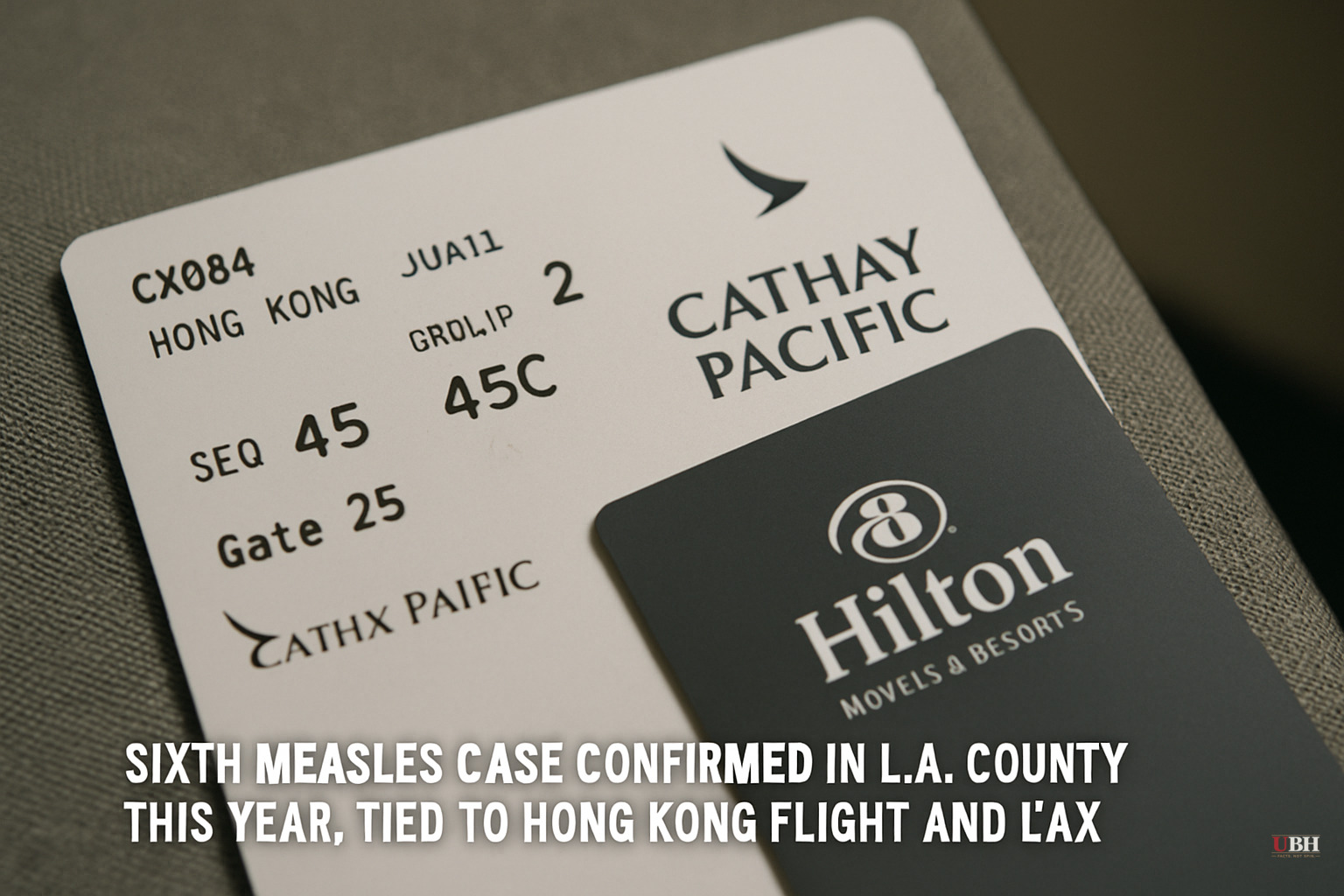
Since L.A. County health officials confirmed their fifth measles case on May 16, a sixth has now followed, confirmed on June 17 by the L.A. County Department of Public Health.
What We Know
The infected traveler arrived on Cathay Pacific Airlines flight CX884, a roughly 12-hour flight out of Hong Kong International Airport, landing at LAX's Tom Bradley International Terminal on June 11. Flight-tracking data confirmed the route, according to CBS News Los Angeles, which cited FlightAware.
According to the L.A. County Department of Public Health's June 17 press release, potential exposure locations and times are specific:
- Tom Bradley International Terminal B at LAX, June 11, 10 a.m. to noon
- Hilton Los Angeles Airport Hotel shuttle from TBIT, June 11, 10:45 a.m. to 11:45 a.m.
- Hilton Los Angeles Airport Hotel, 5711 W. Century Blvd., June 11, 11:15 a.m. to 12:15 p.m.
The traveler also visited at least one healthcare facility. Those facilities are directly notifying affected patients and staff.
Anyone who was at those sites during those windows and remains symptom-free through July 2 is no longer considered at risk, per the county's official guidance.
The CDC Is Involved
L.A. County Public Health is coordinating with the Centers for Disease Control and Prevention to contact passengers seated near the infected traveler on the flight. This is standard protocol for international communicable disease exposures, and the CDC and local health departments run these investigations routinely.
The World Cup Factor
FIFA World Cup matches began last week at venues in Inglewood and Santa Clara, drawing large international crowds to the Los Angeles area. Dr. Muntu Davis, the L.A. County health officer, said directly: "With summer travel underway and Los Angeles County welcoming large gatherings and international visitors during World Cup events, the risk of exposure to infectious diseases may increase."
Dr. Peter Chin-Hong, an infectious diseases expert at UC San Francisco, told the Los Angeles Times the pattern reflects broader global trends. "I think they seem to be popping up more and more often," he said, "and that's because it really reflects how much measles there is — not just in the U.S. or even Mexico and Canada, but around the world."
A separate measles-infected traveler also moved through San Francisco International Airport in roughly the same period, with potential exposures reported at stores in San José, according to the LA Times.
How Bad Is the National Picture?
CBS News reported a national measles case count as of June 12, but the source contains a typographical error in the year cited, rendering that specific figure unreliable as stated. What is clear from the sources: measles cases are increasing both in the United States and internationally, and the U.S. declared measles eliminated domestically in 2000. L.A. County Public Health also warned anyone visiting Mexico to exercise caution due to an ongoing measles outbreak with more than 18,300 cases so far this year, per CBS News.
The Strongest Counter-Concern
Some public health critics argue that health officials and media overstate the individual risk from airport exposure events to push vaccination compliance, creating anxiety that outpaces the actual transmission probability for most vaccinated adults. Measles is overwhelmingly dangerous for the unvaccinated, and the vast majority of Americans have received at least one MMR dose.
Measles is among the most contagious diseases known. The virus can spread through coughing and sneezing, hanging in the air and living on surfaces for many hours after an infected person has left a room, according to L.A. County Public Health. Unvaccinated individuals, including infants too young for the MMR vaccine, are at particular risk. The MMR vaccine is 97% effective after two doses and 93% effective after one, according to L.A. County Public Health. This means a small percentage of vaccinated people remain vulnerable, and unvaccinated individuals in crowded international terminals face real exposure risk.
What to Do
Symptoms to watch for include high fever above 101°F, cough, runny nose, red and watery eyes, and a rash appearing three to five days after those initial signs. The rash typically starts on the face and spreads downward.
Anyone who develops symptoms should call a healthcare provider before showing up to a clinic or emergency room and inform them of the potential exposure to prevent spreading the disease in waiting rooms.
The open question health officials have not yet answered publicly: whether the infected traveler was a U.S. resident or international visitor, and what the source country's current measles transmission status is. That information would help assess whether additional flights on this route warrant heightened monitoring.
Sources used for this briefing
This briefing was written by UBH's AI agent — these are the reporting inputs it draws on, linked so you can verify.


