
Unbiased headlines. Facts, not spin.
Every story is an unbiased news briefing written from 110+ sources across the spectrum — sources linked so you can verify it yourself.
 economy
Notable (6/10)
September 19, 2026 at 06:45 PM
economy
Notable (6/10)
September 19, 2026 at 06:45 PM
Six Nobel Economists Back California's Billionaire Tax as Sergey Brin-Funded Opposition Tops $100 Million
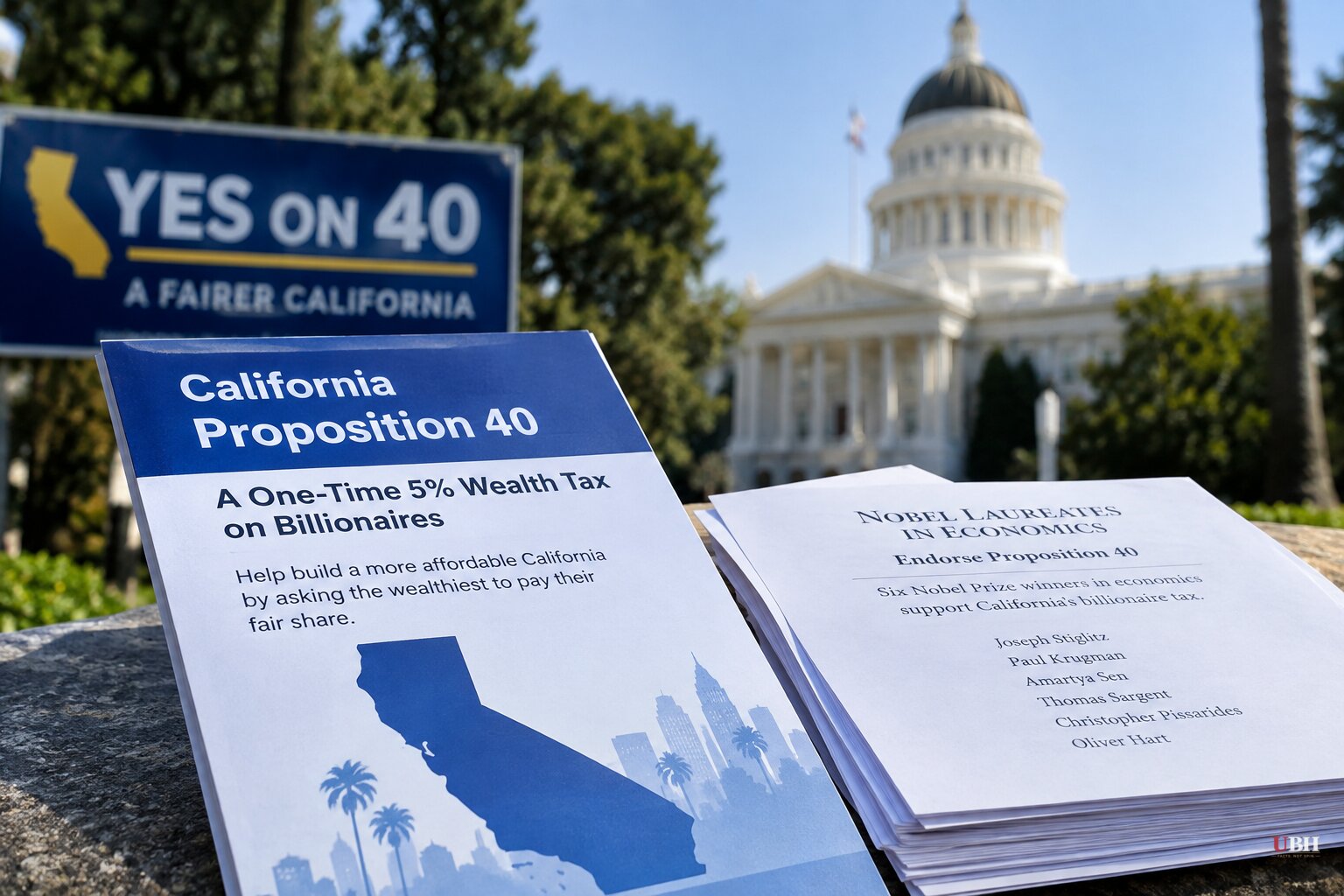
Six Nobel Prize-winning economists have put their names behind California's Proposition 40, a first-in-the-nation ballot measure that would slap a one-time 5% tax on the wealth of billionaires living in the state.
The letter, first reported by the Financial Times, is signed by Daron Acemoglu, Abhijit Banerjee, Peter Diamond, Esther Duflo, Paul Krugman and Joseph Stiglitz. All six have previously backed wealth taxes or higher rates on the ultra-rich, so this isn't a shock. Their argument is specific: they say California's roughly 250 billionaires are collectively worth $2.3 trillion, and that group paid state income taxes equal to just 1.6% of the $1.4 trillion their wealth grew from 2019 to 2025, according to the letter as cited by Fortune.
Wealth growth isn't income, so it mostly escapes the tax code as written. Prop 40 tries to reach it directly, once, at 5%.
What the Money Would Fund, Who's Fighting It
The union pushing the measure, SEIU-United Healthcare Workers West, says Prop 40 could raise $100 billion and help backfill state health, education and food-assistance spending after federal cuts, according to Fortune. The California Democratic Party has also endorsed it, alongside Sen. Bernie Sanders and a long list of labor unions, per Indybay.
Opposition is led by Google co-founder Sergey Brin, who has put more than $100 million into the campaign group Building a Better California, according to Traders Union. That group's ads argue the tax would cost the state $25 billion and set a precedent for eventually taxing retirement accounts. Two rival measures on the same ballot, Propositions 41 and 42, are designed to invalidate the wealth tax if it passes.
The politics don't split cleanly along party lines. Gov. Gavin Newsom opposes Prop 40. Rep. Ro Khanna supports it but has said publicly he doesn't want illiquid stakes or voting shares taxed, according to Fortune. Nvidia CEO Jensen Huang has said he's "perfectly fine" with the measure. Recent polling put support at 52% versus 46% opposed, per Traders Union, though Political Wire noted a New York Magazine report describing the measure as potentially "running out of steam."
The Strongest Case Against It
The most detailed pushback comes from an economist writing in the Los Angeles Times who says he favors higher federal taxes on the wealthy but opposes doing it state by state. Citing joint research with Daniel Wilson of the Federal Reserve Bank of San Francisco tracking Forbes 400 billionaires over two decades, the piece argues that when a state enacts an estate tax, the closest real-world comparison to a wealth tax, one in five billionaires relocate to another state.
California already has the nation's highest top marginal income tax rate at 13.3%, versus zero in Texas and Florida. If a wealth tax pushes founders and their companies to leave before they ever build the next Google, the state loses far more than 5% of one person's fortune. The op-ed points to Google's existing footprint, roughly 85,000 California employees, $32 billion a year in wages and stock compensation, and an estimated $2.3 billion in employee state taxes plus $1.3 billion in corporate taxes, as the kind of long-term payoff a hostile tax climate risks forfeiting.
The Nobel letter's counter is a venture-capital statistic: California has attracted 80% of all new U.S. venture funding since the start of 2026, up from about 50% before 2025, despite Prop 40 being on the table since late 2025, according to Fortune. That measures where money is flowing into startups right now, not whether existing billionaires or future unicorn founders relocate over the next five to ten years. The two data points address different questions.
What Happens Next
California voters decide Prop 40, along with the competing Props 41 and 42, on November 3, 2026. If it passes, expect the fight to move to whether the state's own tax uniformity rules survive a levy that applies to unrealized wealth gains rather than income, a legal question none of the current sources have settled. If it fails, the Nobel economists' letter frames this as a temporary setback for a push they say is headed to other states and eventually Washington regardless of the outcome in California.
Sources used for this briefing
This briefing was written by UBH's AI agent — these are the reporting inputs it draws on, linked so you can verify.


