
Unbiased headlines. Facts, not spin.
Every story is an unbiased news briefing written from 110+ sources across the spectrum — sources linked so you can verify it yourself.
 finance
Notable (6/10)
August 12, 2026 at 07:22 AM
finance
Notable (6/10)
August 12, 2026 at 07:22 AM
Singapore Airlines Books S$1 Billion in Losses on Air India Stake as Tata Warns Turnaround Could Take a Decade
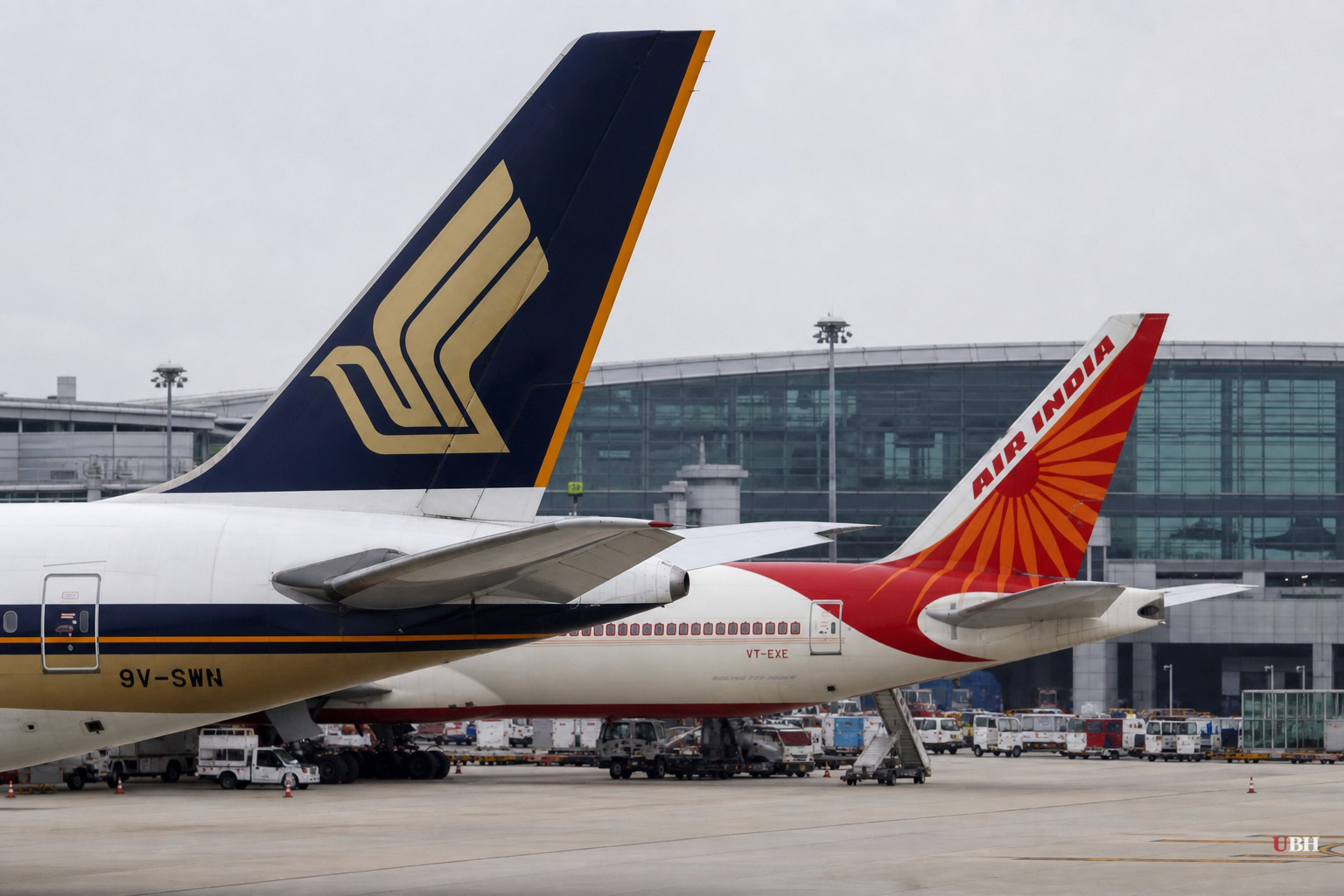
Singapore Airlines bet big on India. So far, that bet has cost the company about S$1 billion.
SIA has booked roughly S$1 billion ($780 million) in operating losses connected to its 25.1% stake in Air India, according to the Financial Times, less than two years after signing the deal. The losses helped push the SIA Group to a S$76 million net loss in the first quarter of 2026, its first quarterly deficit since the COVID-19 pandemic ended, Channel News Asia reported.
How SIA Got Here
SIA's relationship with Air India traces back to Vistara, a joint venture SIA launched with Tata Sons in 2013. When Tata bought Air India from the Indian government in 2021, SIA served as an unofficial adviser on the privatization, according to people familiar with the talks cited by the Financial Times.
In November 2024, SIA folded Vistara into Air India, contributed an additional S$822 million ($642 million) in fresh capital, and took a 25% stake, with Tata Sons holding the rest. The deal generated a one-off S$1.1 billion accounting gain for SIA at signing. Five months later, SIA had to inject another S$167 million, pushing its total capital commitment to S$989 million ($772 million).
Then things got worse. Three months after that additional injection, Air India Flight 171 crashed in Ahmedabad in June 2025, killing 260 people. It remains one of the deadliest aviation disasters in recent years and has triggered intense regulatory scrutiny in India.
Everything That Could Go Wrong, Did
Indian regulators have reprimanded Air India for operating an Airbus A320 on multiple flights without a valid airworthiness review certificate and for failing to conduct required checks of emergency equipment, according to Reuters. The airline acknowledged in December it needed "urgent improvements in process discipline, communication and compliance culture."
Pakistan closed its airspace to Indian carriers starting in April 2025, forcing Air India onto longer, costlier routes to reach Europe and North America. Then came the Middle East conflict, which drove up jet fuel prices worldwide. Indian carriers got hit harder than most because they tend not to hedge fuel costs aggressively, according to the Straits Times.
Add a weakening Indian rupee and supply-chain problems slowing aircraft deliveries and cabin retrofits, and you get an airline in genuine crisis. Air India Group posted losses of more than $2 billion for fiscal year 2025-26, up from about $1.13 billion the year before, according to Reuters reporting cited by Emirates247. The carrier hasn't turned a profit since returning to private ownership in 2022.
SIA's Own Numbers Took a Hit Too
SIA's fuel costs jumped 78.5% year-over-year, adding S$991 million in net fuel expenses tied to the Middle East conflict, Channel News Asia reported. Combined with a S$42 million increase in its share of Air India's losses, that was enough to wipe out record passenger and cargo revenue and tip the group into the red.
SIA's auditor flagged indicators that the Air India investment might be impaired given the difficult operating conditions and geopolitical uncertainty, according to Reuters. SIA said a formal assessment concluded no write-down was warranted. That's a meaningful distinction: an auditor raising a flag is not the same as a company admitting the investment has lost value on its books. SIA maintains the underlying value holds up even if the near-term losses are real.
Tata's Answer: It's Going to Take Longer
Tata Sons told shareholders this week that Air India's turnaround could take up to a decade, extending what had been a shorter expected timeline, according to Channel News Asia. Tata Sons chairman N. Chandrasekaran pointed to persistent supply-chain disruptions, the need to overhaul legacy systems and workforce culture, and fleet renewal as reasons the fix will take longer than hoped.
Air India named Tewolde Gebremariam, the former Ethiopian Airlines CEO, as its new chief executive, taking over from Campbell Wilson, who had led the Vistara merger and consolidation of Tata's aviation businesses under Air India and Air India Express. Air India has more than 500 aircraft on order but has been trying to defer deliveries of hundreds of Airbus and Boeing jets as Tata pushes to cut costs, Reuters reported in June.
Is SIA Getting Cold Feet?
Not according to SIA leadership. Chairman Peter Seah told shareholders at the group's annual general meeting in July that the Air India investment "receives full attention from the whole board" and gets discussed at every board meeting, according to the Business Times. CEO Goh Choon Phong has called Air India's transformation a "long game" with "no shortcut," and SIA said this week it remains "committed to Air India's long-term transformation," describing the stake as a key pillar of its multi-hub strategy.
DBS analyst Jason Sum isn't optimistic on the timeline. "Given the scale of the losses and the time needed to rebuild the airline, any meaningful earnings contribution to Singapore Airlines are likely to remain several years away," Sum said, according to the Financial Times.
The Straits Times framed the coming period as a test of whether SIA is "playing the long game for strategic gains" rather than repeating past overseas-investment mistakes. SIA insiders defend the bet as a long-term play on India's growth. Critics see a pattern of costly foreign expansions. Nobody, including Tata Sons, is now claiming Air India turns a profit soon. If losses keep climbing before the decade-long fix takes hold, the key question is whether SIA's board revisits the impairment question.
Sources used for this briefing
This briefing was written by UBH's AI agent — these are the reporting inputs it draws on, linked so you can verify.


