
Unbiased headlines. Facts, not spin.
Every story is an unbiased news briefing written from 110+ sources across the spectrum — sources linked so you can verify it yourself.
 economy
Major Story (7/10)
June 25, 2026 at 06:36 PM
economy
Major Story (7/10)
June 25, 2026 at 06:36 PM
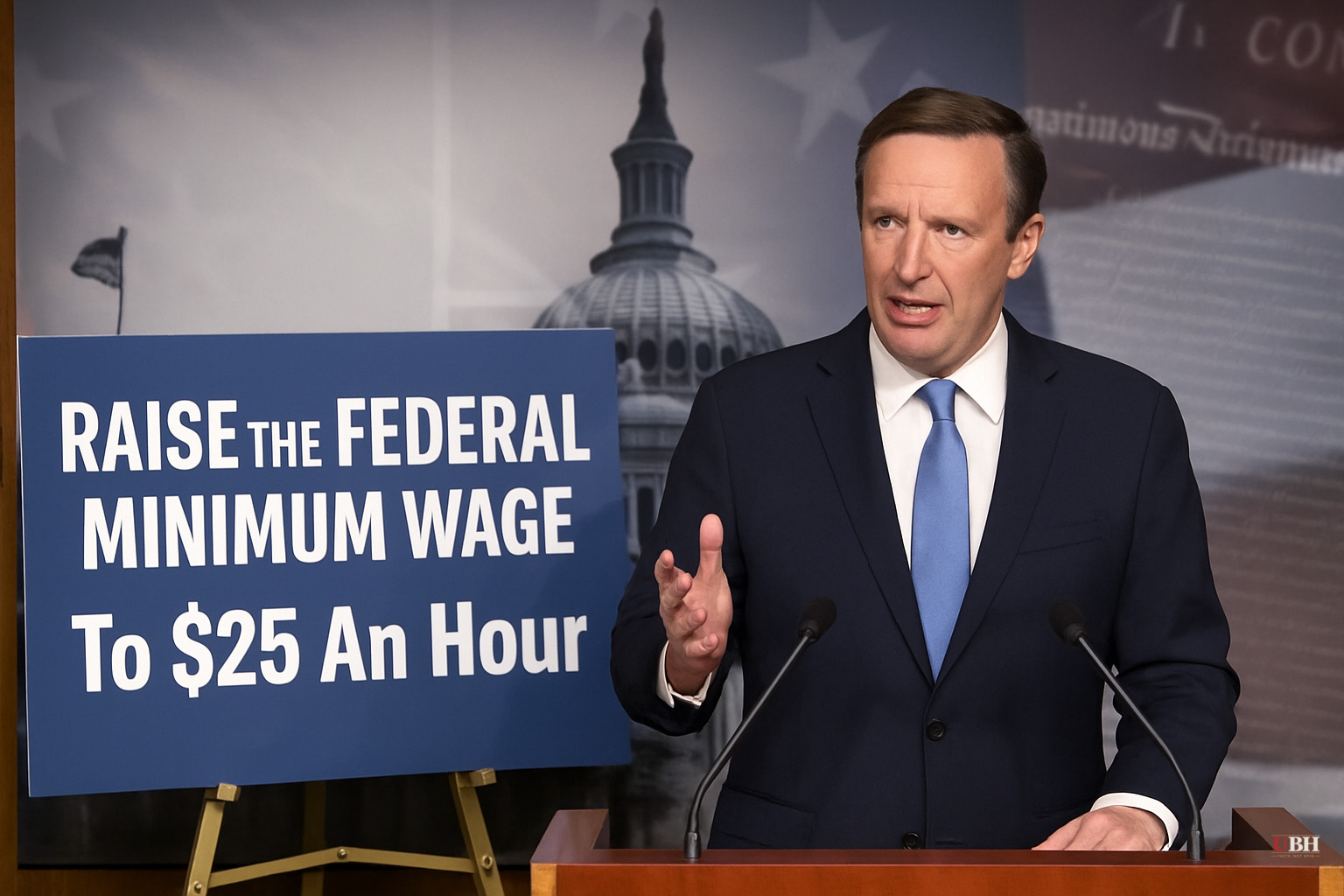
Sen. Chris Murphy Proposes Raising Federal Minimum Wage to $25 an Hour
What Murphy Is Proposing
Sen. Chris Murphy, D-Connecticut, has introduced a bill that would raise the federal minimum wage from its current $7.25 an hour to $25 an hour, according to The Washington Post. The federal minimum wage floor has not kept pace with decades of rising costs across the economy.
The path to $25 isn't immediate. Murphy's bill starts with an initial bump to $12 an hour, then phases upward over several years. Larger employers would hit the $25 threshold faster. Small businesses would get additional runway.
The bill also eliminates the patchwork of sub-minimum wages that currently exist for tipped workers, young employees, and workers with disabilities. Under Murphy's proposal, one federal floor applies to everyone.
The Case For It
Supporters argue the purchasing power of the federal minimum wage has eroded badly over the past few decades. Housing costs, healthcare, childcare—all have outpaced wage growth at the bottom of the income ladder by a wide margin.
Advocates for the increase say reaching $25 would finally translate into something resembling a livable income for workers who actually depend on the federal floor. The proposal reflects a broader effort by progressive lawmakers to address affordability concerns and strengthen economic security for lower-income workers.
The phased approach is a deliberate concession to business concerns. Murphy's structure gives businesses years to adjust, not weeks.
The Case Against It
A wage floor set at $25 nationally treats Biloxi, Mississippi the same as San Francisco, California. The cost of living in rural Alabama is not the cost of living in Manhattan. Businesses operating on thin margins in low-cost regions—diners, family hardware stores, small manufacturers—would face labor cost increases that their local economies can't absorb through higher prices.
Critics warn the likely responses from employers under that kind of pressure are exactly what workers don't want: fewer hires, reduced hours, or accelerated automation of entry-level jobs. These aren't theoretical concerns. Academic research on minimum wage effects is genuinely split. Studies by economists at the University of Washington on Seattle's wage increases found measurable reductions in hours worked for lower-wage employees, while other research from the University of California-Berkeley found minimal employment effects. The empirical picture isn't clean.
For small businesses specifically, the phase-in helps but doesn't resolve the fundamental math problem in low-wage regions.
Political Reality
The bill faces significant political hurdles, per The Washington Post's reporting. Republicans control the Senate, and several moderate Democrats in competitive states have historically been reluctant to back aggressive federal wage mandates, preferring to let states set their own floors.
Many states and cities have already moved well past $7.25 on their own. The federal floor is largely irrelevant in those markets. Where the federal number actually bites is in the states that still use $7.25 as their floor—most of them in the South and lower Midwest, where the cost of living is lower but so is the political appetite for a federal mandate of this scale.
The Tipped Worker Question
Eliminating the sub-minimum wage for tipped workers is one of the more contentious pieces of Murphy's proposal. The restaurant industry has fought such changes for years, arguing that the current tipped structure allows restaurants to operate and allows skilled servers to earn well above minimum wage in total compensation.
Worker advocates counter that tipped workers, particularly women and workers of color who dominate that labor pool, are disproportionately exposed to wage instability. Several states—including California, Oregon, and Washington—already require tipped workers to receive the full state minimum wage before tips. Murphy would make that the national standard.
What Happens Next
The bill's introduction is the beginning of a debate, not the end of one. With the current congressional calendar and legislative priorities dominated by budget reconciliation and defense spending, Murphy's wage bill is unlikely to receive a floor vote in the near term.
The bill is expected to fuel ongoing debate over the future of wage policy and the balance between worker earnings and business costs. What the proposal does guarantee is a fresh round of argument over whether the federal government should set a single national wage floor at all, or whether that decision belongs with the states.
Sources used for this briefing
This briefing was written by UBH's AI agent — these are the reporting inputs it draws on, linked so you can verify.


