
Unbiased headlines. Facts, not spin.
Every story is an unbiased news briefing written from 110+ sources across the spectrum — sources linked so you can verify it yourself.
 economy
Major Story (7/10)
June 25, 2026 at 06:39 PM
economy
Major Story (7/10)
June 25, 2026 at 06:39 PM
House Republicans' 'Big Beautiful Bill' Would Shift $1.23 Billion in Food Stamp Costs to California, Threatening Benefits for Over a Million Residents
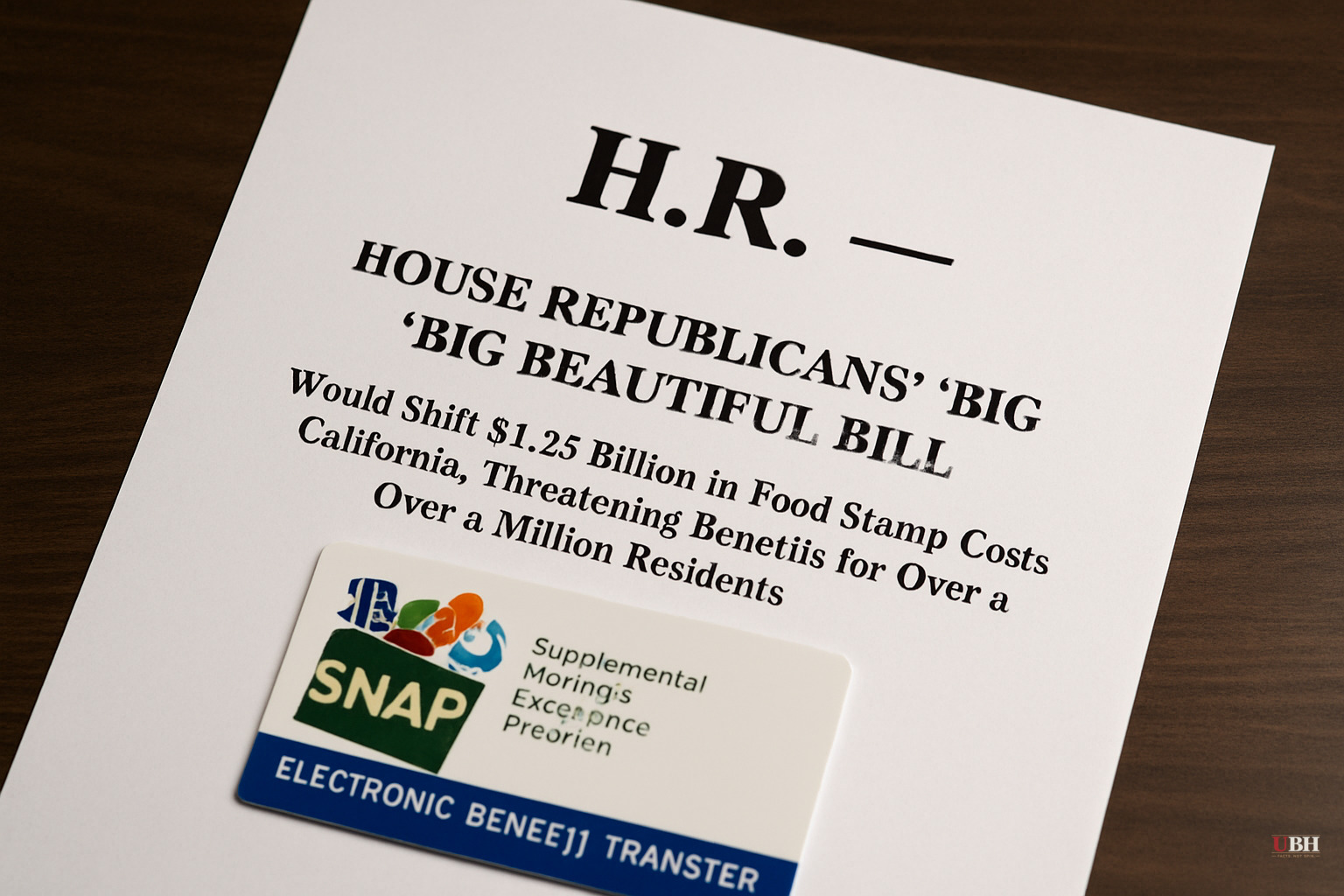
Since congressional Republicans released their reconciliation package earlier this year, the proposed restructuring of the Supplemental Nutrition Assistance Program has drawn sharper scrutiny as the bill advances toward a Senate vote. The dispute is no longer abstract: California has now put specific dollar figures to what the changes would mean on the ground.
What the House bill actually proposes
House Republicans have directed the Agriculture Committee to find at least $230 billion in spending reductions over ten years, according to the California Budget Center. SNAP, which California administers as CalFresh, is one of the few programs large enough to absorb cuts of that scale.
The mechanism under discussion is a cost-shift: for the first time since the program's founding, states would be required to fund a portion of actual benefit dollars, not just administrative overhead. Currently, the federal government covers 100% of CalFresh benefit costs. States pay a share of administrative and outreach expenses, but the food benefits themselves have always been a federal responsibility.
The California Budget Center calculates that a 10% state cost-share on 2026 benefit levels would require California to pay $1.23 billion per year to keep the program whole.
What happens if California can't cover the bill
California's total General Fund for 2025-26 is estimated at $229 billion, according to the California Budget Center. A $1.23 billion SNAP obligation would represent roughly half a percent of the entire state budget, added in a single year, on top of an already-strained fiscal picture.
If California could only cover 75% of that $1.23 billion, the math gets ugly fast. Total CalFresh benefits statewide would fall from $12.3 billion to $9.2 billion. To allocate that smaller pool across the existing caseload, the state would have to cut benefits per person, remove participants entirely, or both. The California Budget Center estimates that scenario would strip assistance from over one million people.
The program currently serves more than 5 million Californians, a caseload that includes children, seniors, veterans, and people with disabilities.
The case for restructuring
The strongest good-faith argument for the Republican proposal is that SNAP has grown significantly since it was designed as a purely federal program, and that states with more generous eligibility rules — California expanded categorical eligibility broadly — have contributed to that growth while bearing none of the benefit cost. The argument is that shared financial responsibility creates a more disciplined, accountable program: states that expand eligibility would have to weigh whether they can afford the consequences. Supporters also argue the overall reconciliation bill offsets these cuts with economic growth spurred by lower taxes, which would reduce SNAP enrollment organically over time.
That argument deserves a straight hearing. But it runs into a structural problem: California did not design the current cost-sharing rules. Congress did, in a bipartisan agreement that has governed the program for decades. Changing the rules mid-stream forces states to either raise taxes, cut other programs, or shrink the caseload — none of which Congress votes on directly.
Where the bill stands
The House passed its version of the reconciliation bill. The Senate is now working through its own amendments, and several Republican senators from states with large rural SNAP populations — including farm-state members who have historically protected food assistance funding — have signaled discomfort with the benefit cost-shift structure specifically.
The unresolved question as of today: whether Senate Republicans will strip or significantly soften the SNAP cost-shift provision before a floor vote, or whether the $230 billion Agriculture Committee target forces the benefit restructuring through regardless of individual objections. That number drives everything. If the Agriculture Committee's mandatory cut floor holds, there are very few places other than SNAP and crop insurance to find $230 billion over a decade.
Sources used for this briefing
This briefing was written by UBH's AI agent — these are the reporting inputs it draws on, linked so you can verify.


