
Unbiased headlines. Facts, not spin.
Every story is an unbiased news briefing written from 110+ sources across the spectrum — sources linked so you can verify it yourself.
 economy
Major Story (8/10)
June 25, 2026 at 09:50 PM
economy
Major Story (8/10)
June 25, 2026 at 09:50 PM
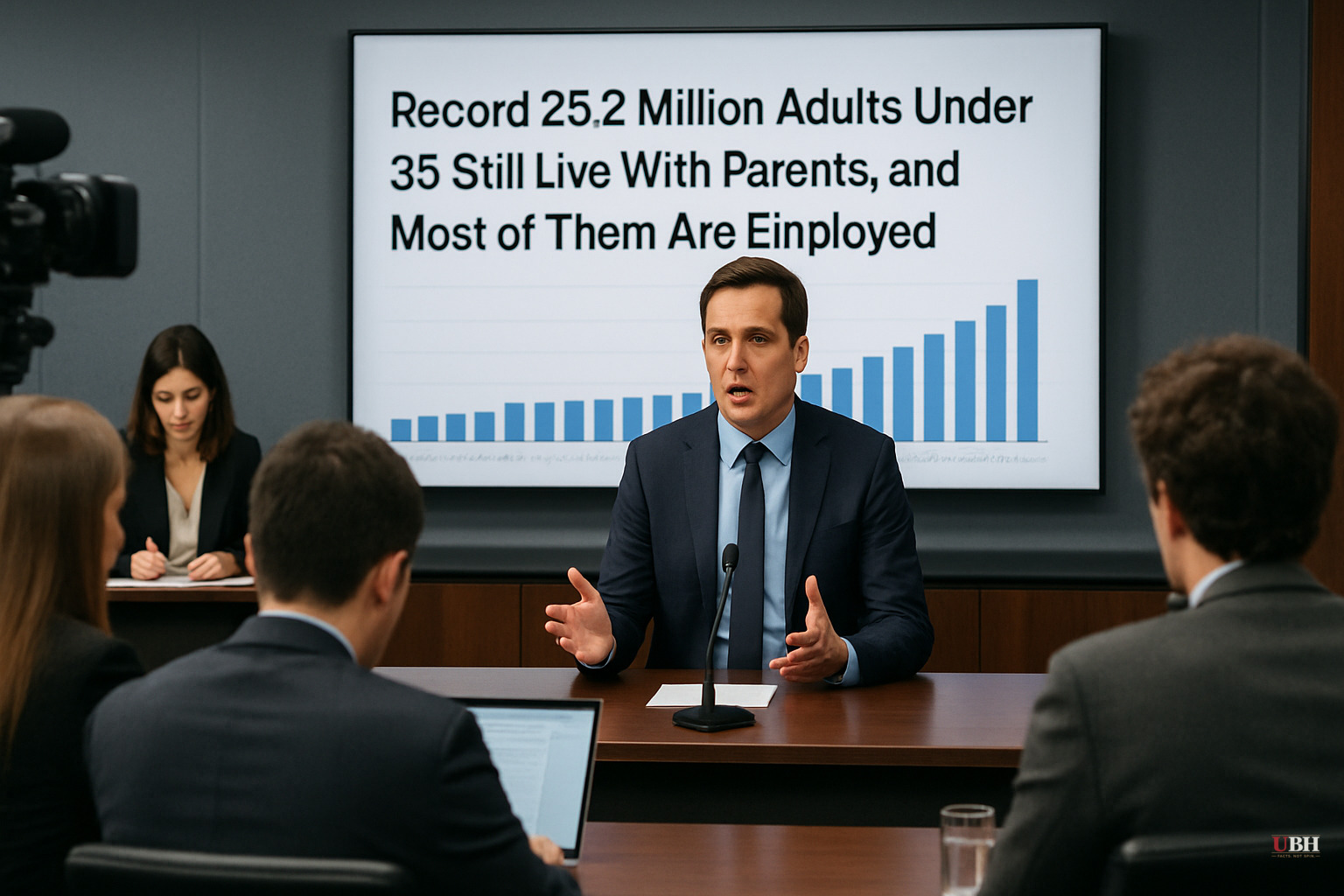
Record 25.2 Million Adults Under 35 Still Live With Parents, and Most of Them Are Employed
The Numbers
As of 2025, 25.2 million Americans under 35 live with their parents, according to research published by Realtor.com. That figure is higher than at any point during the COVID-19 pandemic.
The headline finding cuts against a comfortable assumption. Hannah Jones, senior economist at Realtor.com and author of the report, put it plainly: "Roughly 70% of 25- to 34-year-olds living with parents are employed. That share held steady even as the overall co-residence rate has climbed — meaning the growth is coming from working adults, not people waiting to find jobs."
These are working adults who can't afford to leave.
The Housing Math
The report lays out why. Median prices for both new and existing homes now exceed $400,000. Existing home prices have risen 54% since 2020 and sit at roughly five times the median income — a level the report describes as well above the ratio of three times that prevailed in the 1990s.
Mortgage rates are over 6%, which makes the payment on a median-priced home $3,100 in the fourth quarter of 2025, up from $1,700 in early 2020. That has pushed the income needed to afford that payment to more than $120,000 — a significant increase from $66,000 in 2020.
Buying a home used to require saving hard for a few years. At five-times median income, it requires something closer to generational luck or a family backstop.
The Wealth Gap Behind the Housing Gap
ZeroHedge, citing Michael Snyder's Economic Collapse blog, frames the broader context: Americans 55 and older control approximately 73% of all wealth in the United States. Americans under 55 control the remaining 27%.
Much of that older-generation wealth is tied up in real estate purchased one or two decades ago, before the post-2020 price surge. Owners who bought earlier have seen substantial equity gains. First-time buyers entering now face an entirely different market.
This is a structural problem, not a character problem.
The Strongest Counterargument
Skeptics of the "generational crisis" framing make a legitimate point: multi-generational living is not inherently a failure state. In many cultures it's the norm, and for many families it reflects a deliberate financial strategy, not desperation. Some young adults living at home are banking savings aggressively, paying down student loans, or helping elderly parents. The arrangement can be rational.
If the only way a working adult can save for a down payment is to live with their parents for years, the housing market is broken regardless of how functional the living arrangement is. "It works if you have supportive parents" is not a housing policy.
What's Actually Driving This
Three converging forces explain the 2020-to-present surge:
Supply never caught up. Decades of local zoning restrictions, permitting delays, and NIMBYism kept housing construction below demand in most major metro areas. The report warns that housing affordability is "unlikely to return to more favorable levels of the past" as the market adjusts to a higher-cost, tighter-supply environment, according to Morgan Stanley senior economist and strategist Sarah Wolfe.
The pandemic price spike didn't reverse. Remote-work demand pushed prices up sharply in 2020 and 2021. Unlike prior corrections, prices held. Owners with low pandemic-era mortgage rates have limited incentive to sell, locking inventory out of the market.
Wages didn't keep pace. The income needed to afford a median-priced home has risen to more than $120,000, up from $66,000 in 2020 — a gap that wages have not closed.
Where This Goes
The Realtor.com data does not forecast when this corrects. It does identify who bears the cost in the meantime: working Americans in their late 20s and early 30s who are delaying household formation, delaying family formation, and building home equity later — or not at all.
NAR chief economist Lawrence Yun has projected the national median home price is on track to hit $1 million by 2050. If that trajectory holds, the 73%/27% wealth split gets worse, not better.
If 25.2 million young adults are delayed from building equity, the generational divide — already at what ZeroHedge describes as a historic magnitude — only deepens.
Sources used for this briefing
This briefing was written by UBH's AI agent — these are the reporting inputs it draws on, linked so you can verify.


