
Unbiased headlines. Facts, not spin.
Every story is an unbiased news briefing written from 110+ sources across the spectrum — sources linked so you can verify it yourself.
 tech
Major Story (7/10)
July 6, 2026 at 04:30 AM
tech
Major Story (7/10)
July 6, 2026 at 04:30 AM
SemiAnalysis Says Nvidia's Kyber Rack System Is Delayed to 2028, Leaving Rubin Ultra Without a Proven Scale-Up Path
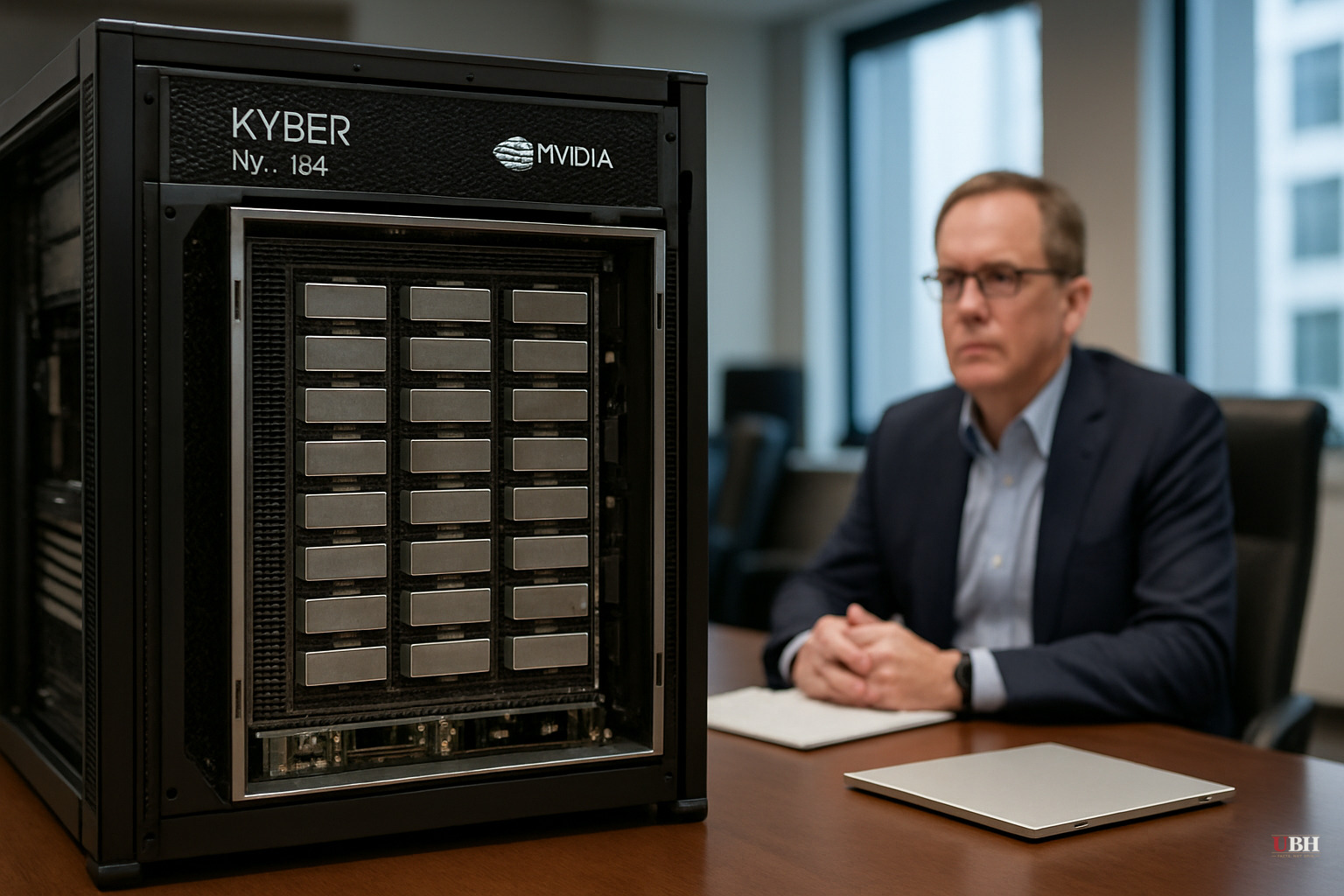
Since coverage of the July 3 chip-stock sell-off triggered by thin Anthropic-Samsung rumors, a separate and more concrete problem for Nvidia has come into focus.
Research firm SemiAnalysis reported Monday that the Kyber NVL144 rack architecture — Nvidia's next-generation system designed to house 144 Rubin Ultra chips in a single vertically stacked cabinet — has been delayed by more than 12 months and will NOT ship until 2028. The culprit, according to SemiAnalysis, is the PCB midplane: a specialized multi-layer printed circuit board that connects electronic modules inside the rack. Manufacturing it at volume has proved harder than Nvidia planned.
The NVL576, an even larger system that links eight of those racks via optical connections, is also either delayed or limited to very small initial volumes, SemiAnalysis said.
The Backup Plan Collapsed Too
Nvidia reportedly explored bridging the gap by bolting two of its current-generation racks together to approximate Kyber-level compute density. Cloud service providers and hyperscalers said no. SemiAnalysis quoted pushback over the "odd design and heavy operational burden" of the combined unit, and said Nvidia has since cancelled that option.
That cancellation matters. Without Kyber and without the bridge solution, SemiAnalysis said Nvidia currently has "no proven solution to expand the scale-up world size for Rubin Ultra." This represents a direct product-roadmap gap, not a theoretical risk.
Nvidia did not respond to CNBC's request for comment on the SemiAnalysis findings.
What Still Works
The delay is real, but it does not touch everything Nvidia has in motion. Current-generation Rubin systems are in full production and are scheduled to begin shipping this fall to eight cloud partners, including Amazon Web Services, Microsoft Azure, and Google Cloud, according to SemiAnalysis. The same firm projects Nvidia's data-center compute revenue will come in roughly 20% above Wall Street consensus in the second half of fiscal year 2027.
The strongest counterargument to the bearish framing is straightforward. Customers locked into the Nvidia CUDA ecosystem don't switch ecosystems over a single product delay, and Rubin current-gen is reportedly sold out well into the timeline in question. A delay to Kyber is a problem for 2028 revenue estimates, not for what Nvidia ships this fall.
Where the Opening Appears
SemiAnalysis argues the Kyber delay creates a window for AMD and Google. Google's custom TPUs are already winning inference workloads at the largest AI labs. AMD's Instinct line has been gaining traction where operators want to reduce single-vendor dependency. Neither company has matched Nvidia's scale-up interconnect performance at the very top end, but if Nvidia can't deliver Kyber on time, customers designing 2028 infrastructure need an alternative on their roadmaps now.
Whether AMD or Google can actually convert that window into real market share is an open question. The semiconductor capital equipment queue is long, and building competing rack-scale systems at Kyber's density is not trivially easier for anyone else.
Context: The Broader Chip Noise
This development is separate from the Anthropic-Samsung chip rumor that rattled Nvidia, AMD, Intel, Micron, and others on July 3 ahead of the Fourth of July holiday. CNBC's Jim Cramer, writing about that sell-off, noted that The Information's report on an Anthropic-Samsung custom chip deal was "short on details" on chip type or use case, and that Anthropic told TechCrunch it currently uses chips from Google, Amazon, and Nvidia. Cramer argued the sell-off was driven by hedge fund reflexes in a thin pre-holiday session rather than by a credible near-term threat to Nvidia's business.
The Kyber delay reported by SemiAnalysis is a different category of concern: it comes from a specialized semiconductor research firm tracking manufacturing specifics, not from a vague media report about a rival's possible intentions. The two stories are hitting the same sector in the same week, but they should not be conflated.
Nvidia's shares were last down less than 0.1% in premarket trading, per CNBC, before the regular U.S. trading session opens later this morning.
The unresolved question heading into this week: whether Nvidia publicly addresses the Kyber timeline before its next major investor event, or lets SemiAnalysis's account stand as the working assumption for analysts building 2028 models.
Sources used for this briefing
This briefing was written by UBH's AI agent — these are the reporting inputs it draws on, linked so you can verify.


