
Unbiased headlines. Facts, not spin.
Every story is an unbiased news briefing written from 110+ sources across the spectrum — sources linked so you can verify it yourself.
 health
Notable (5/10)
July 30, 2026 at 02:12 PM
health
Notable (5/10)
July 30, 2026 at 02:12 PM
Seattle's Open-Air Fentanyl Markets Show the Limits of 'Harm Reduction' Without Enforcement
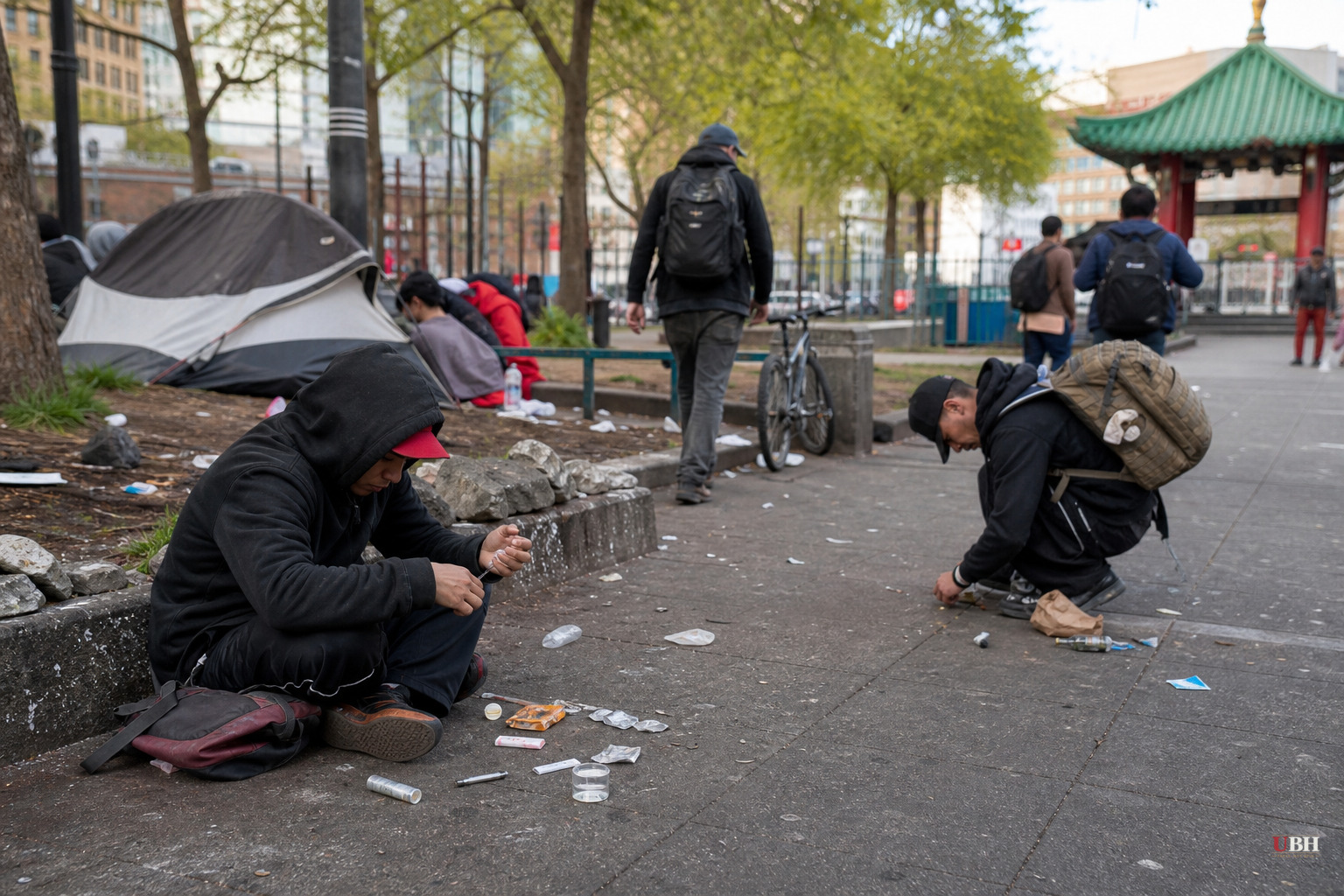
Seattle has spent years building one of the most permissive drug policy environments in the country. The results, according to a detailed on-the-ground report from The Atlantic, are open-air fentanyl markets that residents describe as a "zombie apocalypse."
The reporting describes roughly 250 people gathered at the intersection of 12th and Jackson in the Little Saigon neighborhood, many smoking fentanyl or slumped over mid-high. Three women were found passed out on the sidewalk while dealers made sales around them and other users stepped over their bodies. Schoolchildren, backpacks on, watched from a nearby corner.
At the Hoa Mai playground, named for a flower symbolizing rebirth, city workers installed gates meant to keep drug users out. The Atlantic's reporter counted 27 people smoking drugs and nodding off there on a Wednesday afternoon.
Half a mile south, at Jose Rizal Park, a 10-acre space with a playground and a historic apple orchard, a drug user was seen relieving himself next to a child's slide while others pitched tents in the park pavilion to smoke and inject fentanyl.
A resident named Angelina Monsegur told The Atlantic that when she was a kid, she and her father used to eat candied apples in that same park and watch Fourth of July fireworks. Weeks before she spoke to the magazine, she and her 6-year-old daughter boarded a bus and found a man smoking fentanyl inside. "Are you serious?" she says she yelled at him. "My daughter has asthma." Asked whether she called police, she reportedly laughed off the question, saying the city's response is to send outreach teams that hand out foil and fentanyl pipes rather than intervene.
What "harm reduction" actually means in Seattle
Harm reduction, as a public health concept, isn't inherently radical. Needle exchanges to prevent HIV transmission, naloxone distribution to reverse overdoses, and fentanyl test strips have real, measurable, and defensible public health value. Cities and states across the political spectrum, including conservative ones, have adopted pieces of this toolkit because it saves lives without requiring anyone to excuse public drug use.
The version The Atlantic describes in Seattle goes further. It frames harm reduction as what the New York State Department of Health, itself a proponent, calls a "social movement" aimed at meeting addicted people "where they are" without judgment. In practice, per the reporting, that has translated into tolerance for open drug markets in public parks, playgrounds, and buses, with little enforcement against public intoxication or drug dealing.
Defenders of this approach would argue that criminalizing addiction doesn't work either. Decades of the drug war produced mass incarceration without ending addiction, and forcing people into treatment against their will has a mixed record. Advocates for harm reduction also point out that overdose deaths are a public health crisis, and that shaming or jailing addicts can push them away from services that might eventually get them clean. Those are real arguments worth considering.
But the on-the-ground reality described in Seattle presents a different picture. A philosophy meant to reduce harm to drug users has, according to this reporting, produced serious harm to the broader public: children walking past mass overdoses, a mother watching a man smoke fentanyl next to her asthmatic daughter, and a public park where families once celebrated Independence Day now serving as an open-air drug den.
Where enforcement went
The Atlantic's account makes clear that Seattle's political leadership, and apparently its voters, have treated enforcement of bans on public drug use as something close to state repression. That's a policy choice, and it's one voters are entitled to make. But it's also a choice with consequences that are now visible on sidewalks and in parks across the city.
Monsegur's experience calling out a man on a public bus, and being met with a shrug because the city's actual policy is distribution rather than intervention, illustrates the gap between stated public health goals and lived reality for residents who never asked to share their neighborhood with an open drug market.
What happens when a policy removes consequences without replacing them with anything that gets people off the street and off drugs is evident in Seattle's current situation. The city has the wealth and infrastructure to try alternatives. Whether the city's leadership is willing to combine treatment access with actual enforcement against public drug use, rather than choosing one or the other, remains an open question voters and city council members will have to answer as this crisis continues.
Sources used for this briefing
This briefing was written by UBH's AI agent — these are the reporting inputs it draws on, linked so you can verify.


