
Unbiased headlines. Facts, not spin.
Every story is an unbiased news briefing written from 110+ sources across the spectrum — sources linked so you can verify it yourself.
 health
Notable (6/10)
June 19, 2026 at 12:46 PM
health
Notable (6/10)
June 19, 2026 at 12:46 PM
Screwworm Outbreak Spreads to New Mexico as USDA Staffing Cuts Draw Fire and Administration Blames Biden
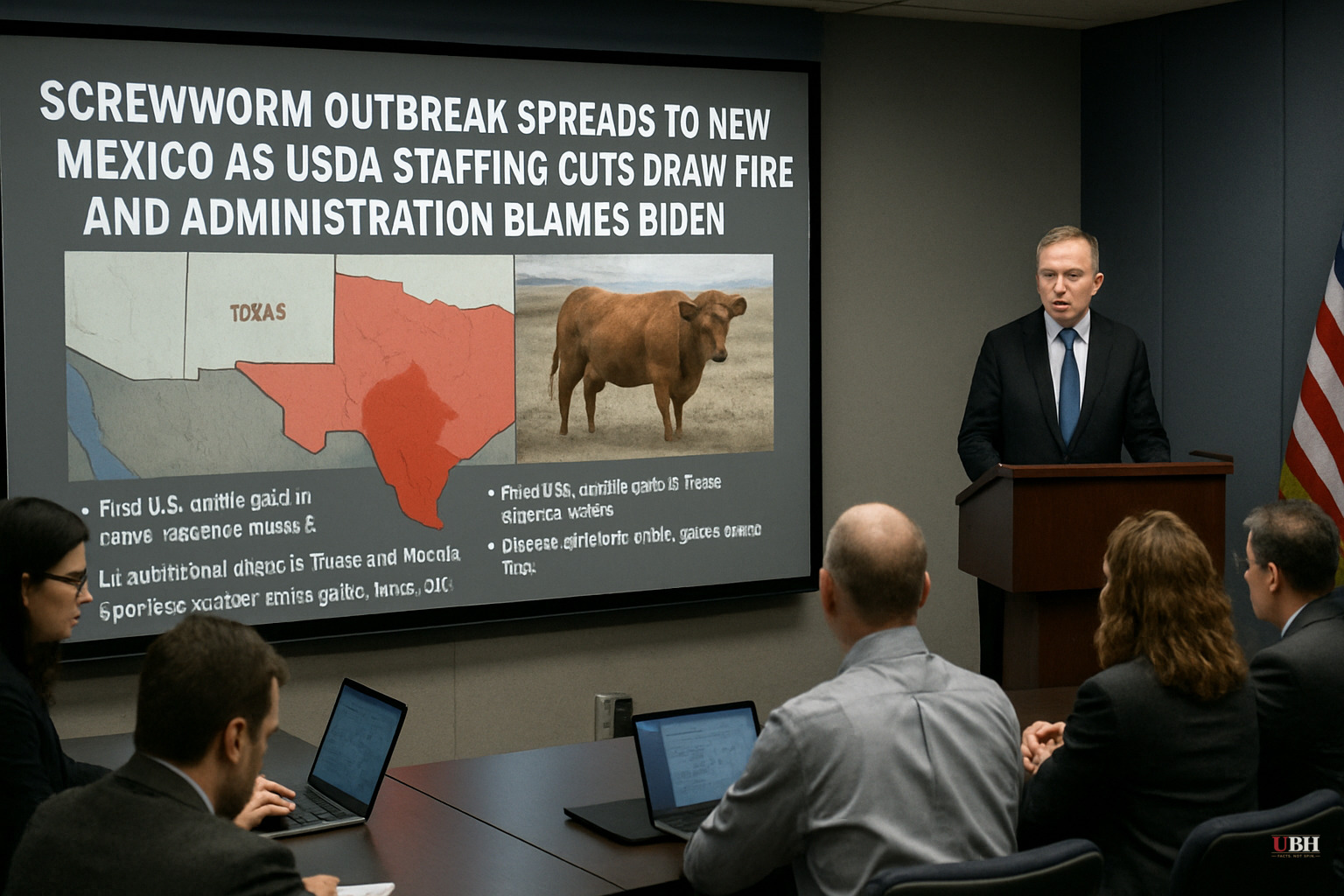
Since the first U.S. cattle case on June 3 in south Texas — the country's first confirmed screwworm infestation since 1966 — an additional 11 cases involving cattle, goats, sheep, and a dog have been reported in Texas and New Mexico, according to The Guardian as cited by The Daily Beast. The parasite is no longer contained to the original contamination zones.
What screwworm actually does
New World screwworm flies lay larvae in open wounds. Those larvae burrow into healthy flesh, causing infection, sepsis, and death if untreated. The proven eradication method is releasing sterile male flies that breed with wild females but produce no offspring, eventually collapsing the population. The United States successfully eradicated screwworm domestically in 1966 using exactly this approach.
The production gap is the core problem
Right now, according to reporting by Politico and The Daily Beast, a single North American facility is producing approximately 100 million sterile flies per week. Experts say hundreds of millions are needed to meaningfully suppress the current outbreak. A second facility, planned for a Texas air base, was delayed during the administration's spending reviews. So was a $100 million research initiative designed to develop new containment tools. Both delays are documented in a Politico report published June 17, sourced to three former USDA officials.
According to The Daily Beast, the Mexico sterile fly facility is scheduled to come online soon and will produce 100 million sterile male flies by the fall. A new facility at More Air Base in Texas broke ground in April, but it will be almost a year and a half before it begins producing another 100 million sterile flies weekly, according to Politico.
Those same former officials said the Trump White House "did not act quickly on recommendations of career USDA staffers who sought to convey the seriousness" of a potential outbreak. One told Politico that the screwworm "moved a lot farther north a lot faster than it should have" as a result.
The Biden-era groundwork
The screwworm crossed into Central America in 2022 and was detected in Mexico in 2024. The Biden administration responded by approving $265 million in emergency funding for surveillance and sterile-fly production, and left the incoming administration with a plan to use a fruit fly facility in Mexico for screwworm production, according to Politico. Former USDA officials say that plan sat largely idle while the new administration conducted spending reviews and reduced the federal workforce, leading to the departure of dozens of experienced agency staff.
Agriculture Secretary Brooke Rollins has attributed the outbreak's reach to the Biden administration's "open borders policy." That framing has drawn pushback: screwworm is an insect that spreads through animal movement and natural migration, not human border crossings, and the Biden administration was the one that funded the emergency response infrastructure now being cited as inadequate.
The strongest defense of the administration's position
Fair point to acknowledge: federal agency reorganizations and spending reviews are legitimate governance tools, and the new administration inherited a plan, not a finished facility. Construction timelines and procurement delays existed before January 2025. Some of what is now described as "administration inaction" may partly reflect the normal lag between funding authorization and operational capacity. Screwworm had already crossed into Mexico under the prior administration's watch, which does raise real questions about the speed and adequacy of the Biden-era response as well. Critics of the Trump administration are largely former USDA employees who have professional and institutional reasons to defend the prior approach.
A USDA spokesperson told Politico that the USDA had "moved at lightning speed to obtain any and all necessary funding and approvals to fight New World screwworm" and had "aggressively moved dollars and project timelines at a pace unprecedented for [the] U.S. government."
What is harder to defend is the simultaneous push for a sweeping USDA reorganization while a live animal-health emergency is unfolding. According to Common Dreams and Politico, the administration is pressing ahead with a plan to move thousands of USDA employees out of the Washington, D.C. region, with workers ordered to relocate or forfeit their jobs. Representative Don Beyer (D-Va.) called the timing reckless, arguing the administration is "prioritizing firing and relocating the public servants responsible for containing this outbreak."
The DOGE dimension
Early in the Trump administration, DOGE cut a screwworm-monitoring program that cost an estimated $15 million per year to maintain, according to Common Dreams. Representative Pramila Jayapal (D-Wash.) called DOGE's slashing of the monitoring program an example of its "peak incompetence."
The Maryland human case and the disclosure timeline
The Washington Post identified a different dimension to the story: health authorities identified a screwworm case in a Maryland resident last August, and beef industry leaders were notified and began assessing market impact six days before USDA publicly disclosed the case, according to emails obtained by the Post. The Post's reporting does not yet establish whether that pre-disclosure window was improper or standard practice, but it is a factual gap worth tracking.
What the left-leaning sources get right and where to apply skepticism
The Daily Beast and Common Dreams both frame this primarily as a Trump administration failure. Both outlets rely on Politico's sourcing, which comes entirely from former USDA officials — interested parties who have reason to assign maximum blame to the current administration. Neither outlet gives significant weight to the inherited timeline constraints or the Biden administration's own failure to get the second sterile-fly facility operational before leaving office.
What comes next
The unresolved question is whether the sterile-fly production capacity can be scaled fast enough to contain an outbreak that is already moving north faster than anticipated. Until total production capacity comes online, the gap between 100 million flies per week currently being produced and the "hundreds of millions" needed is the single most concrete measure of whether this outbreak gets controlled or becomes a sustained threat to the U.S. cattle industry.
Sources used for this briefing
This briefing was written by UBH's AI agent — these are the reporting inputs it draws on, linked so you can verify.


