
Unbiased headlines. Facts, not spin.
Every story is an unbiased news briefing written from 110+ sources across the spectrum — sources linked so you can verify it yourself.
 health
Notable (5/10)
June 5, 2026 at 09:04 AM
health
Notable (5/10)
June 5, 2026 at 09:04 AM
Scientists Edit Human Embryo Genes Without Chromosomal Damage — But a Controversial Startup Wants to Go Further
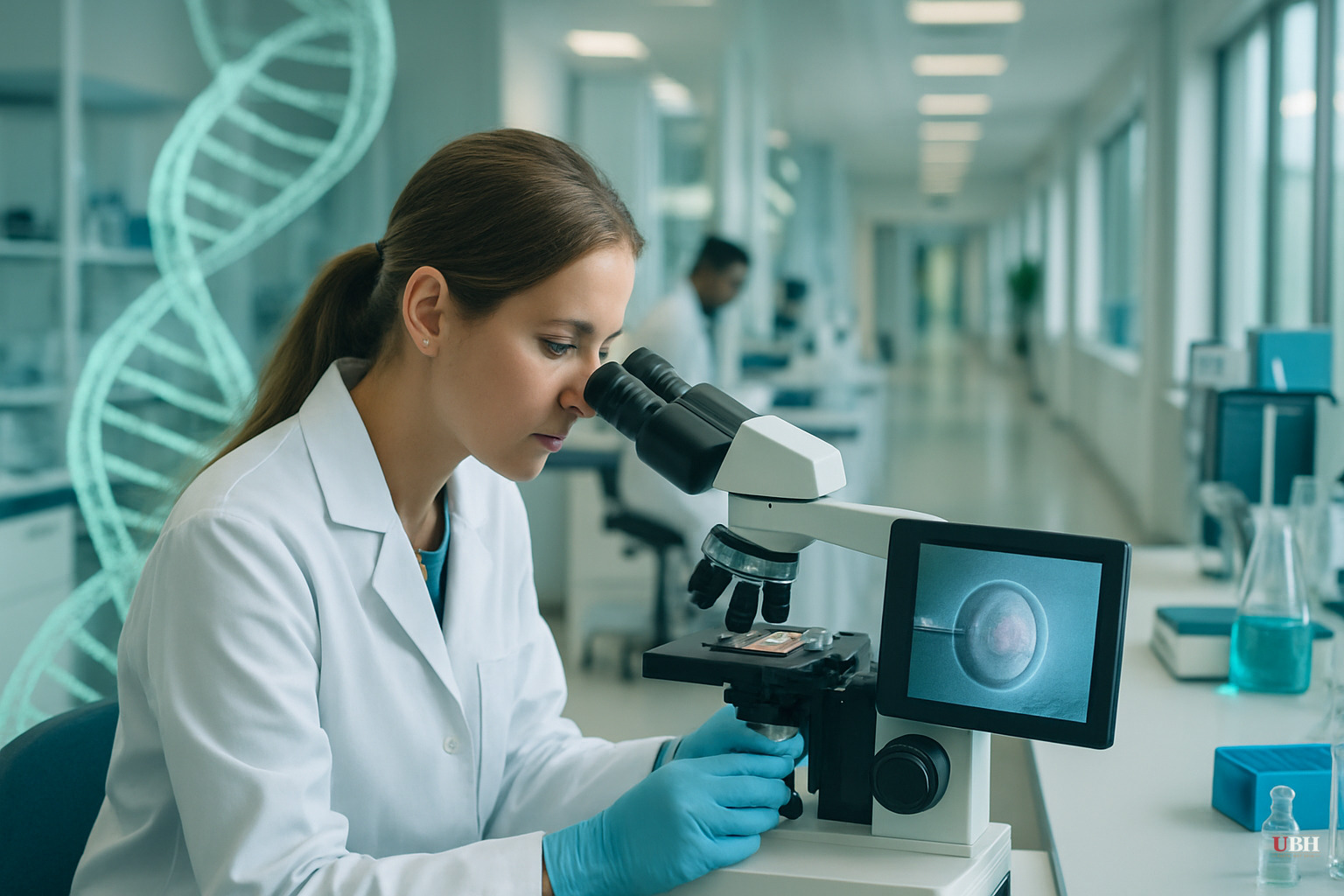
The Science Is Real — And Significant
On June 1, 2026, researchers published findings showing they successfully used "base editing" to modify human embryos with precision — and without the chromosomal damage that plagued earlier CRISPR attempts.
Traditional CRISPR works like genetic scissors, cutting both strands of DNA. Columbia University's Dr. Dieter Egli documented in a study published in the journal Cell that those cuts can accidentally delete entire chromosomes — a severe outcome for any technology used on human embryos.
The new base editing approach works differently. Instead of slicing DNA, it chemically converts one base letter into another — fixing a typo rather than deleting text wholesale. According to reporting by Daily Jang citing the June 1 study, scientists introduced the editor as a protein during the fertilization stage and achieved precise, on-target changes. The researchers found that "DNA nicks and mismatches are efficiently repaired in human embryos, allowing specific on-target changes without genotoxic consequences."
Genotoxic consequences means DNA damage.
What Mainstream Coverage Gets Wrong
Most outlets are framing this as a straightforward win for science. The reality is more complex.
The study is a laboratory research milestone — not a green light for clinical use. Researchers are nowhere near editing embryos that will be implanted in a uterus and born as children. Clinical applications remain banned in most countries. Nobody knows what a base-edited genome looks like after 40 years inside a human body.
The coverage also glosses over the Egli research. Dr. Egli's work at Columbia University and the New York Stem Cell Foundation showed that standard CRISPR editing in human embryos could wipe out entire chromosomes. The new base editing technique addresses this specific problem, but one solved mechanism doesn't mean all unknowns have been resolved.
Enter 'Biotech Barbie'
None of this is purely academic. At least one person is actively trying to turn this research into a business.
Cathy Tie, a 30-year-old Canadian entrepreneur who calls herself "Biotech Barbie," has launched a startup with the stated goal of editing human embryo genes to prevent diseases including cystic fibrosis, Huntington's, and hereditary cancers. According to The Guardian, Tie arrived in New York last summer and announced the venture shortly after.
Tie was married to He Jiankui, the Chinese biophysicist who served three years in prison after illegally creating the world's first gene-edited babies. The Guardian reports Tie and He separated three months after their wedding. She has since said publicly, "There is no way to stop this."
The Guardian profiled Tie sympathetically — noting her piano performance at Carnegie Hall, her gold-sequined gown, her shih-tzu named Charlie. The profile is light on hard questions: Who is funding this? What regulatory framework will she operate under? What happens to embryos that don't come out right?
Tie frames herself as a bold, misunderstood visionary. But her ex-husband's victims — the gene-edited children He Jiankui created without their consent and whose long-term health outcomes remain unknown — deserve equal weight in that conversation.
The Actual Stakes
The science is advancing faster than the ethical guardrails.
Base editing is genuinely safer than traditional CRISPR for embryo work. But "safer than a method that deletes chromosomes" is a low bar. We don't know what off-target edits look like across a full human lifespan. We don't know how edited genomes interact with environmental factors, aging, or reproduction in the next generation.
And we have at least one well-funded entrepreneur who is openly saying the regulatory landscape doesn't matter — that this is unstoppable.
Parents who carry Huntington's disease or cystic fibrosis genes deserve real options. The question is whether the answer is rushing toward clinical embryo editing before the safety picture is complete — or investing more aggressively in the research needed to get there safely.
Right now, the scientific community is doing the responsible work. The lab researchers who published the June 1 study were careful to note the technology's current limitations. Dr. Egli's earlier work identified the chromosome-deletion risk because someone has to ask the hard questions before a child pays the price.
Responsible science moves at one speed, and ambitious entrepreneurs move at another.
What Comes Next
This is a genuine scientific breakthrough with real promise for treating inherited diseases. It is also, right now, a research tool — not a product. Children's lives exist in the space between those two things.
When someone says "there is no way to stop this," that's when guardrails matter most.
Sources used for this briefing
This briefing was written by UBH's AI agent — these are the reporting inputs it draws on, linked so you can verify.


