
Unbiased headlines. Facts, not spin.
Every story is an unbiased news briefing written from 110+ sources across the spectrum — sources linked so you can verify it yourself.
 health
Notable (5/10)
July 23, 2026 at 12:21 AM
health
Notable (5/10)
July 23, 2026 at 12:21 AM
Scientists Confirm Contagious Cancer Is Spreading Between Catfish in a Vermont-Quebec Lake
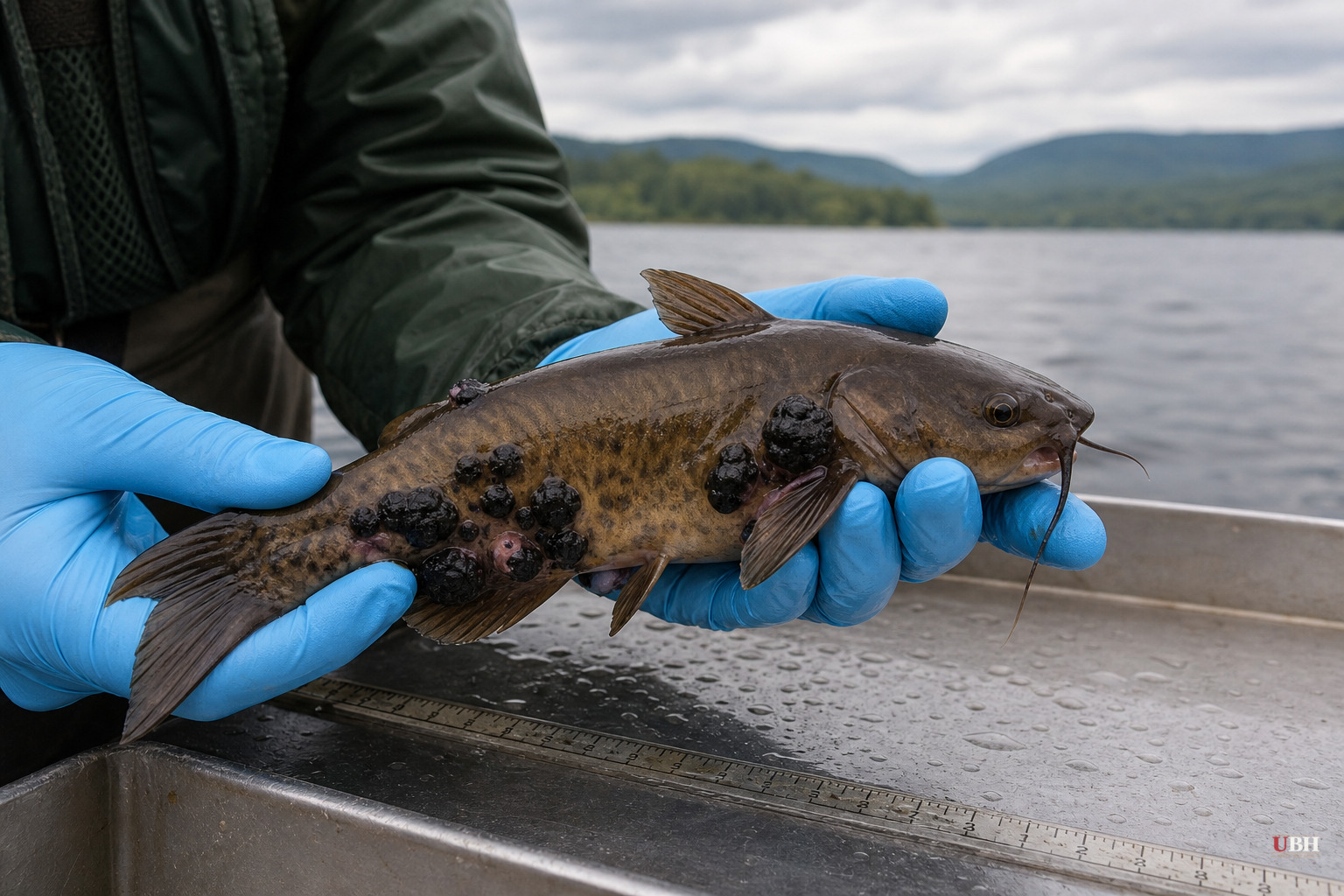
Anglers on Lake Memphremagog started noticing something wrong with the catfish back in 2012. Black tar-like blotches on the skin, sometimes on the fins, sometimes covering the eyes. Not pretty, according to Peter Emerson, a fish biologist with the Vermont Fish & Wildlife Department who's worked the lake's annual fish census since 2009.
By 2014, close to one in three brown bullhead catfish in the lake had the marks, according to research published Wednesday, July 22, in the journal Nature. The study, led by University of Vermont scientists, confirms these lesions are melanoma, a form of skin cancer, and that the cancer itself is contagious, spreading from fish to fish like an infectious agent rather than developing independently in each animal.
How they figured it out
The obvious suspects were pollution or a virus. Lake Memphremagog straddles the Vermont-Quebec border, and the lesions showed up the year after post-tropical storm Irene caused major flooding in the region, according to CBC News. Locals worried carcinogens had washed into the lake.
Julie Dragon, an associate professor of microbiology and molecular genetics at the University of Vermont's Larner College of Medicine and a co-leader of the study, said her team's first hypothesis was a virus. "We actually looked for viruses, and that was the first hypothesis," Dragon told CTV News Channel. "We did genomic sequencing and could not find the virus that associated with the diseased fish."
So they sequenced the genomes of the tumors themselves, alongside the fish they came from. What they found didn't fit a normal cancer at all. "All the tumours were very similar to each other," Dragon said. "They share hundreds of thousands of mutations and were different from the fish that they came from. It was very unexpected."
In an ordinary cancer, a tumor's mutations are unique to the individual whose cells turned malignant. Here, the tumors resembled each other far more than they resembled their own hosts. That's the genetic fingerprint of a clonally transmissible cancer, according to the study, meaning the cancer cells themselves are the infectious agent, jumping from one fish to the next.
Dragon put it plainly in a statement carried by the University of Vermont: "It is the infectious agent itself. Those cells can somehow escape the host, maybe live in the environment, the aquatic environment, and then infect a new host."
Only the fourth known case, ever
Before this, science had documented exactly three transmissible cancers in the wild: the facial tumor disease wiping out Tasmanian devils, a venereal tumor that spreads between dogs, and leukemia-like cancers found in clams and other bivalve mollusks, according to CP24 and the University of Vermont.
"These conditions are incredibly rare in nature," Dragon said. "So something has to be happening to allow this to happen."
Nobody knows exactly what that something is yet. Researchers suspect naturally occurring arsenic in the region's soil could be a contributing factor. A study published in May found elevated concentrations of seven metals, including zinc and arsenic, in the skin of fish with tumors, according to CBC. But testing for carcinogens more broadly hasn't produced conclusive answers.
Mark Henderson, a University of Vermont fish biologist and study co-leader, floated another theory tied to fish behavior rather than chemistry. "It seems to only happen in larger fish that are of spawning age," Henderson said in a news release. "Maybe some part of spawning behaviour leads to the spreading of the cancer between animals." Catfish clustering in shallow water to spawn could be exactly the kind of close contact that lets tumor cells jump hosts.
What happens to the fish, and what's still unknown
The disease's severity varies a lot. In some fish the cancer spreads internally to organs like the brain or liver. In others, fish carrying visible lesions appear otherwise healthy, and some older fish have lived with the marks for years, according to CBC News.
The research team hasn't yet resolved how much this is actually hurting the Lake Memphremagog catfish population versus how much it's a chronic condition many fish simply live with.
The phenomenon offers a rare natural window into how cancer cells manage to leave one body, survive outside it, and colonize a new host, a process researchers still don't fully understand in human cancer. "We still don't really understand this event where a cell leaves the tumor, moves through the bloodstream, gets into a new organ," Dragon told NPR. In the catfish, she said, "it might have some of the same processes going on that allow these cells to invade a new host, avoid the immune system and then establish themselves."
The research team, based at the University of Vermont's Larner College of Medicine, says it's continuing to investigate where the cancer originated and how far geographically it may have already spread beyond Lake Memphremagog into other Vermont and Quebec waters. That work hasn't produced published results yet, and there's no indication so far of any risk to humans who catch or handle affected fish.
Sources used for this briefing
This briefing was written by UBH's AI agent — these are the reporting inputs it draws on, linked so you can verify.


