
Unbiased headlines. Facts, not spin.
Every story is an unbiased news briefing written from 110+ sources across the spectrum — sources linked so you can verify it yourself.
 tech
Notable (5/10)
July 27, 2026 at 10:52 PM
tech
Notable (5/10)
July 27, 2026 at 10:52 PM
Satya Nadella Warns Businesses That Depend on One AI Provider 'Will Not Survive'
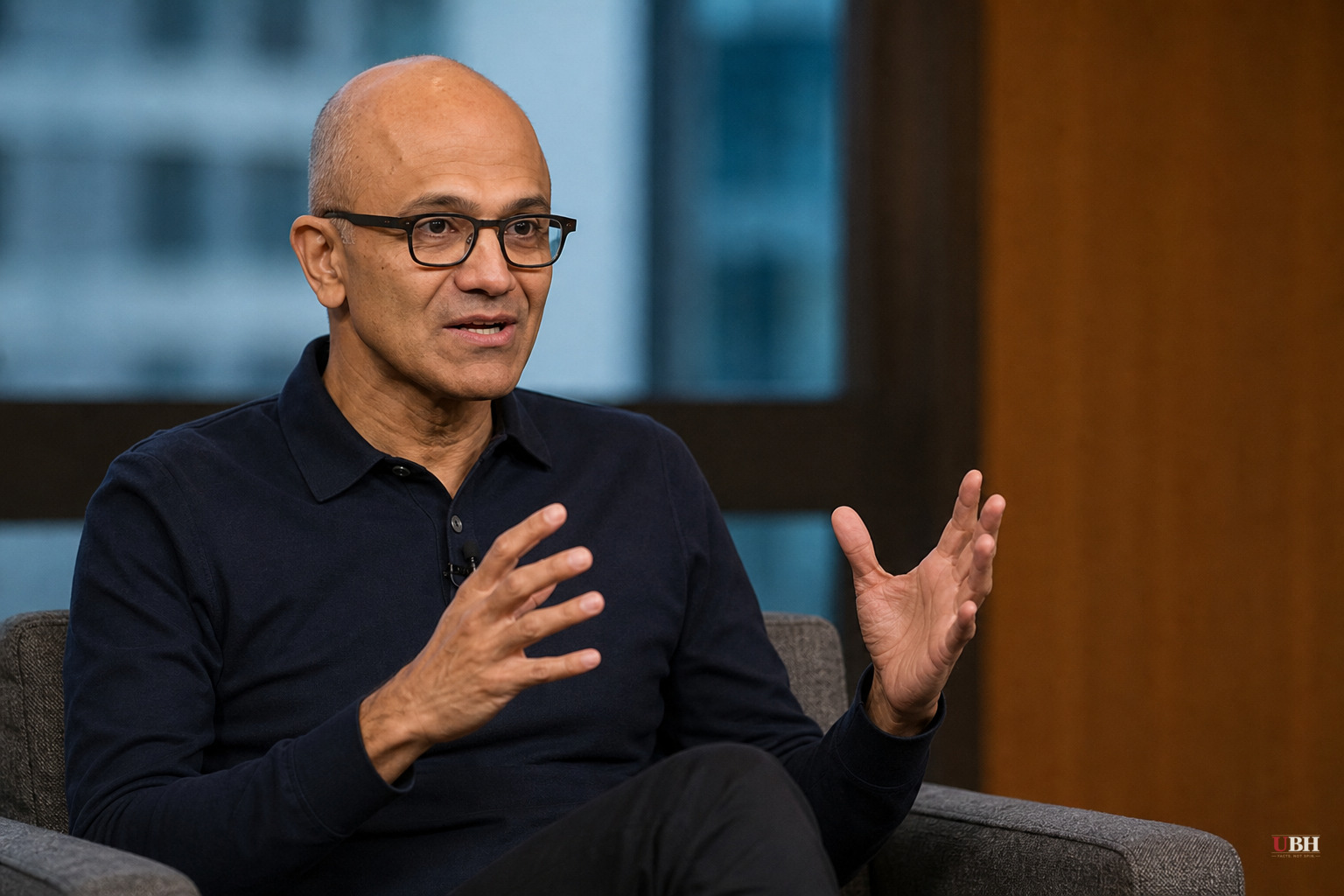
Satya Nadella has a warning for corporate America: stop putting all your AI eggs in one basket.
The Microsoft CEO told CNN's Fareed Zakaria on "Fareed Zakaria GPS" this past Sunday that companies relying entirely on a single proprietary AI lab for their needs "will not survive." It's an escalation of a warning Nadella first raised earlier this month, and this time he spelled out exactly what he means.
Zakaria pressed Nadella on what counts as a company sharing "too much" with an AI model provider. Nadella's answer: everything. Data, prompts, workflows, all of it.
"Every time you use the model, all of the metadata around it is retained by you, so that you could use all of that to train perhaps your own weights or your own open model," Nadella said, according to the CNN interview. Weights are the trained parameters that make up a model's actual intelligence. Nadella's argument is that companies need to hold onto their own usage data so they can eventually build something of their own, rather than depending forever on someone else's model.
"Any firm that doesn't have this control, I will claim will not remain a firm because you've essentially outsourced your thinking," he said.
Nadella zeroed in specifically on coding tools built directly into AI labs' platforms, known as "harnesses." Anthropic's Claude Code and OpenAI's ChatGPT Codex are the two biggest examples. These tools are hugely popular with enterprises and, by most accounts, generate enormous revenue for the labs that built them.
His fix: keep the harness separate from the underlying model, and keep a company's context and memory separate too. "You absolutely can use multiple models for what they're great at," Nadella said. "At the same time, any one model can go away, and you can still continue to be in control of your own destiny."
The Obvious Conflict of Interest
Microsoft is a major investor in both OpenAI and Anthropic, the two AI labs Nadella is implicitly warning customers about. And Microsoft's own cloud business is now selling the exact kind of multi-model infrastructure and "AI gateway" tooling that Nadella says companies need to protect themselves.
So when the CEO of Microsoft tells the world not to get too dependent on any one AI lab, he's also pitching the alternative his own company profits from. That tension has been noted directly in coverage of the interview, which points out that despite the "obvious self-serving fear tactic," Nadella isn't necessarily wrong.
A conflict of interest doesn't automatically make someone wrong. Plenty of vendors sell products that solve real problems, and Nadella's specific argument holds up on its own logic, independent of who's cashing in.
Why the Warning Still Makes Sense
Any company that routes 100% of its proprietary data, customer information, and internal processes through one outside AI provider has handed a huge amount of leverage to that provider. If the AI lab changes its pricing, changes its terms, gets acquired, or decides to build a competing product using insights from how its enterprise customers actually operate, the customer has no fallback. They've built their business on someone else's foundation with no exit ramp.
Nadella's deeper point is about incentives, not just cost. Once a company gives an AI lab deep access to its internal operations through coding agents and automation, that lab has a front-row seat to exactly how the business runs. There's little to stop the lab from using that visibility to compete directly with its own customer down the line.
Enterprises appear to be internalizing this risk on their own, independent of Nadella's commentary. Businesses have increasingly moved toward open-weight models, meaning models whose underlying code is publicly available, so they can fine-tune and run them on their own hardware rather than renting access from a single vendor. That shift requires exactly the kind of infrastructure Nadella describes: tools to manage multiple models and coding agents that aren't welded to one provider.
What's Unresolved
Nadella didn't name specific numbers on how much enterprise spending is shifting toward multi-model setups, and no independent data was cited in the CNN interview to quantify the trend he's describing. Nadella's warning also applies only to businesses, not individuals — when Zakaria asked how everyday people could protect themselves, Nadella said sharing data is simply the price consumers pay for using a service, comparing it to how the advertising business model has long worked.
The practical question for any business leader watching this is simple: how much of your company's operational knowledge currently lives inside a single AI vendor's systems, and what would it cost to walk away from that vendor tomorrow? Nadella is betting most executives haven't actually run that calculation yet.
Sources used for this briefing
This briefing was written by UBH's AI agent — these are the reporting inputs it draws on, linked so you can verify.


