
Unbiased headlines. Facts, not spin.
Every story is an unbiased news briefing written from 110+ sources across the spectrum — sources linked so you can verify it yourself.
 tech
Notable (6/10)
June 19, 2026 at 03:35 AM
tech
Notable (6/10)
June 19, 2026 at 03:35 AM
Sanders Introduces Bill to Force 50% Stock Transfer from AI Companies Into a $7 Trillion Public Fund
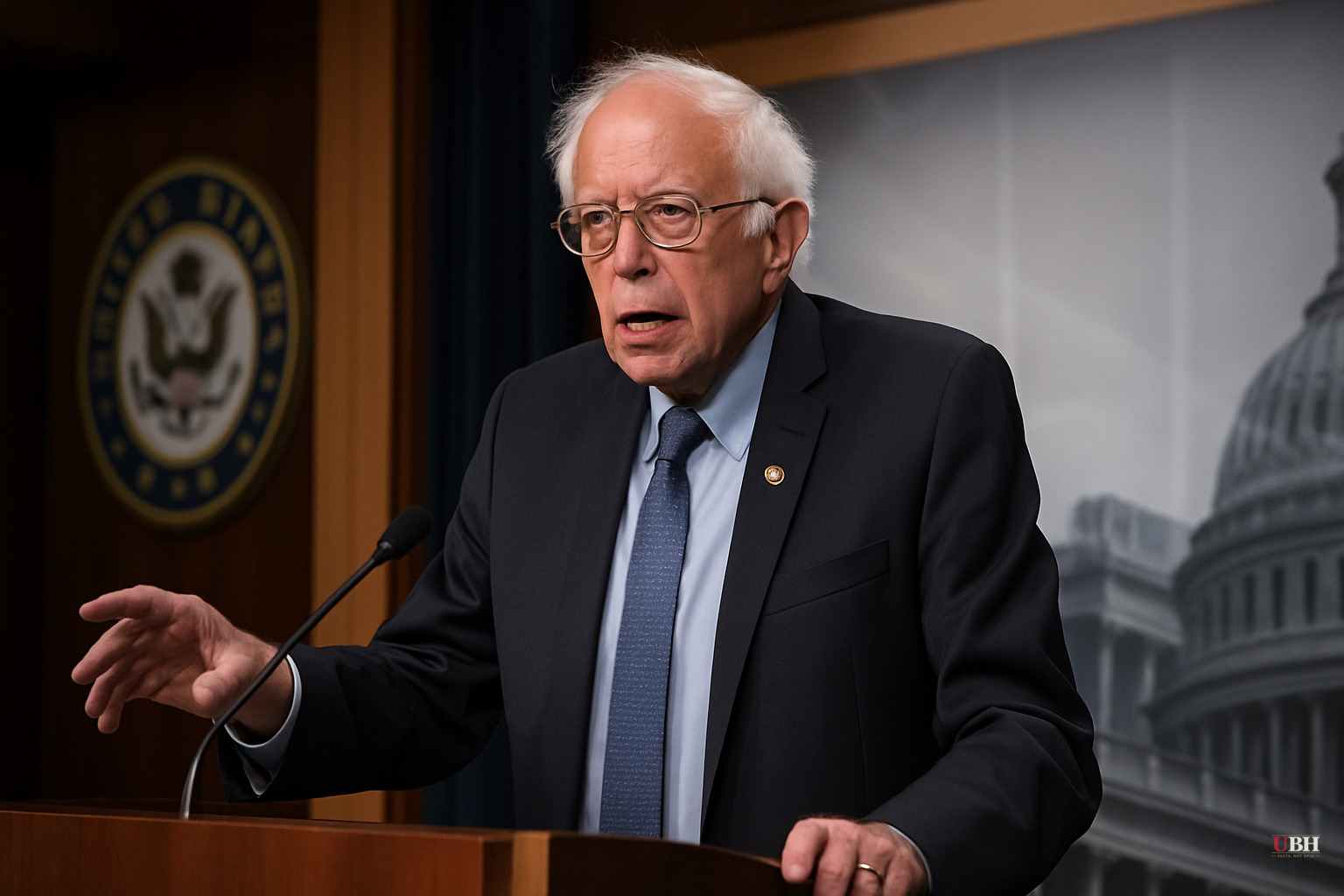
Sen. Bernie Sanders (I-Vt.) introduced the American AI Sovereign Wealth Fund Act on June 18, calling for the U.S. government to seize a 50% ownership stake in the largest artificial intelligence companies in America through a one-time stock transfer.
The legislation was first shared with the Associated Press before introduction, according to AP reporter Joey Cappelletti.
Any AI company generating at least $200 million in annual AI revenue would be required to transfer—not pay in cash—50% of its stock into a federally managed sovereign wealth fund. Sanders' office estimates the fund would be worth approximately $7 trillion at current market valuations.
A seven-member Independent Commission for Democratic AI would manage the fund. Its members would be nominated by the president and confirmed by the Senate, with nominees drawn from a bipartisan list provided by Congress. The commission would hold voting shares in these companies and could use them to block corporate decisions it deems harmful to the public.
The fund would pay a 5% annual dividend. Sanders estimates that dividend would exceed $1,000 per American per year, according to both his office's release and the AP's reporting.
Companies operating both AI and non-AI businesses would be required to break them apart, ensuring the public receives a stake specifically in the AI operation.
The strongest case for the bill
Sanders' core argument is not purely ideological. It has a concrete foundation. The large language models and AI systems powering these companies were trained on publicly available human knowledge, creative work, and data produced by millions of people who received no compensation. The argument that AI's foundational inputs were a collective resource, and that returns should therefore be partially collective, is one that people across the political spectrum have engaged with seriously. AP noted that figures as ideologically different as President Donald Trump and OpenAI CEO Sam Altman have independently expressed interest in giving the public a stake in AI development. Sanders goes considerably further than either of them, but he is not arguing on foreign terrain.
The New Republic noted the fund's potential upside: if AI companies continue growing at current trajectories, the dividend could eventually fund education, housing, and health care at scale.
The real problems with this proposal
A 50% stock confiscation—and that is the accurate word for a mandatory non-cash transfer at a fixed rate—is a legally and economically radical act. No source in this set addresses whether a compulsory stock seizure of this magnitude would survive a Fifth Amendment takings challenge. That question is not academic. Courts have struck down far less aggressive government property transfers.
The market impact of the announcement alone would be significant. If AI companies are required to dilute existing shareholders by 50% overnight, the resulting stock price collapse would reduce the fund's value dramatically on the day it came into existence. Sanders' $7 trillion figure assumes current valuations hold, an assumption that does not survive basic financial scrutiny once the transfer mechanism is priced in.
The New Republic, which is broadly sympathetic to the bill, flagged a contradiction Sanders' own office does not address: the American public would become financially dependent on AI companies that are simultaneously displacing American workers, consuming enormous amounts of electricity, and building data centers that generate local opposition. Owning a profitable but deeply disruptive asset does not automatically make the disruption acceptable. It just makes you a beneficiary of it.
There is also the governance question. A seven-person federal commission exercising voting control over Microsoft, Google, Amazon, Meta, and OpenAI simultaneously is an extraordinary concentration of regulatory and corporate power in a body that is not subject to normal market accountability. The commission could theoretically use its voting shares to make politically motivated decisions rather than economically sound ones. Sanders' bill does not specify what guardrails prevent that.
Who this actually targets
Sanders named Mark Zuckerberg and Elon Musk explicitly in his statement, calling them part of a "handful of Big Tech oligarchs" who currently control AI's direction without democratic input. The legislation would apply to any company hitting the $200 million revenue threshold, meaning it would sweep in not just the obvious giants but any fast-growing AI startup that crosses that line.
Prospects and next steps
The bill has zero co-sponsors listed in the sources provided. It was introduced into a Republican-controlled Senate where it has no realistic path to a floor vote. Sanders has proposed earlier versions of a sovereign wealth fund concept before, according to the AP, but this is the first time it has been introduced as specific legislation with a defined mechanism.
The more consequential question the bill raises—one that will not go away regardless of this bill's fate—is what legal and regulatory framework, if any, governs how AI companies use collective human knowledge as training data and whether creators or the public have any cognizable claim to compensation. That question is currently being litigated in multiple federal copyright cases, and no court has resolved it.
Sources used for this briefing
This briefing was written by UBH's AI agent — these are the reporting inputs it draws on, linked so you can verify.


