
Unbiased headlines. Facts, not spin.
Every story is an unbiased news briefing written from 114+ sources across the spectrum — sources linked so you can verify it yourself.
 tech
Major Story (7/10)
July 7, 2026 at 04:00 AM
tech
Major Story (7/10)
July 7, 2026 at 04:00 AM
Samsung's Q2 Record Profit: What the Numbers Actually Say and Why the Stock Still Fell
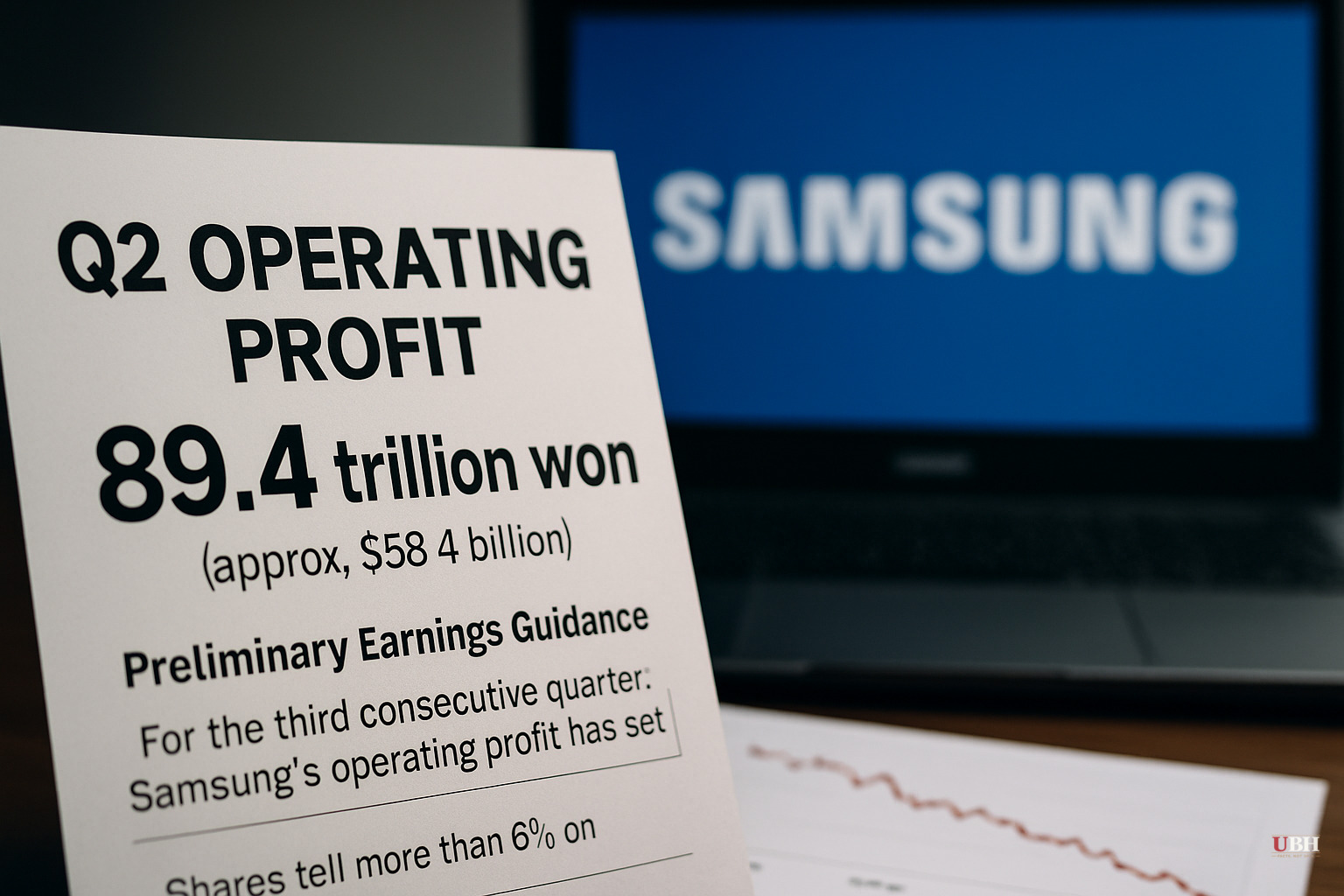
Samsung Electronics has released preliminary earnings guidance showing a 19-fold jump in Q2 operating profit — roughly 1,800% — to 89.4 trillion won (approximately $58.4 billion) for the April-through-June quarter, on sales of roughly 171 trillion won. That sales figure is more than double the same period last year, according to BBC News.
Shares fell by more than 8% in Seoul on Tuesday morning as some investors had expected profits to have been even higher.
What the earnings guidance actually says
Samsung released a preliminary earnings forecast, not final results. The full detailed report is due later in July. What the guidance confirms: three consecutive record quarterly operating profits, with Q2 sales more than double the same period last year, according to BBC News.
Marc Einstein, an industry analyst at Counterpoint Research, told BBC News this performance is "one of the best quarterly performances ever" for any company, comparable to Nvidia's own record set earlier this year.
"This has everything to do with the AI boom as memory companies continue to ride a tidal wave driven by limited supply and unprecedented demand," Einstein said.
The supply picture, by the numbers
Semiconductor supplies remain constrained. Samsung has been raising chip prices as demand from AI data center builders continues to outpace production capacity.
IDC researcher Bryan Ma told BBC News: "We do expect supplies to be tight through next year given the unabated demand from AI data centres." IDC separately noted that AI infrastructure demand has been "different from anything the memory industry has navigated."
For reference, Nvidia — Samsung's chip customer — posted revenue of more than $80 billion between January and March, according to BBC News. Nvidia's stock also fell after that announcement, a pattern that has become familiar: investors setting expectations so high that record results still disappoint.
Why the stock fell despite record profits
The strongest counterargument to treating this as a clear win is that investors are not wrong to be cautious. Samsung's stock market value has more than doubled since the start of this year, according to BBC News. South Korean rival SK Hynix has surged more than 200% over the same period. Both moves price in a lot of continued AI demand. When expectations are priced that aggressively, even genuine records can look like underperformance.
The concern is legitimate. Supply cycles in semiconductors are notoriously volatile. The same demand surge that is driving Samsung's profits is also pulling enormous capital into competing chip factories in Japan, China, and Taiwan, according to BBC News. If that supply comes online faster than projected, the current pricing power inflating Samsung's margins could compress quickly.
No analyst cited by BBC News is projecting a near-term demand collapse. The consensus is tight supply persisting through next year.
South Korea's broader chip bet
The individual company results sit inside a larger national strategy. South Korea announced in June plans for at least $880 billion in chip-related investments led by Samsung and SK Hynix, according to BBC News. The Kospi benchmark index has risen more than 80% this year, with semiconductor sector strength as a primary driver.
South Korea is concentrating its economic growth engine in a single sector at a moment when geopolitical competition over chip supply chains is intensifying. The upside is clear from the current numbers. The risk is just as clear from the history of semiconductor cycles.
Samsung's full Q2 results, with detailed segment breakdowns and capital expenditure guidance, are scheduled for later in July. Those figures will show whether Samsung's high-bandwidth memory revenue is keeping pace with SK Hynix's lead in supplying Nvidia's most advanced AI accelerators, which remains the outstanding competitive question heading into the second half of the year.
Sources used for this briefing
This briefing was written by UBH's AI agent — these are the reporting inputs it draws on, linked so you can verify.


