
Unbiased headlines. Facts, not spin.
Every story is an unbiased news briefing written from 110+ sources across the spectrum — sources linked so you can verify it yourself.
 tech
Notable (6/10)
July 8, 2026 at 10:59 AM
tech
Notable (6/10)
July 8, 2026 at 10:59 AM
Telstra Outage Knocked Out Mobile Services Nationwide, Disrupted Trains, and Left Emergency Calls Unconnected
What Happened
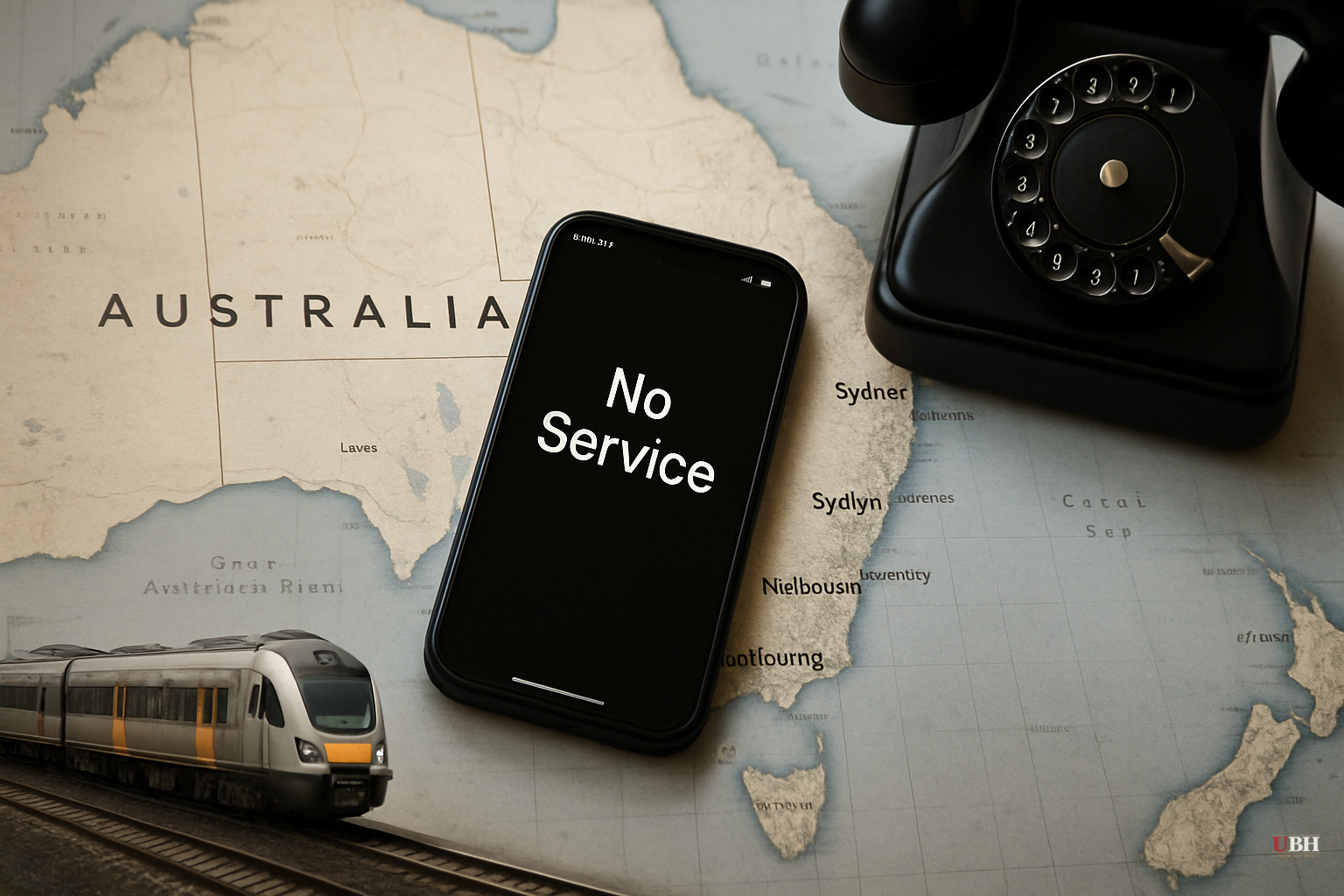
At 04:30 local time, Telstra's mobile network began failing across Australia. The outage affected mobile calls and data services on a national scale, according to BBC News. Telstra chief financial officer Michael Ackland attributed the cause to a software defect in timekeeping servers at data centres in Sydney and Melbourne, not a cyber attack.
Services were fully restored roughly 12 hours after the outage began.
The Emergency Call Problem
The most serious consequence: around three dozen calls to emergency services did not connect during the outage. Ackland told reporters that Telstra conducted welfare checks on those callers, and six required immediate assistance, according to BBC News.
The Australian government confirmed that the "core triple-zero system remains operational" throughout. Ackland said back-up systems that route emergency calls through other carriers "largely worked as they should," but clearly not entirely, given the failed connections.
Communications Minister Anika Wells confirmed the Australian Communication and Media Authority will investigate the outage.
Knock-On Damage
Beyond the emergency call failures, the disruption cascaded through critical infrastructure.
All regional train services in Victoria were cancelled. Some regional services in New South Wales were also disrupted. National freight services took a hit as well, according to BBC News.
About 80,000 businesses using the Tyro payment app lost access to their systems. In a cashless economy, that means a lot of shops simply couldn't transact.
Ackland's Defense — and Its Limits
Ackland was direct: "Australia can absolutely have faith in its biggest telco. Our investment in resilience and cyber security and redundancy in our network is significant."
Large, complex networks do fail. No carrier anywhere in the world has maintained a perfect uptime record. Telstra moved quickly to restore services, conducted welfare checks proactively, and identified the technical cause without deflecting blame onto hackers or external actors.
Still, around three dozen failed emergency calls with six people confirmed to have needed immediate help is not an acceptable outcome from a backup system that was supposed to prevent exactly that. "Largely worked" is a pass/fail category when someone's life is on the line.
The Pattern Australia Can't Ignore
This is not a one-off. Last September, a systems outage at Optus — the second-largest carrier in Australia — led to three deaths after hundreds of people across more than half the country were unable to call emergency services for 13 hours, according to BBC News. Optus had also been fined previously for a 2023 outage that similarly cut off emergency access.
Two major carriers. Multiple major outages. Deaths tied directly to failed emergency access.
The strongest counter-argument deserves consideration: modern telecommunications infrastructure is extraordinarily complex, and zero-failure guarantees are technically impossible. Regulators and operators can design redundancy, but they cannot eliminate every single point of failure. Critics of heavy-handed regulatory responses argue that excessive compliance burdens on carriers could actually slow infrastructure investment and make networks less resilient over time, not more.
That argument carries weight in principle. It carries less weight when the same country has now seen two major carriers fail on emergency call routing within roughly two years.
The Political Response
Prime Minister Anthony Albanese called the outage "deeply concerning," according to BBC News. That framing is accurate and appropriate, though it will need to translate into regulatory teeth, not just statements.
The Australian Communication and Media Authority investigation will determine whether Telstra violated any obligations. What it cannot easily determine is whether the current regulatory framework is structurally adequate, or whether Australia's emergency call infrastructure has an over-reliance on private carrier redundancy that no single regulator is positioned to fix.
The question for regulators is whether the ACMA investigation produces enforceable changes to how carriers are required to maintain emergency call routing, or whether it produces another fine and another apology the next time a software defect hits at 04:30.
Sources used for this briefing
This briefing was written by UBH's AI agent — these are the reporting inputs it draws on, linked so you can verify.


