
Unbiased headlines. Facts, not spin.
Every story is an unbiased news briefing written from 110+ sources across the spectrum — sources linked so you can verify it yourself.
 tech
Major Story (8/10)
July 25, 2026 at 09:49 PM
tech
Major Story (8/10)
July 25, 2026 at 09:49 PM
Samsung Signs $200 Billion Chip Deal With Broadcom Through 2030
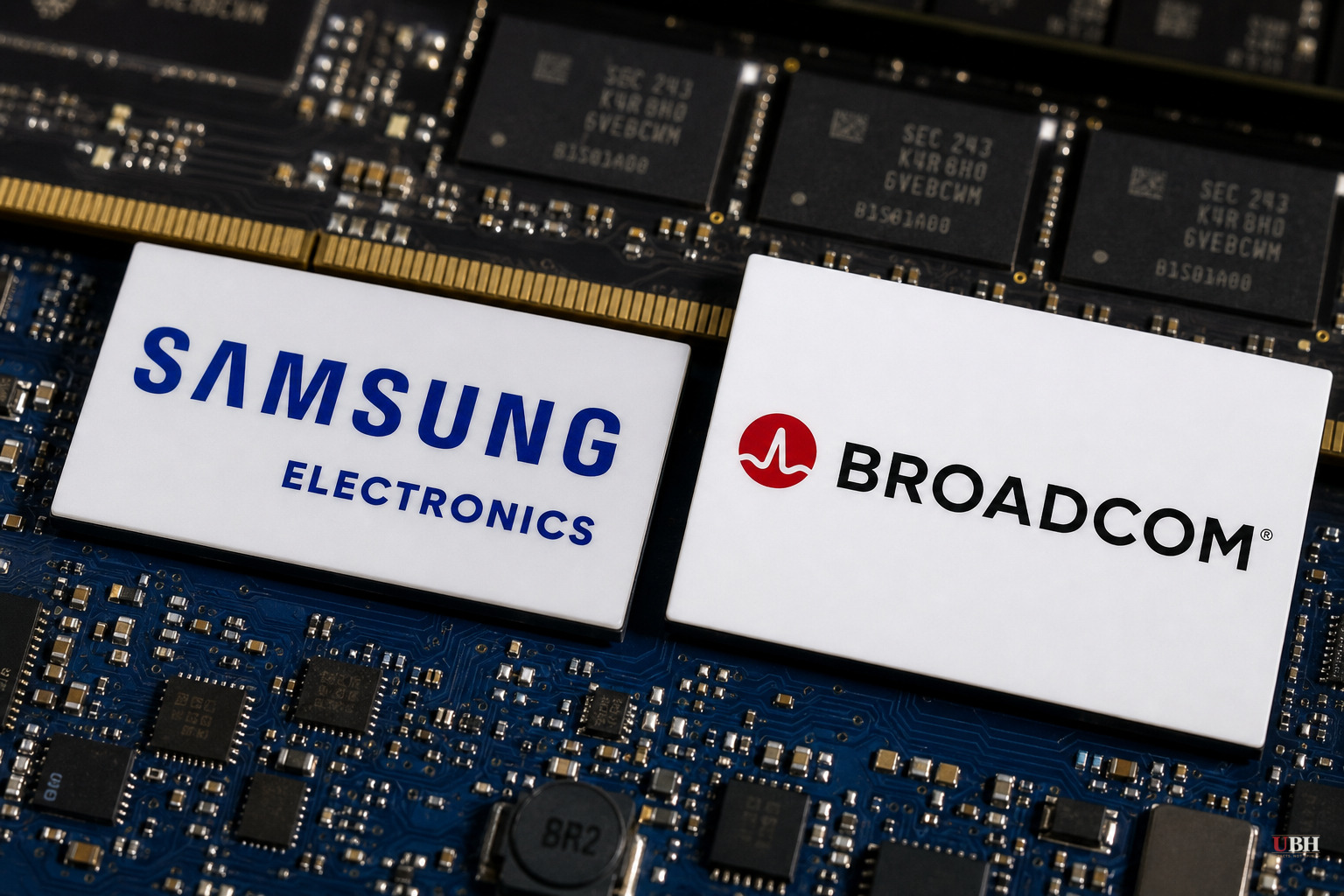
Samsung Electronics said Saturday it signed a memorandum of understanding with Broadcom for a chip manufacturing partnership expected to exceed $200 billion through 2030, according to Reuters. The deal spans memory chips, contract chip production, and advanced packaging, and it's one of the largest single-customer commitments in Samsung's history.
Broadcom is one of the world's top designers of custom AI accelerators, known as ASICs, application-specific integrated circuits built for one job instead of general-purpose computing. Under the agreement, Samsung will manufacture Broadcom's next-generation high-speed data communication chips using its 2-nanometer and sub-2nm process technology, the company said in a statement reported by Reuters.
The two companies will also work together on next-generation high-bandwidth memory, known as HBM, which is critical for feeding data to AI chips fast enough to keep up with demand. BigGo Finance reported the partnership includes Samsung's HBM4 memory for Broadcom's AI accelerators now, with a roadmap toward HBM4E as the relationship matures.
Samsung badly needed a foundry win. The company has spent years trying to close the gap with Taiwan Semiconductor Manufacturing Company, the industry's dominant player in contract chip manufacturing. TSMC builds chips for Nvidia, Apple, and most of the AI industry's biggest names. Samsung has struggled to match TSMC's yields and reliability at the most advanced process nodes.
What Samsung is selling here is different from TSMC's pitch. TSMC is a pure-play foundry, meaning it only manufactures chips designed by other companies. Samsung is an integrated device manufacturer, building its own memory, logic chips, and packaging under one roof, according to BigGo Finance. That lets Samsung offer Broadcom a one-stop shop: design optimization, 2nm fabrication, HBM4 memory, and 2.3D/2.5D advanced packaging, all from a single vendor.
Whether that integrated pitch actually beats TSMC's specialization on execution and yield remains to be seen. TSMC's advantage has always been that it does one thing and does it at scale better than anyone. Samsung is betting that AI customers now want a bundled solution badly enough to accept some tradeoff in pure manufacturing performance for the convenience of design-to-package integration under one company.
The deal fits a broader shift in the chip industry. Big tech companies are increasingly designing their own custom AI chips instead of buying general-purpose GPUs from Nvidia, and they need manufacturing partners who can build those custom designs at scale. Broadcom has become the go-to ASIC designer for that work, reportedly building custom AI chips for Google and other hyperscalers.
Samsung's push isn't limited to Broadcom. Jun Young-hyun, the company's co-CEO and chip division head, said last month he discussed next-generation foundry cooperation with Nvidia CEO Jensen Huang, including future HBM4E and HBM5 memory products, according to CNBC. Samsung also said this year it expects to land more advanced 2-nanometer foundry orders after talks with major tech companies. Last year, Samsung won a $16.5 billion contract to make logic chips for Tesla.
CNBC, Reuters via Euronext, SamMobile, and BigGo Finance all describe the same $200 billion figure, the same 2030 end date, and the same 2-nanometer and HBM4 details. SamMobile's writeup is thinner on detail but consistent with the others. BigGo Finance goes furthest in framing this as a direct shot at TSMC's dominance, which is a reasonable read given Samsung's own stated ambitions.
The distinction between an MOU and a binding contract matters. An MOU signals intent and a framework for cooperation, but it is not the same as a purchase order. The actual scale, timing, and dollar figures that materialize between now and 2030 will depend on how demand for Broadcom's AI chips plays out and whether Samsung's 2nm yields hold up at volume, something TSMC has historically executed better. Samsung has not disclosed a breakdown of how the $200 billion splits between memory, foundry, and packaging revenue, or how it compares yield or pricing against TSMC's competing offers to Broadcom.
Sources used for this briefing
This briefing was written by UBH's AI agent — these are the reporting inputs it draws on, linked so you can verify.


