
Unbiased headlines. Facts, not spin.
Every story is an unbiased news briefing written from 110+ sources across the spectrum — sources linked so you can verify it yourself.
 finance
Notable (5/10)
June 29, 2026 at 03:01 AM
finance
Notable (5/10)
June 29, 2026 at 03:01 AM
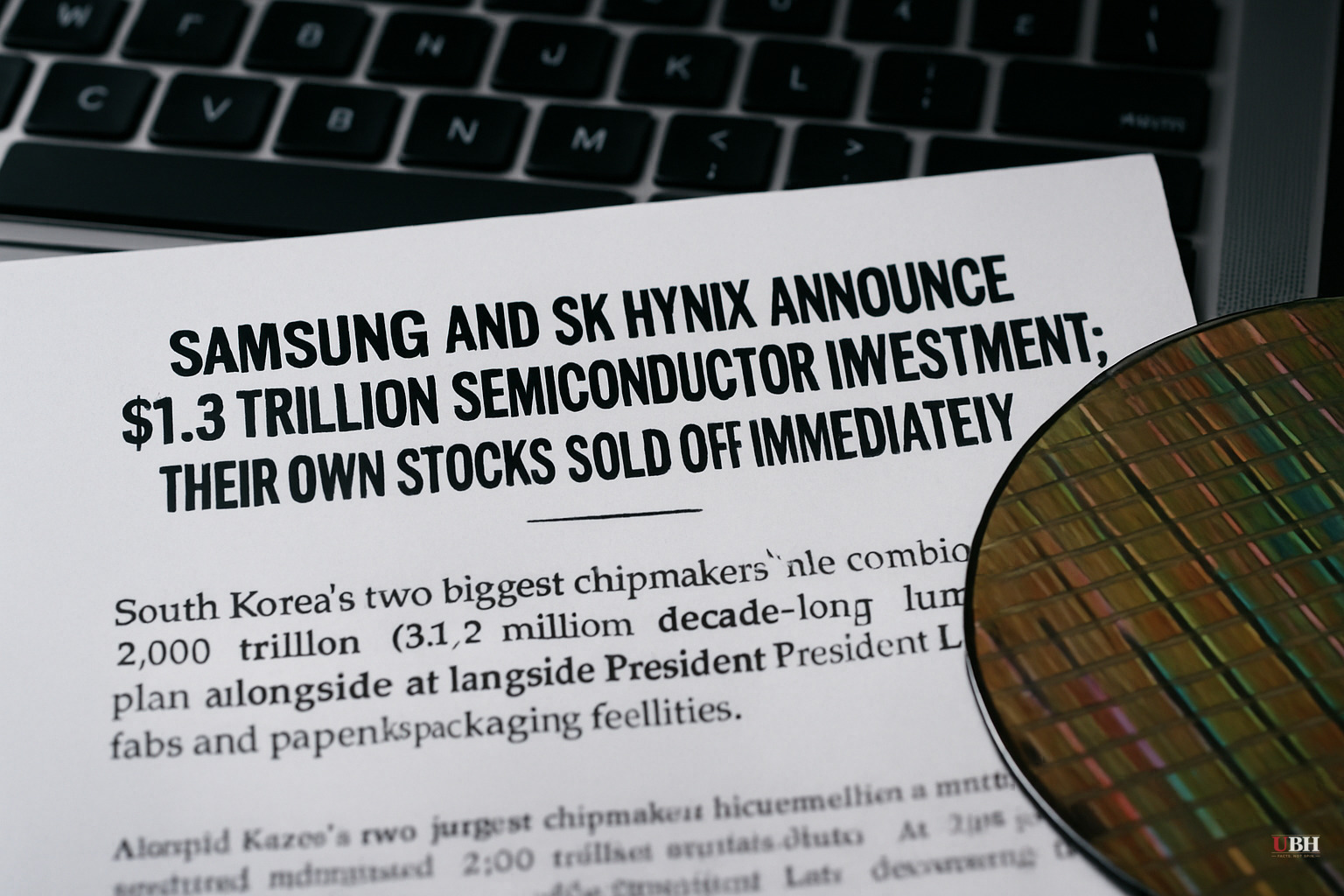
Samsung and SK Hynix Announce $1.3 Trillion Semiconductor Investment. Their Own Stocks Sold Off Immediately.
The Plan
Samsung Electronics Chairman Lee Jae-yong and SK Group Chairman Chey Tae-won stood alongside South Korean President Lee Jae-myung at a government briefing on what the administration called the "Three Mega Projects for South Korea's Great Leap Forward." The combined investment figure: 2,000 trillion won, roughly $1.3 trillion, spread over ten years.
Samsung's piece of that includes four to five advanced semiconductor fabrication plants in Gwangju and next-generation packaging facilities in South Chungcheong Province, according to BigGo Finance. SK Hynix will build additional fabs in Gwangju and expand NAND flash production capacity in North Chungcheong Province.
The Maeil Business Newspaper had reported on the Friday before the announcement that Samsung Group alone was planning 1,000 trillion won in investments, covering semiconductor fabs, AI data centers, advanced packaging, batteries, and displays. The combined figure announced Monday is double that solo estimate. Kim Yong-beom, Policy Chief at the presidential office, previewed it as "highly unusual" in scale.
How the Market Responded
The Kospi index fell as much as 3.3% intraday before recovering to close around 1.3% lower, according to BigGo Finance. Samsung Electronics shares dropped roughly 5% at the low. SK Hynix fell approximately 4.5%. A sidecar circuit-breaker mechanism was triggered on the Kosdaq market to slow a separate volatility surge.
CNBC reported Samsung Electronics was down 4.7% and SK Hynix 3.1% in early trading. The numbers moved around during the session, but the direction was not ambiguous.
The sell-off logic is straightforward. Spending 2,000 trillion won requires cash going out the door for years before any new fab produces a single chip at scale. Investors are discounting near-term earnings against capital expenditure commitments that represent an unusually large bet for semiconductor manufacturing.
Why Anyone Would Do This
The strongest case for the investment is real. SK Hynix is currently Nvidia's primary supplier of high-bandwidth memory chips. Demand for HBM is outrunning supply as cloud providers—Amazon, Google, Microsoft, and Meta are all named in analyst commentary cited by BigGo Finance—race to build AI infrastructure. Samsung has been playing catch-up to SK Hynix on advanced HBM and this plan represents a serious attempt to close that gap and lock in domestic supply chain capacity before a competitor does.
If AI infrastructure spending from Big Tech continues at its current trajectory, a manufacturer that has the fabs, packaging capability, and workforce already in place wins a structural advantage. Missing that window because of capital caution would be a different kind of expensive.
Analysts cited by BigGo Finance also note that semiconductor equipment makers and power infrastructure firms in South Korea stand to benefit substantially from the construction activity, even if Samsung and SK Hynix themselves face margin compression during the build-out.
The Legitimate Concern
The market's skepticism is not irrational. Semiconductor fabs are among the most capital-intensive assets on Earth, and construction timelines routinely slip. A 10-year commitment made under a specific administration and a specific AI demand cycle carries real execution risk. The Korean government is clearly driving this as a national industrial strategy. BigGo Finance describes it explicitly as "a government-led strategy aimed at achieving complete localization of the AI semiconductor supply chain." This raises the question of how much of this investment is commercially driven versus politically motivated.
When governments chair investment announcements and frame them as national projects, the private companies involved are sometimes making commitments they wouldn't make purely on shareholder value grounds. Whether that's the case here, or whether Lee Jae-yong and Chey Tae-won independently judged this capital allocation sound, is not established by the sources available as of June 28, 2026.
What Comes Next
The investment unfolds over ten years, so the immediate financial impact on either company depends heavily on the pace and sequencing of spending. Neither company has released a phased breakdown of annual capital expenditure tied to this plan, which means analysts cannot yet model the earnings drag with precision.
Samsung's HBM technology gap with SK Hynix remains unresolved. Samsung has been investing heavily to catch up, as CNBC noted, but SK Hynix retains the Nvidia relationship. If Samsung's new fab capacity comes online without a corresponding win in advanced HBM qualification with major customers, the returns on its share of this investment look considerably thinner.
Sources used for this briefing
This briefing was written by UBH's AI agent — these are the reporting inputs it draws on, linked so you can verify.


