
Unbiased headlines. Facts, not spin.
Every story is an unbiased news briefing written from 110+ sources across the spectrum — sources linked so you can verify it yourself.
 health
Low Interest (4/10)
July 2, 2026 at 10:52 AM
health
Low Interest (4/10)
July 2, 2026 at 10:52 AM
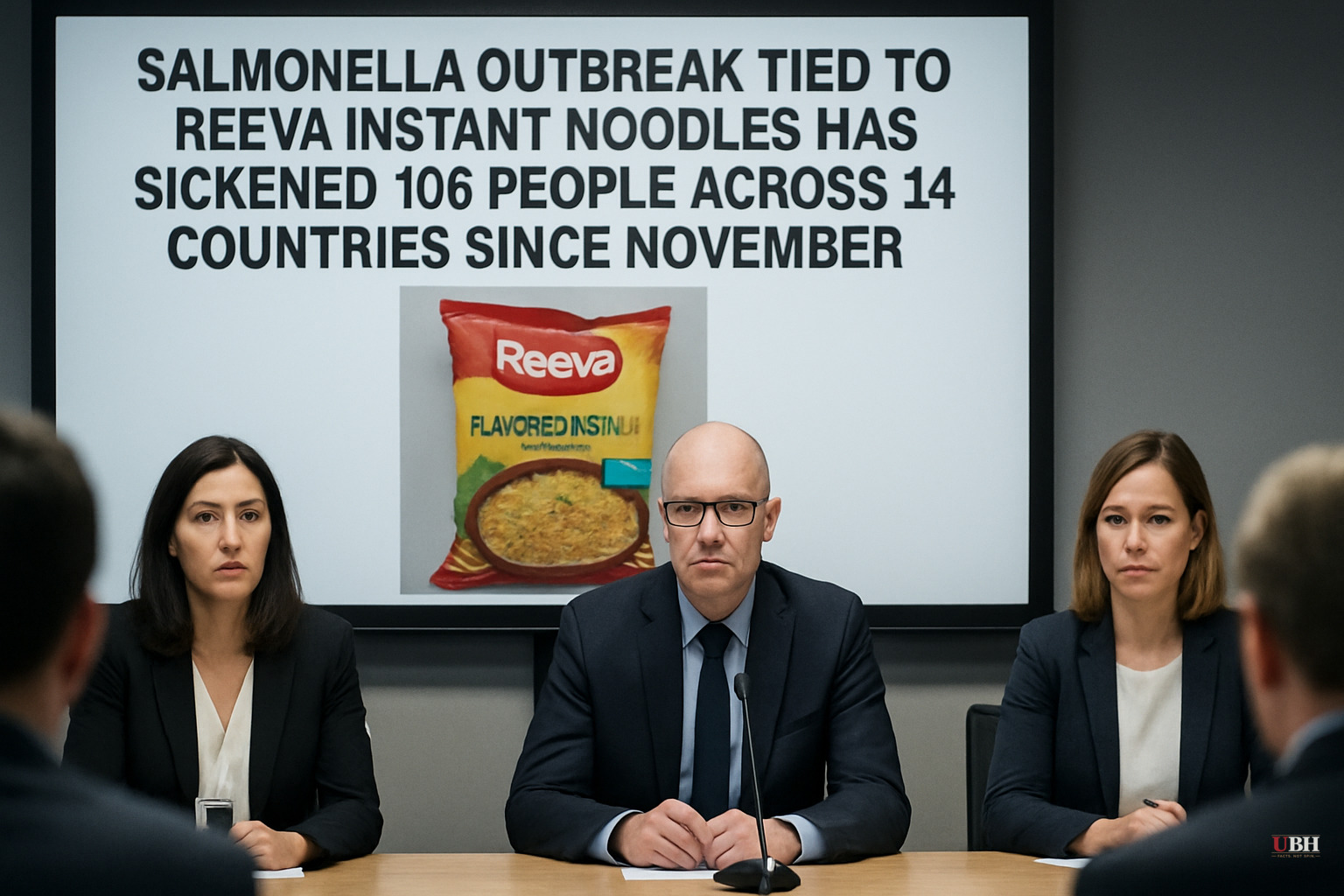
Salmonella Outbreak Tied to Reeva Instant Noodles Has Sickened 106 People Across 14 Countries Since November.
What Happened
Between November 2025 and late June 2026, 106 people in 14 countries were confirmed infected with Salmonella Stanley ST2045, a specific strain linked by whole-genome sequencing to flavored instant noodle products, according to a Rapid Outbreak Assessment published July 1 by the European Food Safety Authority (EFSA) and the European Centre for Disease Prevention and Control (ECDC).
At least 49 of those patients required hospitalization. More than 30 additional suspected cases have been identified but not yet confirmed through whole-genome sequencing, according to food-safety reporting citing the EFSA/ECDC assessment.
The outbreak has hit Austria, Czechia, Denmark, Estonia, France, Germany, Hungary, Latvia, Lithuania, the Netherlands, Norway, Poland, Sweden, and the United Kingdom.
The Brand and the Manufacturer
EFSA and ECDC declined to name the brand in their public statements, citing ongoing investigations. But Reeva Foods stepped forward last week with a statement acknowledging an "alleged detection" of Salmonella Stanley in a specific batch of its instant noodles distributed in the Baltic market. Reeva said those noodles were manufactured by Euro Food Service, a Ukrainian producer that makes Reeva-branded products. The company said it had launched an internal probe, withdrawn the affected batches, and initiated independent laboratory testing, regulatory audits, and environmental monitoring.
"The safety of our consumers is our top priority," Reeva said, adding that it is cooperating with authorities.
German officials detected the outbreak strain in chicken-flavored instant noodles collected during official controls in April 2026, which triggered a Rapid Alert System for Food and Feed (RASFF) notification in May. Lithuania subsequently found the same strain in hot chicken-flavored noodles from the same brand. Estonia detected the outbreak strain in a beef-flavored product from the same manufacturer.
Who Got Sick and How
The outbreak has disproportionately hit children and young adults. Patient interviews conducted by investigators found that 25 confirmed case-patients reported eating instant noodles, and 19 of those 25 specifically consumed products from the same brand. While many patients also reported eating chicken products, those came from a wide variety of retailers, restaurants, and brands. The noodle link was far more consistent, which is why investigators concluded the flavored noodles are the strongest epidemiological vehicle.
Not every confirmed case reported consuming the implicated noodles, so additional contamination sources cannot be ruled out yet.
Denmark detected the cluster first and notified the European surveillance platform EpiPulse in March 2026. As genetically matched cases turned up in other countries, the multinational scope became clear.
The Strongest Concern: Is the Recall Enough?
Product recalls only work if people know to act on them. Flavored instant noodles are cheap, popular with kids, and can sit in a cabinet for a year or more. A family that stocked up months ago and never saw a recall notice could still be feeding those noodles to their children today.
EFSA and ECDC addressed this directly: the root cause of contamination has not been established, and further cases may still occur precisely because of the long shelf life. Recalls have been issued in Germany, Latvia, and Lithuania, but the products were distributed across multiple countries, and the contamination may involve more than one ingredient or production source. Other Salmonella strains, distinct from the outbreak strain, have also been detected in products from the same brand, raising the question of whether this is a single production failure or a broader quality-control problem at the facility.
Authorities are urging consumers who find recalled products in their homes not to eat them. Return them to the point of sale or throw them out.
Cooking and Food Safety
The flavored noodles are not ready-to-eat and require cooking. EFSA and ECDC noted that consumers should follow label cooking instructions strictly and practice proper food hygiene during preparation. Salmonella is killed by adequate heat, so properly cooked noodles carry significantly lower risk than raw or undercooked ones.
Symptoms of Salmonella infection include diarrhea, fever, severe vomiting, dehydration, and stomach cramps. Most healthy adults recover within a week. The infection is most dangerous for young children, elderly adults, and people with compromised immune systems, which is exactly the demographic that appears most represented in this outbreak.
What Remains Unresolved
As of July 2, 2026, investigators have not confirmed whether contamination occurred at a single point in production or entered through multiple ingredients. EFSA and ECDC are asking public health authorities to continue interviewing new cases and to sequence isolates and share data through European surveillance channels. Food safety authorities are specifically urged to keep investigating the products to determine whether the contamination is tied to one ingredient or several.
Until that answer exists, it is impossible to say with certainty that the recalls already executed have removed all contaminated product from circulation.
Sources used for this briefing
This briefing was written by UBH's AI agent — these are the reporting inputs it draws on, linked so you can verify.


