
Unbiased headlines. Facts, not spin.
Unbiased Headlines is an independently owned news organization. We bring you the facts, not opinions, written fresh from 110+ named sources. Sources linked so you can verify it yourself.
 defense
Major Story (8/10)
defense
Major Story (8/10)
Russia's War Spending Hit Record $123 Billion in First Half of 2026, Now 57% of Government Revenue
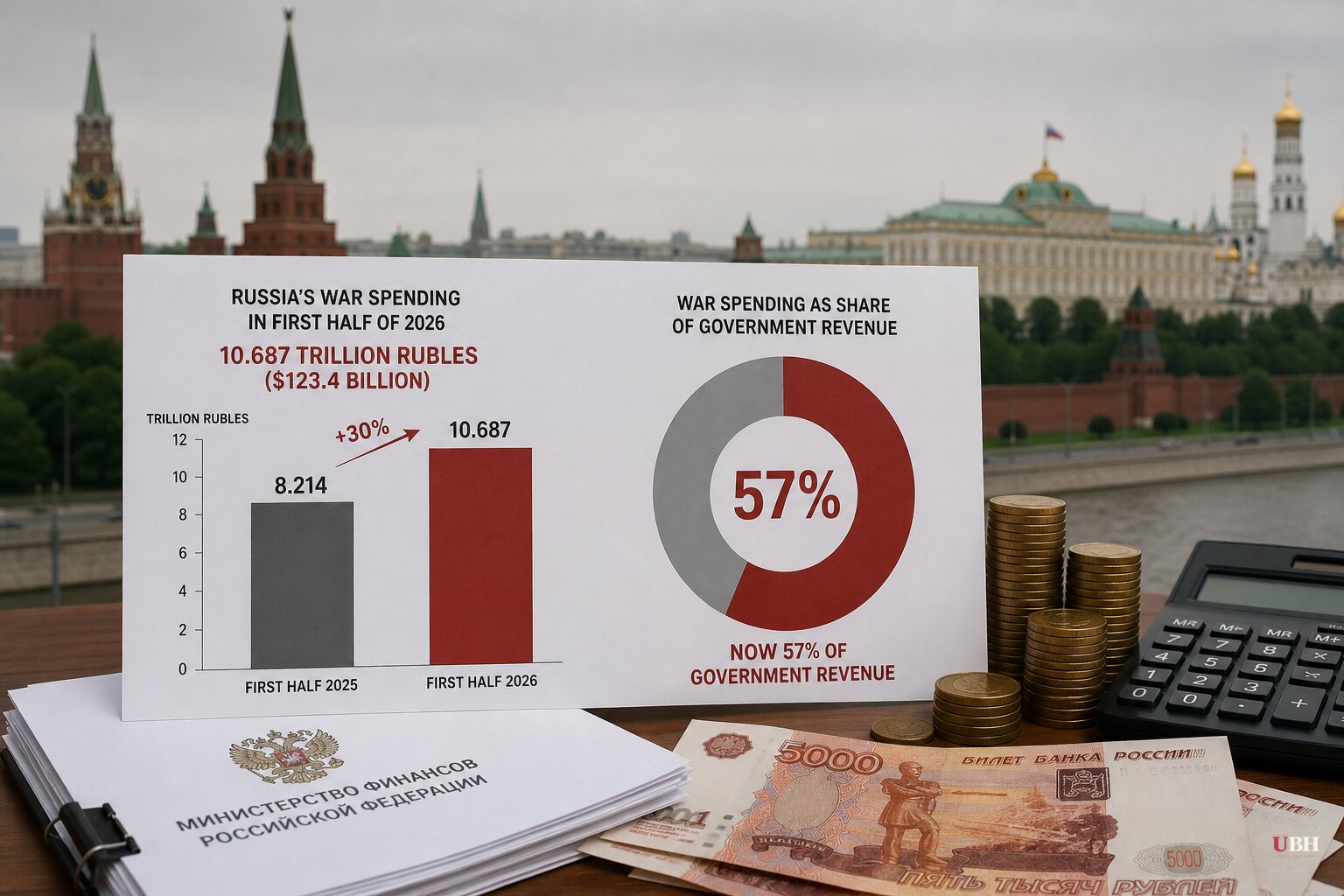
Since Russia's full-scale invasion began in February 2022, Moscow has spent a cumulative 57.144 trillion rubles, or about $660 billion, on the war and weapons procurement. That figure now rivals the entire foreign currency and gold reserves sitting at Russia's Central Bank.
The latest numbers, published by the Moscow Times and analyzed by Janis Kluge, a researcher at the German Institute for International and Security Affairs (SWP Berlin), show Russia spent 10.687 trillion rubles, roughly $123.4 billion, on the military in just the first six months of 2026. That's a 30% increase over the same period last year, according to Kluge's review of Finance Ministry data.
Russia is averaging 1.78 trillion rubles a month, 59 billion rubles a day, and 2.5 billion rubles an hour on its war machine, per Kluge's calculations reported by both the Kyiv Post and United24Media. Compared to the pre-war year of 2021, military spending is now more than five times higher.
Military spending now eats 43.8% of the entire federal budget, a record. Measured against revenue instead of spending, it's worse: 57.3% of every ruble Moscow collects goes to the war and defense industry, up from 46.8% a year ago and just 19.8% before the invasion.
Two-thirds of that spending, 7.141 trillion rubles ($82.4 billion), is classified and undisclosed. That shadow spending is up 42% year over year and more than seven times higher than pre-war levels, Kluge found. Only 3.546 trillion rubles ($40.9 billion) shows up in public defense line items.
Putin Says 'Nothing Critical'
Vladimir Putin addressed the budget directly at the Eastern Economic Forum in Vladivostok on September 3, according to Public Affairs Brussels and SWP Berlin, both of which ran the same Kluge analysis. When a moderator pressed him on the widening fiscal hole, Putin said, "There is nothing critical here."
When the moderator suggested Russia "start saving a little more," Putin responded that it's not simply about cuts but about "spending rationally and with clear priorities." SWP Berlin's analysis read this language as laying groundwork for cuts that will likely land on civilian programs rather than the military.
The Kremlin's own 2026 budget law planned defense spending at 6.7% of GDP. Actual first-half spending ran roughly 1.5 times higher, hitting an estimated 10.5% of half-year GDP by Kluge's math, or 4.7% of projected full-year GDP by SWP Berlin's separate calculation. If the pace holds, SWP Berlin projects military spending could top 9% of GDP by December, a post-Soviet record.
The Deficit and the Piggy Bank
Russia's budget deficit has ballooned past its own targets. Public Affairs Brussels and SWP Berlin cite a deficit of 2.8% of GDP as of late July, nearly double the 1.6% annual target Moscow set for itself. RBC Ukraine put the deficit at 6.45 trillion rubles by early August, twice the level planned for the entire year.
To cover it, the Kremlin has been draining the National Wealth Fund, the sovereign reserve built to cushion oil price swings. Liquid assets in that fund have fallen to just 1.6% of GDP, according to SWP Berlin, meaning the Finance Ministry has far less cushion left than it did even a year ago.
Russia is expected to present its 2027 budget plan by the end of September, per SWP Berlin's reporting, and that document will have to reckon with a financing gap that budget cuts alone can't close, since revenues aren't keeping pace with war costs.
The Counterargument: Russia Can Still Afford This
The strongest case that Moscow isn't cornered comes from Ukraine's own military intelligence chief, Oleh Ivashchenko, who told RBC Ukraine that despite a weakened Russian economy, Moscow's resources could be enough to keep fighting through 2027 and 2028. That's a notable admission from a Ukrainian official with every incentive to portray Russia as running out of road.
Sberbank analysts, cited by RBC Ukraine, reportedly modeled eight scenarios for how the war could end and put the odds of outright Russian military victory at just 7%. That doesn't mean Russia collapses financially either. Reserves comparable to $720 billion don't vanish overnight, and a government willing to spend more than half its revenue on war has shown it will keep doing so rather than fold.
What's Actually New Here
U.S. envoys Steve Witkoff and Jared Kushner shuttled between Kyiv and Moscow over the weekend of September 5-6 pushing a new peace proposal, according to the Epoch Times. The Kremlin called those talks "highly useful," and Kyiv and Moscow agreed to a 72-hour pause on strikes against each other's capitals during the visits.
Whether Russia's fiscal math changes Moscow's appetite for a deal, or just changes what gets cut from the civilian side of the budget while the war grinds on, will become clearer once the 2027 budget is released later this month.
Sources used for this briefing
7 links from 7 independent newsrooms (syndicated copies of the same report count once)
These are the sources it draws on, linked so you can verify.


