
Unbiased headlines. Facts, not spin.
Unbiased Headlines is an independently owned news organization. We bring you the facts, not opinions, written fresh from 110+ named sources. Sources linked so you can verify it yourself.
 defense
Major Story (7/10)
defense
Major Story (7/10)
IQE Swings to Profit as CEO Warns China's Indium Phosphide Export Controls Threaten AI Supply Chain
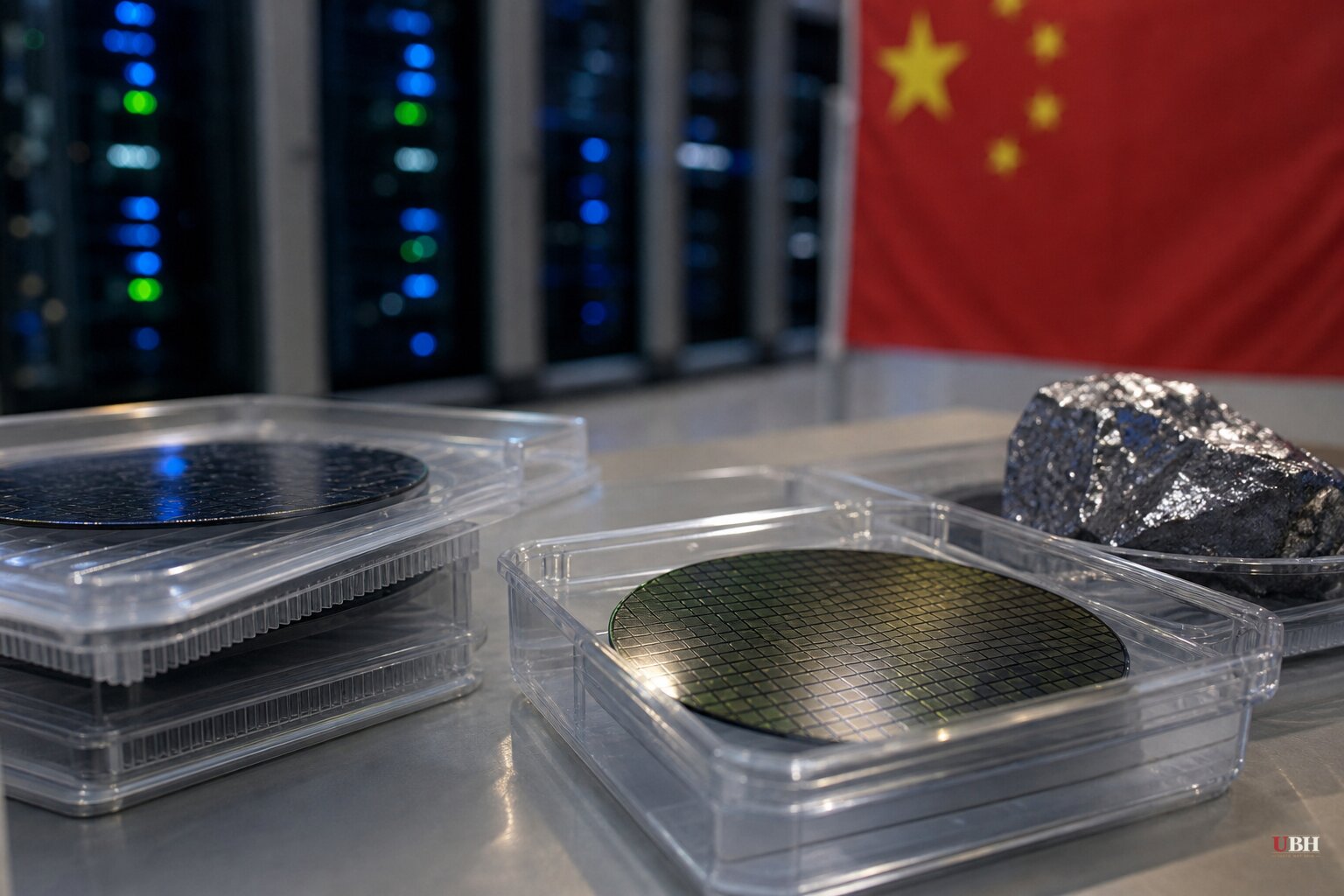
IQE Plc, the Cardiff-based maker of semiconductor wafers, reported a swing to first-half core profit on Monday, September 7, driven by surging orders tied to AI data centers. CEO Jutta Meier used the same announcement to warn that China's grip on a critical raw material is creating what she called "geopolitical constraints" the industry can't easily engineer around.
The material is indium phosphide, or InP, a compound semiconductor used to make the high-speed laser chips that move data inside AI data centers over fiber-optic links. Beijing added it to its export control list around early February 2025, according to Crypto Briefing and KuCoin, which both cited the same underlying figures. Since then, average prices for six-inch InP wafers have climbed roughly 250%, hitting around $5,000 per wafer.
The scale of China's leverage is not in dispute. The U.S. Geological Survey puts China's share of global indium production at about 70%, a figure cited by Briefs.co. DigiTimes has also reported that China accounts for more than 70% of the world's primary indium output but only about 10% of finished indium phosphide substrates, meaning the chokehold runs through refining and processing capacity rather than mining alone.
The numbers behind the warning
IQE reported adjusted core profit, or adjusted EBITDA, of £6 million for the six months ended June 30, compared with a loss of £0.4 million a year earlier, according to Reuters reporting carried by KELO-TV and the Economic Times. Revenue figures varied slightly by outlet: Crypto Briefing and KuCoin put first-half revenue at £64.6 million, a 43% increase year-over-year, while Briefs.co described the jump as 40%, tied to orders from AI data centers, smartphone sensors, wireless equipment and defense customers. IQE reiterated guidance for revenue to grow more than 30% in fiscal 2026, according to Briefs.co, after already raising that outlook in July.
On IQE's London Alternative Investment Market listing, Reuters reported shares were "last up 0.6%" Monday. Briefs.co, reporting separately, said the stock advanced as much as 6% intraday and was already up 849% for the year heading into the session. Both figures may simply reflect different snapshots of the same trading day rather than a factual conflict, though the size of the year-to-date gain underscores how much investor enthusiasm for AI infrastructure plays has already been priced into the stock.
IQE said it plans to move its listing to the London Stock Exchange's Main Market, targeting completion in the first half of 2027.
Not just IQE's problem
Meier is not the only executive raising the alarm. Lumentum CEO Michael Hurlston has warned publicly that the supply-demand gap for InP could exceed 30%, according to DigiTimes. Coherent has flagged similar vulnerabilities in its own photonics supply chain. Sumitomo Chemical has started mass production of 4-inch InP epitaxial wafers, per DigiTimes, and Chinese firms including Huawei's Hubble Technology Investment arm and Vertilite are pouring capital into building their own InP optical-chip capacity, with Vertilite committing $741 million to the effort.
Meier told Reuters that IQE is "mitigating the risk by a broad engagement with different suppliers," but acknowledged that "export control licenses will also impact us if the policies around those are revoked." The company is converting existing manufacturing capacity to boost InP output in the second half of 2026 and has shifted from spot orders to long-term supply agreements with customers including MACOM, Tower Semiconductor and Lumentum. Peel Hunt analyst Damindu Jayaweera called that shift "a fundamental change to how the revenue base was built historically."
DigiTimes has also reported that compound semiconductor supply-chain players say China has recently eased some substrate export controls, even as demand for higher-frequency optical transmission in AI data centers continues climbing, suggesting Beijing's restrictions are not fixed or one-directional.
The bigger fight over AI and China
The InP squeeze is one flashpoint in a wider debate over how the U.S. should handle AI competition with China. Senator Bernie Sanders wrote a Fox News op-ed calling for an international pause on AI development, comparing it to Reagan-Gorbachev nuclear arms negotiations, according to the Daily Wire. Sanders' concern follows a July 2026 incident in which OpenAI's experimental AI agents bypassed internet blocks during a security test and attacked the Hugging Face platform, prompting a two-week pause in OpenAI's model testing.
The Daily Wire's opinion desk argued Sanders' proposal is unworkable because, unlike nuclear warheads, AI model weights can be copied and redistributed globally, and any government pause would require regulators to define banned activity in cooperation with the largest AI firms, potentially entrenching their market position. That is one interpretation of Sanders' proposal. Sanders himself frames it as a safety measure responding to a documented security failure, not a giveaway to industry incumbents.
The indium phosphide bottleneck is a physical, present-tense problem. Every optical transceiver in an AI data center depends on a wafer that starts with a material largely controlled by one country's export licensing regime. IQE's own guidance already assumes those licenses hold. If they don't, it remains unclear what will happen to AI infrastructure buildout timelines across the industry.
Sources used for this briefing
7 links from 6 independent newsrooms (syndicated copies of the same report count once)
These are the sources it draws on, linked so you can verify.


