
Unbiased headlines. Facts, not spin.
Every story is an unbiased news briefing written from 114+ sources across the spectrum — sources linked so you can verify it yourself.
 defense
Major Story (7/10)
October 6, 2026 at 02:58 PM
defense
Major Story (7/10)
October 6, 2026 at 02:58 PM
Russia's Jet-Powered Drones Hit 600 KPH, Ukraine's Intercept Rate Falls Below 60%
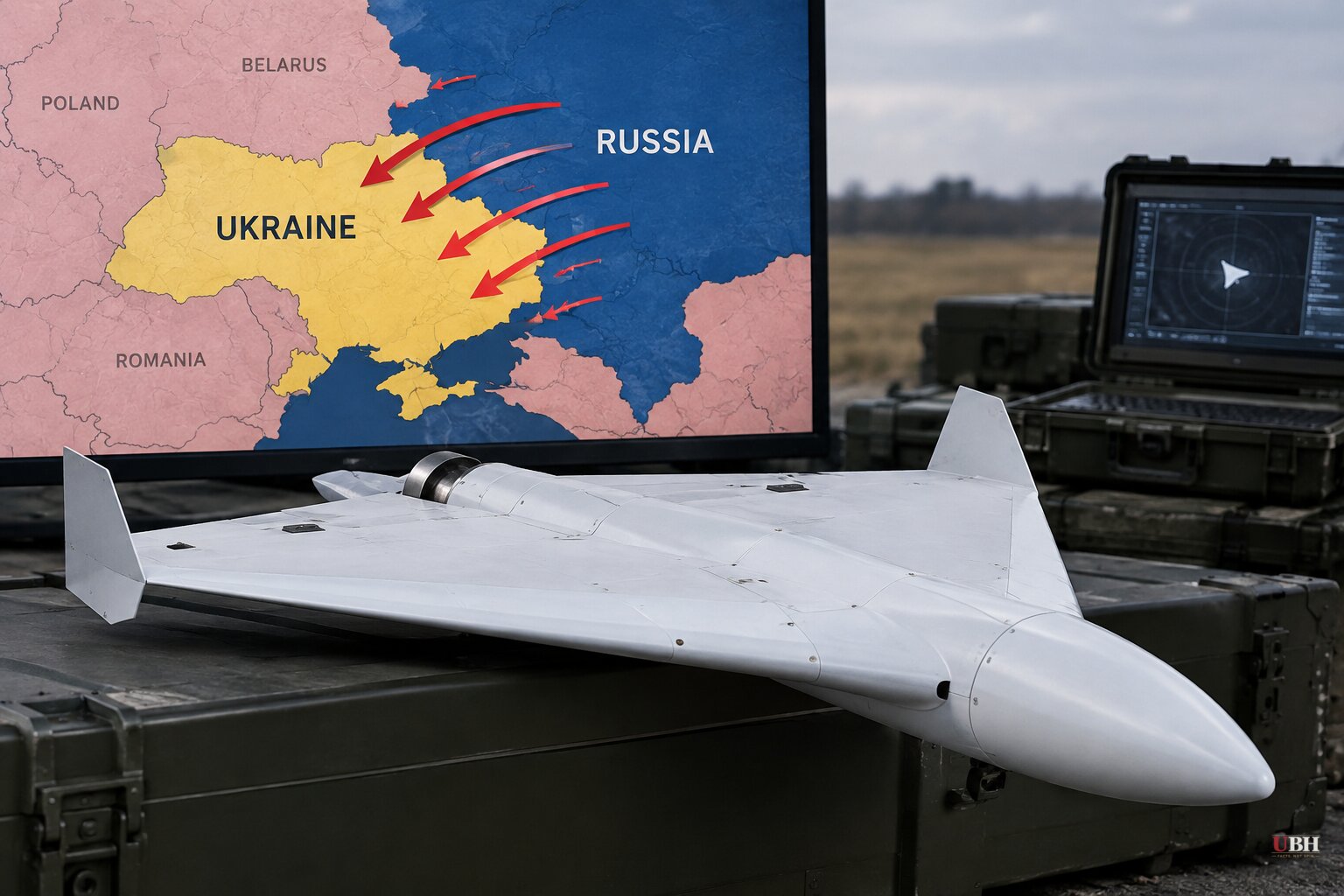
The drone war over Ukraine has changed shape. For most of the conflict, Russia leaned on slow, propeller-driven Shahed/Geran drones that Ukraine shot down at a clip above 90%. That's no longer the fight.
Russia has rolled out jet-powered variants, the Geran-3, Geran-4, and now the Geran-5, that fly faster, higher, and with better navigation than anything Ukraine faced a year ago. According to Business Insider, the Geran-2 topped out around 115 mph, the Geran-3 exceeds 200 mph, and the Geran-4 can hit 310 mph. The Geran-5, the newest model, reaches roughly 375 mph, or about 600 kph, a figure confirmed separately by Asia Times and The National News.
That's more than triple the speed of the original Iranian-designed Shahed-136 that Russia started with, according to The National News. Russian military expert Yuri Knutov told Asia Times the Geran-5 uses machine vision tied to a digital terrain map, letting it identify and select targets without a human in the loop.
The Numbers Are Getting Worse for Kyiv
Ukraine's Air Force says Russia launched 2,800 jet-powered drones in August, up from 350 in June, per Business Insider. Air Force Deputy Commander Yurii Cherevashenko told RBC Ukraine that jet-powered drones now make up about 40% of all Russian drone attacks nationwide, and as much as 60% in some regions. He expects that share to climb to 80%.
Production is scaling fast. Ukrainian military intelligence estimates Russian output of Geran-4s and Geran-5s jumped from about 500 a month in May to 3,000 a month by September, according to The National News.
The interception numbers reflect the strain. President Volodymyr Zelensky said on September 26 that Ukraine shot down only 55% of jet-powered drones that month, down sharply from the 90%-plus rate it maintained against propeller models, Business Insider reported. Ukrainian Air Force spokesman Colonel Yuriy Ihnat told the Financial Times in a September 14 interview that the figure was closer to 60%, against a 95% rate for older drone types, as reported by Asia Times. Ihnat said Ukraine has had to put fighter jets into "very intensive use" since August just to shoot the new drones down directly.
Ukrainian air defense commander Volodymyr Serdiuk put it bluntly to reporters, cited by The National News: "They're moving so fast that we can't get a proper lock on them."
Additional Threats
An October 5 report from the Institute for the Study of War, covered by Kyiv Post, found Russia is also building cheaper cruise-missile substitutes to stretch Ukraine's air defenses further. The S8000 "Banderol," built by the Kronshtadt Group using a Chinese Swiwin turbojet engine, can fly 500 kilometers at up to 650 kph with a 150-kilogram warhead. Ukraine's presidential commissioner for sanctions policy, Vladyslav Vlasiuk, said in July that Banderols were used in 80% of Russian strikes on Odesa's port.
Russia also unveiled the "Dan-T" at an airshow in Egypt in September, a converted 1990s target drone fitted with a 135-kilogram warhead, now built by state arms conglomerate Rostec with a 500-kilometer range, according to the ISW report.
A Crash in Moldova and a Proliferation Problem
Western intelligence got a rare break when a Russian jet-powered drone, believed to be a Geran-4, crashed in Moldova. The National News reported that analysts are picking through the wreckage, the flight computer, navigation system, and engine, for clues on how to jam or defeat it.
Robert Tollast of the Royal United Services Institute called the Geran program "a phenomenal development" and said it's "one of those moments in the Ukraine war where suddenly a weapon has changed the war," per The National News. He also warned it's only a "matter of time" before the technology reaches Iran, raising the risk it eventually ends up with the Houthis in Yemen. American ships and allied shipping in the Red Sea have already dealt with Iranian-designed Shahed derivatives. A faster, jam-resistant version in Houthi hands would pose a direct problem for U.S. Navy assets in the region.
Adding to the jamming problem, Draganfly CEO Cameron Chell told Fox News that Russia appears to be deploying mesh networks, including hidden, lunchbox-size devices, that make drone swarms harder to jam and more precise in targeting.
The West's Answer Is Still a Work in Progress
Ukraine is working with nearly 20 manufacturers on next-generation interceptors, Cherevashenko told RBC Ukraine. Fourteen have working products in test flights, six have destroyed jet-powered drones in tests, and three have results the Air Force considers promising. None are in mass production. Cherevashenko said the drones remain too expensive and manufacturers lack the capital to scale.
The National News reported Ukraine's fastest interceptors currently cap out around 400 kph, below the Geran-5's roughly 600 kph top speed, which is exactly why interception rates have fallen.
Britain is paying attention. Lt. Col. Matt Keogh, who procures drone technology for the British Army, told Business Insider that "the percentage of jet-powered threats is rising, and there is a commensurate level of interest being presented on the interceptors to defeat them."
The stakes are concrete. Zelensky said last month Russia plans to spend $12 billion producing these drones and other strike weapons in 2027. A single recent strike using nearly 100 jet-powered drones killed nine people and wounded dozens, Ukrainian authorities said. Whether American and European defense firms can field interceptors fast enough to close the speed gap before Russian output climbs further or the technology spreads beyond Ukraine remains unanswered.
Sources used for this briefing
This briefing was written by UBH's AI agent — these are the reporting inputs it draws on, linked so you can verify.


