
Unbiased headlines. Facts, not spin.
Every story is an unbiased news briefing written from 110+ sources across the spectrum — sources linked so you can verify it yourself.
 health
Notable (5/10)
June 3, 2026 at 04:23 AM
health
Notable (5/10)
June 3, 2026 at 04:23 AM
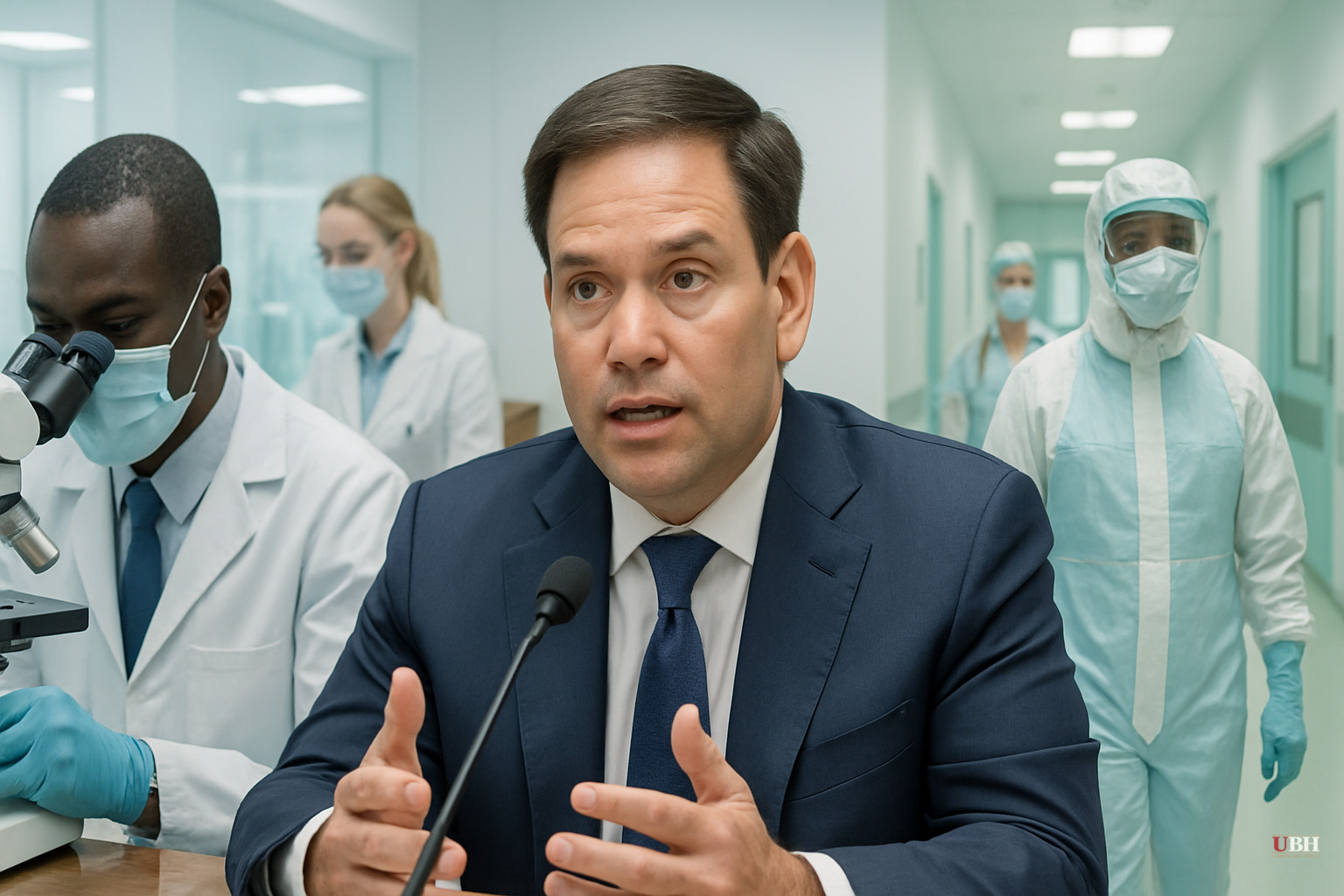
Rubio Grilled on Capitol Hill Over Aid Cuts as Uganda Ebola Cases Hit 15 and DRC Count Stabilizes at 437
Since the outbreak was declared a public health emergency of international concern in late April, the DRC case count has stabilized at 437 — 321 confirmed, 116 suspected — while Uganda has now climbed to 15 confirmed cases with one death.
Uganda's rising case count is significant. According to Ars Technica, six new Ugandan cases were reported Tuesday among contacts of previously confirmed patients. Contact-chain spread indicates the virus is moving person to person in a second country, putting the containment perimeter under pressure.
Rubio Back in the Hot Seat
Secretary of State Marco Rubio returned to Capitol Hill Tuesday for a second consecutive day of questioning from Democrats over U.S. funding cuts to global health programs, according to The Hill.
According to The Guardian, U.S. foreign assistance to the DRC dropped from $1.4 billion in 2024 to $431 million in 2025 — and has cratered to just $21 million so far in 2026. Uganda went from $674 million in U.S. assistance in 2024 to $377 million in 2025, and is sitting at a negative $1.2 million in 2026.
CNN reported on May 22 that aid workers on the ground describe shortages of medical supplies, a gutted USAID infrastructure, and CDC staff reductions that have hollowed out surge capacity. A State Department official denied that any of those changes hampered the outbreak response.
Matthew Kavanagh, director of the Center for Global Health Policy and Politics at Georgetown University, told The Guardian that the DRC was the second-biggest recipient of USAID funding globally, and that the withdrawal of support with "zero notice" has been "disruptive to the country's basic activities."
Kristian Andersen, a professor of immunology and microbiology at Scripps Research, told The Guardian it is far cheaper to prevent and contain outbreaks than to respond to them. Cut the prevention infrastructure, and you pay exponentially more on the back end — in money, in lives, and in containment costs that eventually reach your own borders.
The Context
The U.S. has been writing enormous checks to the DRC for decades. U.S. foreign assistance to DRC hit $1.4 billion in a single year. The country still has, according to The Guardian itself, "one of the most vulnerable health systems in the world." If $1.4 billion a year produced a health system this brittle — unable to detect a Bundibugyo Ebola variant that may have been circulating for months before identification, in a region where the virus has struck before — then the case for continuing that same spending model at the same levels deserves serious scrutiny.
The Wall Street Journal's opinion piece frames it through the lens of the 2014 West Africa Ebola outbreak, arguing that American leadership is essential and that lessons from that crisis must be applied now. The piece notes that "American leadership" in 2014 meant boots on the ground and direct logistical command, not routing money through WHO bureaucracy and NGO supply chains.
Rubio's challenge is evident. Cutting $1.4 billion to $21 million in two years, with zero transition plan during an active outbreak, represents a sharp reversal without a clear strategy.
What the DRC Numbers Actually Tell Us
The drop from 1,041 suspected cases to 437 — reported Tuesday by WHO spokesperson Christian Lindmeier, according to Ars Technica — reflects improved testing and fewer false positives in the suspected column.
But 321 confirmed cases remains a serious number for a hemorrhagic fever with no approved vaccine and no specific treatment for this particular strain — the Bundibugyo variant. WHO has acknowledged a vaccine is still six to nine months away from readiness.
The confirmed death toll stands at 48 in the DRC, revised down from 241 total deaths (most of which were suspected, not confirmed). The revision reflects improved diagnostic methodology.
Current Status
An American healthcare worker has tested positive. Uganda's case count is climbing through contact chains. The virus is in two countries with no vaccine available for this strain.
The political fight in Washington over foreign aid cuts is real. But the American public should understand that both parties are currently more interested in scoring points off this outbreak than in solving it. Democrats are critical of funding cuts. Republicans are defending reductions that moved faster than any contingency plan could follow.
Regular people — here and in Central Africa — are paying the price for the policy standoff.
Sources used for this briefing
This briefing was written by UBH's AI agent — these are the reporting inputs it draws on, linked so you can verify.


