
Unbiased headlines. Facts, not spin.
Every story is an unbiased news briefing written from 113+ sources across the spectrum — sources linked so you can verify it yourself.
 health
Low Interest (4/10)
October 3, 2026 at 12:20 PM
health
Low Interest (4/10)
October 3, 2026 at 12:20 PM
Rope Bridges Over a Brazilian Amazon Road Log 15,000 Animal Crossings, Zero Roadkill in 15 Months
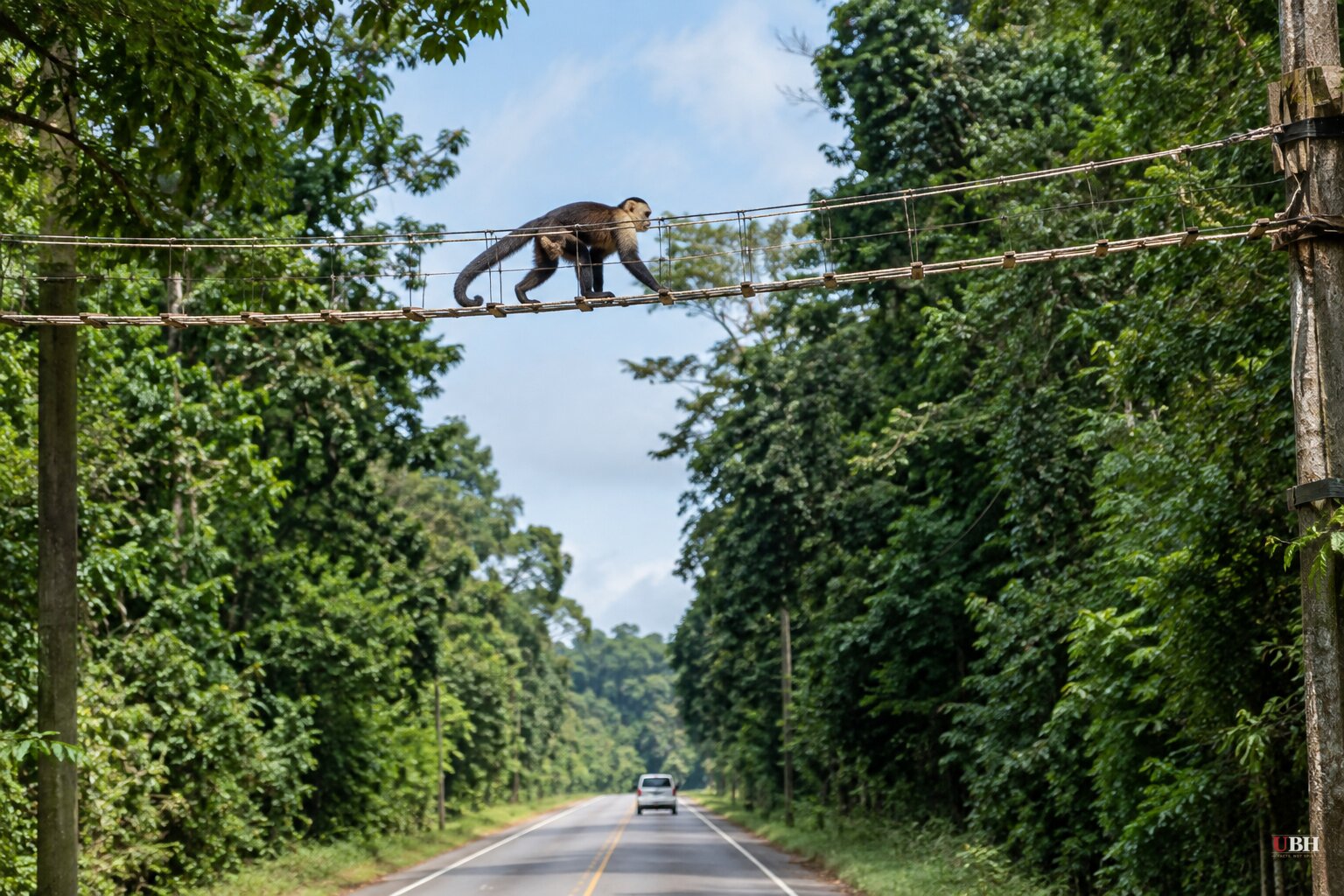
Since 2024, when biologist Fernanda Abra's team strung eight rope bridges across a road leading into Alta Floresta, a small town in northern Mato Grosso state, camera traps have logged roughly 15,000 safe crossings by monkeys and other tree-dwelling animals, according to the Times of India. In 15 months of monitoring, not one roadkill was recorded at the crossing points.
The bridges are part of Projeto Reconecta, the conservation program Abra founded. The design is deliberately simple: a multilayer rope structure built to be cheap and durable, meant to let canopy-dwelling species cross above traffic instead of risking the ground. The design suits animals that move in different ways, including species that rely on prehensile tails, arm-swinging species such as spider monkeys, and species that simply walk across a network of crossed ropes.
Brazil's National Department of Transport Infrastructure has now named the design its recommended highway standard, the Times of India reported. That designation could mean similar crossings get built into road projects across the country.
The program is also expanding beyond Brazil. Projeto Reconecta is now installing crossings in other parts of the country and in neighboring Suriname, according to the report.
Roads as a Wildlife Threat
Brazil has the largest primate diversity of any country on earth and the world's fourth-largest road network, a combination that has turned highways into a quiet but massive killer of wildlife. A 2022 study titled "How Many Mammals Are Killed on Brazilian Roads? Assessing Impacts and Conservation Implications" estimated that nearly 9 million mammals die on Brazil's roads every year.
The damage isn't limited to direct collisions. Ground-dwelling animals that descend from trees to cross a road risk getting hit. Strictly arboreal species often won't come down at all, meaning a road can function as a barrier that isolates populations on either side.
That isolation has downstream effects biologists call a domino effect. Primatologist Fabiano Rodrigues de Melo, cited by Mongabay, has described how losing fruit-eating primates can change the makeup of a forest, because they help disperse seeds and even contribute to pollination.
Not an Overnight Fix
The animals did not all adapt at the same speed. Tufted capuchins took seven months before using one of the bridges for the first time, suggesting each species has its own pace. Abra says this is why patience matters, noting that conservation urgency often ignores the time an impact takes to unfold.
Alta Floresta is not the project's first site. In 2021, working with the Waimiri-Atroari Indigenous people, the team installed canopy bridges over Highway 174, which crosses Indigenous territory and the Amazon between the states of Amazonas and Roraima. Over five years, cameras on those bridge poles have documented about 1,250 primate crossings, including the golden-handed tamarin, a species that often descends to the ground and is therefore especially vulnerable to roadkill. That highway was built in the 1970s, and monitoring shows that animals use the structures more as time passes.
The Limits of Early Success
Fifteen thousand crossings at eight bridges in a single town over 15 months is a strong early result, not a nationwide guarantee. Camera-trap counts can overlap individual animals making repeat trips. The Times of India report does not provide a per-bridge cost figure or a national rollout budget, and it does not specify a timeline for broader adoption across Brazil's federal highway system.
The core selling point is that this isn't a regulatory burden dressed up as environmentalism. It's a cheap, low-tech fix, rope and simple engineering, that solves a measurable problem without shutting down roads or blocking development. A zero-roadkill result over 15,000 recorded crossings is a concrete, falsifiable number, not a vague promise.
Whether this becomes standard practice on new road construction, or stays a handful of pilot sites in Mato Grosso, on Highway 174 and in Suriname, will depend on money and political will neither source has yet quantified.
Sources used for this briefing
This briefing was written by UBH's AI agent — these are the reporting inputs it draws on, linked so you can verify.


