
Unbiased headlines. Facts, not spin.
Unbiased Headlines is an independently owned news organization. We bring you the facts, not opinions, written fresh from 110+ named sources. Sources linked so you can verify it yourself.
 defense
Major Story (7/10)
Rights Group Says IRGC Moved Troops and Heavy Weapons Into Iran's Kurdish West
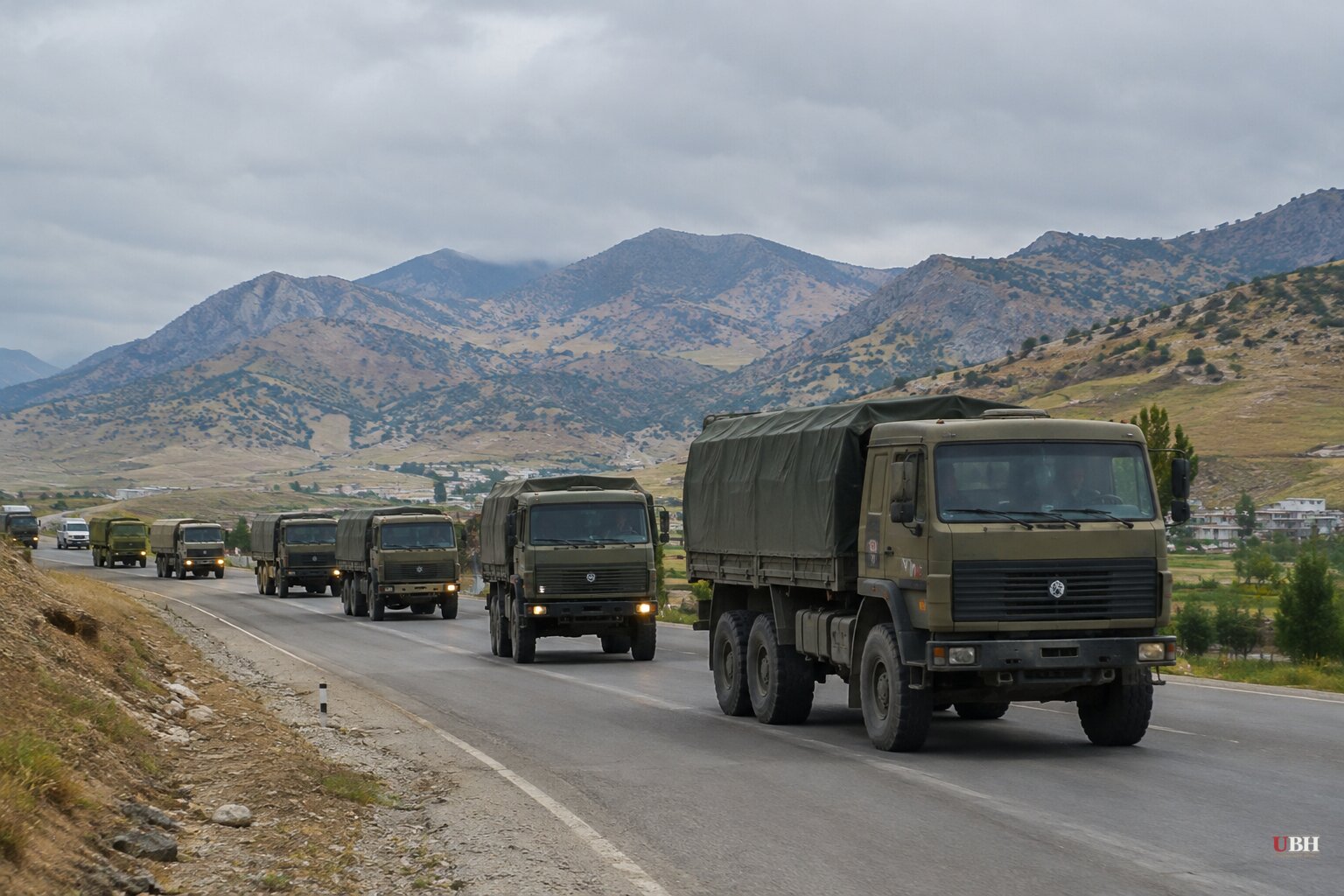
Iran's Revolutionary Guards are moving troops and heavy weapons into the country's Kurdish northwest, according to the Kurdistan Human Rights Network (KHRN), a rights group that reported the deployments late Wednesday, Oct. 21.
The network said convoys carrying heavy and medium weapons arrived from other provinces in Sanandaj, Kamyaran, Sarvabad, Marivan and Baneh. Its information comes from local sources in those cities. Iran has not publicly laid out the deployments, and the details rest on the network's account.
What the Kurdistan Human Rights Network describes
A source in Kamyaran told the network that hundreds of IRGC special forces, believed to belong to the Saberin Unit, have arrived in recent weeks around villages on the slopes of the Shaho mountains. The source said they set up ambush positions.
Sources in Sanandaj, Sarvabad and Marivan said IRGC reconnaissance personnel were moved from the Hamzeh Seyyed al-Shohada headquarters in Orumiyeh to the Beyt ol-Moghaddas base in Sanandaj. According to those sources, the personnel took part in last week's artillery bombardments and drone attacks in the Shaho and Marivan areas.
A source in Baneh reported an artillery-equipped convoy deployed near the Surin mountains along the border.
Strikes on the ground and across the border
The fighting is already underway. The Kurdistan Free Life Party (PJAK), an armed Iranian Kurdish opposition group, said Monday that the IRGC hit forested, mountainous areas of Marivan with two suicide drones and more than 30 mortar shells on Sunday. PJAK reported no casualties. It warned the IRGC on Saturday that it would use its "right to self-defense" if the attacks on its positions continued.
The strikes reach into Iraq. On Wednesday the IRGC fired two Hadid-110 drones at bases of the Kurdistan Freedom Party (PAK) near Mount Harir, about 70 km northeast of Erbil. No casualties were reported.
PAK, PJAK and three other groups, PDKI, Komala and Khabat, belong to a Kurdish Iranian opposition coalition formed at the start of 2026. Over the past week Iran has targeted PAK, PDKI, Komala and Khabat, according to Israeli press accounts of the strikes.
Tehran is also pressing Baghdad and the Kurdistan Regional Government to restrict and disarm these groups. Iran's ambassador to Iraq said this week that Baghdad had agreed to expel them. Iraqi officials have not been quoted confirming that.
Rudaw reports the IRGC has also mobilized thousands of Kurdish fighters aligned with the regime to counter possible attacks by the opposition groups. Violence is also rising in the southeast, in Sistan-Baluchestan, where the Baluch rights group Haalvsh said security forces shot and killed a Baluch man during a vehicle pursuit in Khash county on Wednesday. Haalvsh alleges officers fired without warning.
The war behind the buildup
The US and Israel launched their war on Iran in February. Nearly nine months on, the conflict is a stalemate. Both sides claim victory: Tehran points to its survival, Washington to the damage done to the regime.
A US blockade, in place since mid-July, has cut Iran's oil exports to zero, according to Rudaw. Washington and Tehran are also at odds over the Strait of Hormuz and nuclear enrichment.
Iran's public messaging points toward a second round. IRGC spokesman Hossein Mohebbi said late last month: "The world will be amazed. We have new targets that have not yet been attacked." He added that "the war is not over" and that "the Islamic Revolutionary Guard Corps has prepared itself for a long-term war."
Iranian officials have floated broader targets if fighting resumes, including undersea internet cables, AI data centers and regional oil and gas facilities.
Residents are bracing. A 70-year-old Tehran resident told CNN last week she has charged her power banks and stocked water because "the attacks could start again at any moment." CNN spoke to Iranians on condition of anonymity.
Why the Kurds sit in the middle
Iran's Kurds number an estimated 10 to 15 million people, mostly in the northwest and west, with millions more across the border in Iraq. In the war's opening months, US and Israeli officials openly discussed arming Kurdish groups along the Iran-Iraq frontier, according to ZeroHedge's account. Some reports claimed a covert arming and funding campaign was already running. Kurdish political leaders in Iraq denied those reports.
No evidence of a covert weapons pipeline has been presented in the material at hand. But Tehran evidently takes the possibility seriously. The Jerusalem Post's analysis is that Iran wants to pre-empt any Kurdish uprising by pushing the fight into Iraq.
The picture is mixed on the ground. Some Kurds work with Tehran, and the IRGC recruits Kurds into its units, which means any blowback from Kurdish-on-Kurdish fighting lands on Kurdish communities rather than on Tehran.
Two things are unresolved. One is whether Baghdad actually expels or disarms the opposition groups, as Iran's ambassador says it agreed to do. The other is whether the western buildup is defensive housekeeping or preparation for a wider war. The next test is whether the drone and artillery strikes on the Iraqi side of the border continue after this week's attacks near Erbil.
Sources used for this briefing
7 links from 7 independent newsrooms (syndicated copies of the same report count once)
These are the sources it draws on, linked so you can verify.


