
Unbiased headlines. Facts, not spin.
Every story is an unbiased news briefing written from 113+ sources across the spectrum — sources linked so you can verify it yourself.
 health
Major Story (7/10)
September 30, 2026 at 07:11 AM
health
Major Story (7/10)
September 30, 2026 at 07:11 AM
RFK Jr. Tells MAHA Summit AI Will End 'Trust The Experts,' Pushes Government to Centralize Health Data
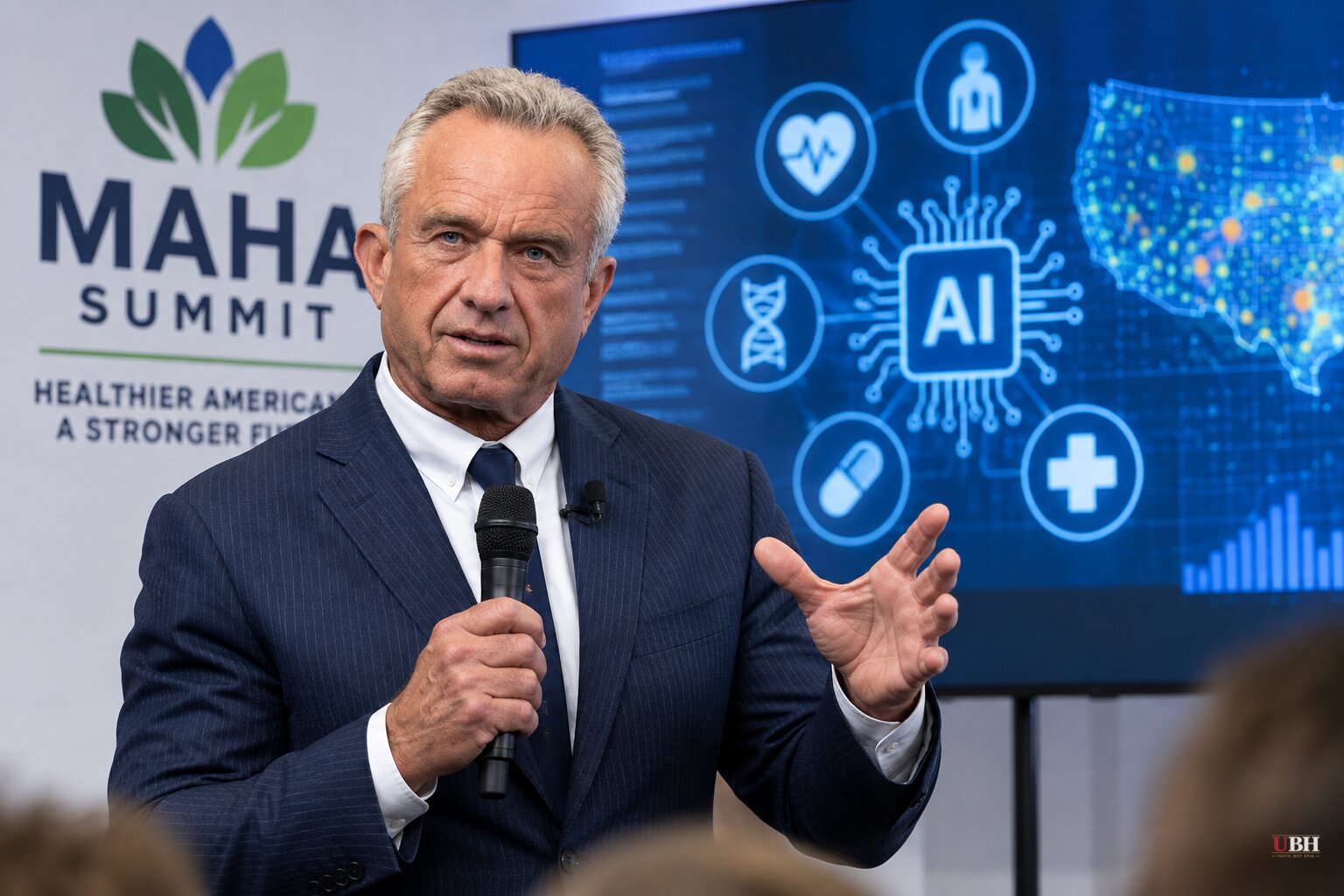
Health Secretary Robert F. Kennedy Jr. spent Monday and Tuesday this week making the case for two things at once: a massive expansion of government-collected health data, and artificial intelligence as the technology that will finally set Americans free from doctors and public officials telling them what to believe.
On Monday, at an event hosted by the Maha Institute, Kennedy laid out what The Guardian described as an expansive vision for connecting medical and lifestyle data, from doctor visits to exercise habits, and feeding it to AI systems and outside researchers. "We need to use America's health data to determine whether the food we eat, the chemicals we encounter, the vaccines that we're administering... are contributing in one way or another to the chronic disease epidemic," Kennedy said.
The Maha Institute is run by Mark Gorton, who called himself "the boldest anti-vaxxer in the anti-vax conference" two weeks earlier, according to The Guardian. It was co-founded by Tony Lyons, whose publishing house gave $4 million to Kennedy through various Maha foundations, funded by political contributions and health-related corporations, per reporting by The New York Times cited by The Guardian. No investigation into that funding has been announced.
The data Kennedy wants pooled
Kennedy told the crowd that Medicaid alone holds "hundreds of millions of lives," including tens of millions of children tracked for a decade or more, and called it "a really useful vehicle" for studying health exposures. Medicare, he said, gives HHS "enormous amounts of information on older Americans and people with disabilities."
He also pointed to commercial platforms like HealthVerity, which link insurance claims, prescriptions, lab results and electronic health records, and to FDA systems that can conduct "active safety surveillance" by tying claims data to medical records. State-level data reported to the CDC, by contrast, is often "unusable," Kennedy said, because states collect different data points and the systems stay siloed.
Kennedy separately claimed that medical records openly shared across the health care industry jumped from under 10 million when he took office to a billion roughly 15 months later, according to an interview with Armstrong Williams reported by KRCR-TV. That figure comes from Kennedy himself and hasn't been independently verified in these sources.
AI as the cure for 'medical tyranny'
Tuesday's Make America Healthy Again Summit at the Waldorf Astoria in Washington, sponsored by OpenAI and Anthropic, shifted the focus to artificial intelligence. In a fireside chat with Vance, Kennedy said AI would end an era where "we're never, ever again going to be able to be dominated by public officials who tell us 'trust the experts,'" according to Politico and Yahoo News, which both carried the same account of the exchange.
Kennedy went further in remarks reported by Europe Says, telling the crowd that if officials say masks work or social distancing works, "AI may tell you otherwise," and that AI "has the capacity to dominate us, to free us from medical tyranny" including vaccine mandates tied to school and job requirements.
Kennedy also said he met recently with OpenAI CEO Sam Altman, who told him it would now be "malpractice" for a doctor not to consult AI tools when advising patients, according to KRCR-TV. This is a striking claim for the head of HHS to repeat approvingly, given that AI chatbots are not FDA-regulated as medical devices and have no formal liability framework if they give a patient bad advice.
Vance, for his part, said AI companies should be held accountable if their tools cause harm, but argued Americans are too focused on downside risk. He cited a man he'd spoken with that morning at a White House AI luncheon who said he used AI to help design a cancer treatment combination for his wife after doctors said nothing more could be done, and that she is alive today, per Europe Says.
The gap between the stage and the public
The positivity on stage runs against public sentiment. A POLITICO poll cited in the network's own reporting found a majority of Americans share fears that AI could cause serious harm, not comfort. Republican Sen. Josh Hawley of Missouri has separately pressed Kennedy at a congressional hearing this spring over health risks from the data centers powering AI, calling them "horrendous," according to Yahoo News.
There's also a rift inside Kennedy's own coalition. Yahoo News and Europe Says both reported that Maha grassroots activists have felt betrayed by the administration since Trump issued an executive order this year boosting domestic glyphosate production, a chemical the movement has campaigned against.
Kennedy's argument, taken on its own terms, isn't crazy. Siloed state health data genuinely is hard to use for research, and giving patients their own thousand-page medical file distilled by AI could be useful when doctors only get six minutes per visit. But nothing in these sources describes what privacy safeguards, consent rules, or security standards would govern a federal database pulling together Medicaid, Medicare, FDA and commercial claims data on hundreds of millions of Americans. Kennedy has outlined the ambition. He hasn't outlined the guardrails, and no legislation or formal HHS rule implementing this data-sharing vision has been announced.
Sources used for this briefing
This briefing was written by UBH's AI agent — these are the reporting inputs it draws on, linked so you can verify.


