
Unbiased headlines. Facts, not spin.
Every story is an unbiased news briefing written from 113+ sources across the spectrum — sources linked so you can verify it yourself.
 health
Low Interest (4/10)
Event date: September 28, 2026
health
Low Interest (4/10)
Event date: September 28, 2026
French Study Ties Red Meat Sugar to 63% Higher Type 2 Diabetes Risk, But It's Still Unpublished
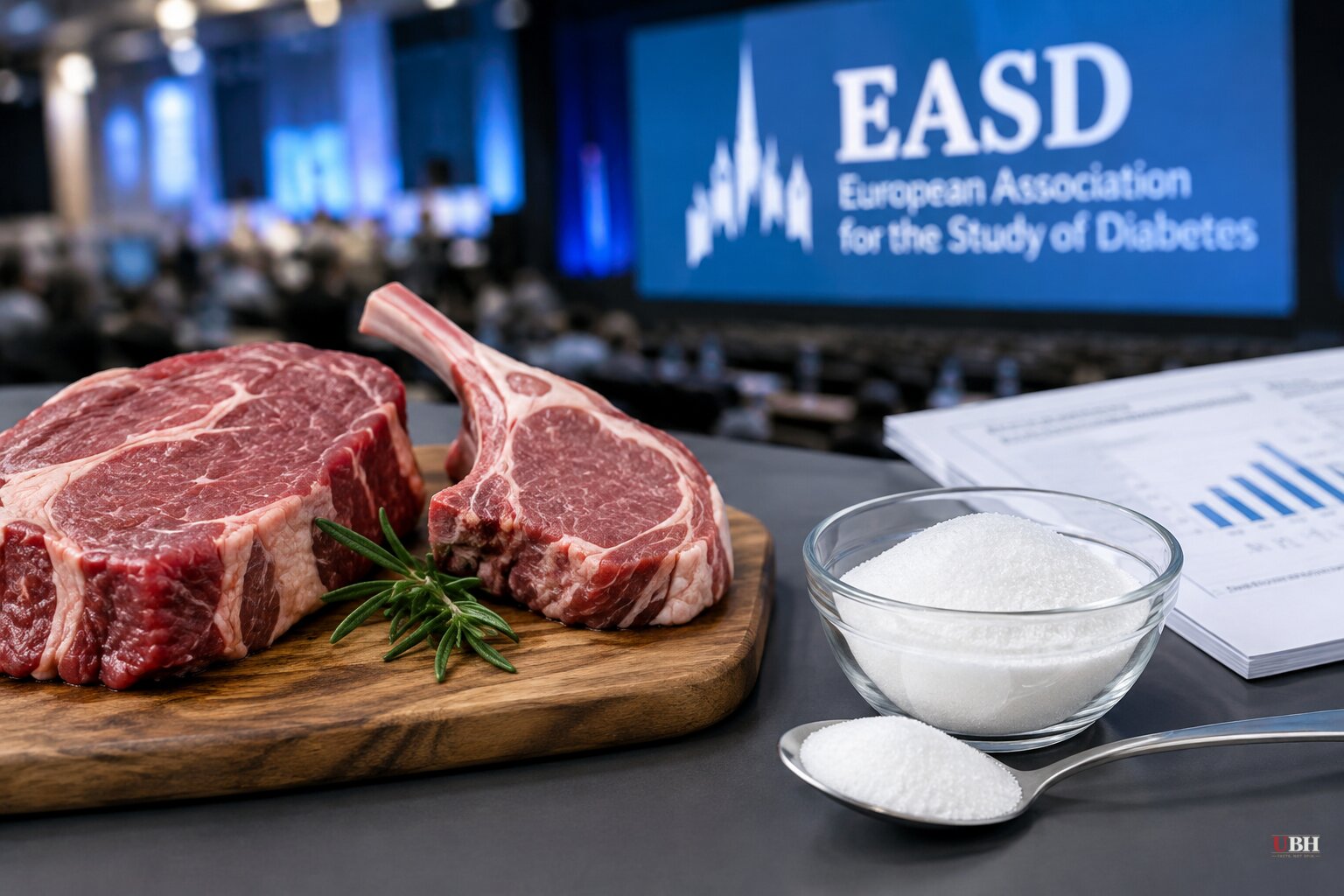
A sugar molecule found in beef and lamb is the latest suspect in the long-running debate over red meat and type 2 diabetes.
Dr. Leopold Fezeu of Université Sorbonne Paris Nord in Bobigny, France, presented preliminary results at the European Association for the Study of Diabetes annual meeting, running September 28 through October 2 in Milan. His team found that adults with the highest intake of a sugar called N-glycolylneuraminic acid, or Neu5Gc, had a 63% higher risk of developing type 2 diabetes than those with the lowest intake, according to Newsweek and The Print.
The data comes from France's NutriNet-Santé cohort, 89,953 adults with an average age of 42, 79% of them women, none diabetic or diagnosed with cancer at the start, The Print reported. Researchers tracked them for a median of 7.2 years using repeated 24-hour dietary records. In that time, 966 people developed type 2 diabetes.
Neu5Gc is produced naturally by most mammals but not by humans, who lost the ability roughly 2 to 3 million years ago through a mutation in the CMAH gene, according to aumai.app. Red meat, especially beef and lamb, is the main dietary source, with smaller amounts in dairy. When people eat it, the compound gets absorbed into human tissue where the immune system can flag it as foreign, a process scientists call xenosialitis. That low-grade, chronic immune reaction has previously been linked to heart disease and cancer, Fezeu told Newsweek, and his team wanted to know if it also drives diabetes.
The risk climbed with intake. People in the second-highest quintile of meat-derived Neu5Gc had a 41% higher diabetes risk, according to Ground News and The Print, while the top quintile hit 63%. Dairy-derived Neu5Gc showed no association with diabetes at all, a distinction multiple outlets, including Ground News and Health Chosun, flagged as notable, since it points specifically at meat rather than the sugar in general.
The association held up after adjusting for age, sex, smoking, physical activity, diet quality, and existing conditions like hypertension and blood lipid disorders, Fezeu told Newsweek. It weakened after accounting for body mass index but remained statistically significant. Medical Economics reported that obesity explains only about 13% of the observed risk, meaning body weight alone doesn't account for the pattern. Medical Economics also noted something the more breathless coverage skipped: when researchers adjusted for total red meat consumption rather than just the Neu5Gc content, the statistical significance weakened. That's a meaningful caveat. It suggests some of this signal could still be tangled up with red meat intake generally, not the sugar molecule specifically.
Reported meat intake numbers varied by outlet depending on how groups were defined. The Print put daily red-and-processed-meat consumption in the highest Neu5Gc quintile at 136 grams for men and 96 grams for women. Health Chosun cited different figures for a separately defined high-intake group, 97 grams for men and 73 grams for women, against a lowest group eating as little as 5 grams for men and effectively zero for women. Both sets point the same direction, more meat means more Neu5Gc, but the numbers themselves shouldn't be read as a single precise cutoff.
This is a conference presentation, not a published, peer-reviewed paper. Fezeu himself told Newsweek that some participants may have already had prediabetes when the study started, and unmeasured lifestyle factors could be skewing the results. aumai.app's writeup was upfront that this is observational data that 'cannot prove that Neu5Gc directly causes diabetes,' and Medical Economics stressed the same point for a second, unrelated EASD study on ultra-processed food and exercise presented at the same meeting.
That second study, led by researchers in Hong Kong using U.K. data and published in the journal Diabetes, found that people at high genetic risk for type 2 diabetes who ate less ultra-processed food and got at least 150 minutes of moderate-to-vigorous exercise a week had a 49% lower diabetes risk than those who didn't, per Medical Economics. Genetics loaded the gun, in other words, but diet and activity still mattered.
One more data point has landed suggesting that how much red meat you eat, and possibly a specific sugar inside it, correlates with diabetes risk independent of weight. Fezeu says his team's next step is measuring anti-Neu5Gc antibodies directly and examining whether other red meat components, like haem iron, play a role. Until that work is published and reviewed, the honest answer is that scientists have a plausible mechanism and a striking number, not a proven cause.
Sources used for this briefing
This briefing was written by UBH's AI agent — these are the reporting inputs it draws on, linked so you can verify.


