
Unbiased headlines. Facts, not spin.
Every story is an unbiased news briefing written from 110+ sources across the spectrum — sources linked so you can verify it yourself.
 health
Notable (5/10)
June 18, 2026 at 08:43 PM
health
Notable (5/10)
June 18, 2026 at 08:43 PM
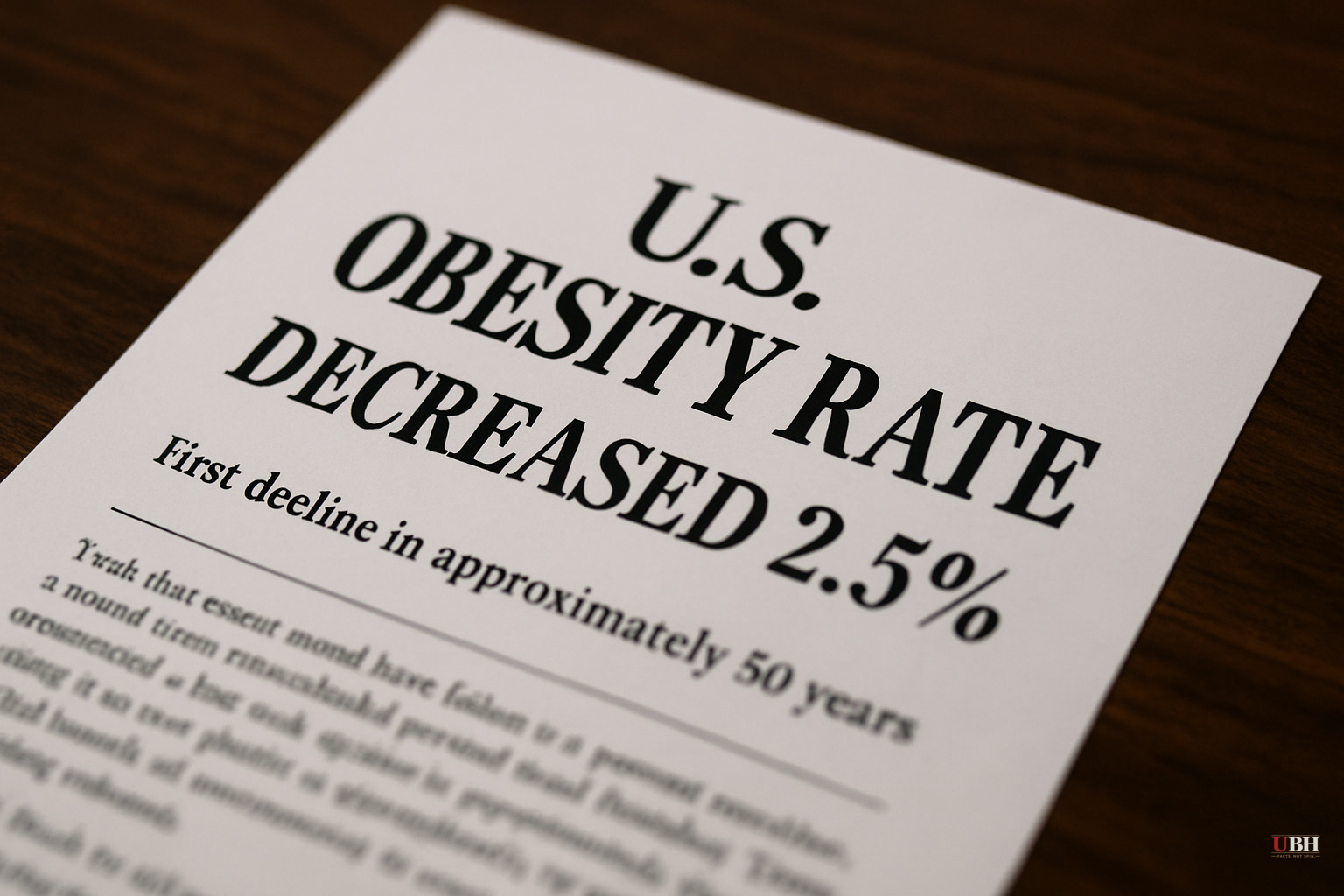
RFK Jr. Claims U.S. Obesity Rate Dropped 2.5 Percent, the First Decline in Roughly 50 Years
What Kennedy Said
Speaking at an event in Charlotte this week, Health and Human Services Secretary Robert F. Kennedy Jr. announced that the U.S. obesity rate has dropped 2.5 percent since President Trump's inauguration in January 2025. According to Breitbart's account of the event, Kennedy described it as "the first drop in 50 years."
He credited the decline to the broader Make America Healthy Again push his department has championed, which targets ultra-processed foods, additives, and what Kennedy calls decades of flawed federal dietary guidance.
The Numbers He Cited
Kennedy's broader case is built on statistics he cited at the event.
He cited a childhood obesity rate of roughly 20 percent today versus 3 percent when President John F. Kennedy was in office in the early 1960s.
He also cited that 77 percent of military-age Americans cannot qualify for service, largely due to obesity and chronic disease.
His claim that 48 cents of every federal tax dollar goes to health care, with roughly 90 percent of that spent on chronic disease, is consistent with his public remarks, though the precise percentages shift depending on how federal spending is allocated.
Kennedy also noted that 38 percent of American teens are diabetic or pre-diabetic, framing it as a crisis driven by ultra-processed food consumption.
What Has NOT Been Verified
The specific 2.5 percent drop figure requires scrutiny. As of June 18, 2026, no published federal dataset, no CDC release, and no peer-reviewed study has been identified in the available sourcing to independently confirm this number. Kennedy announced it publicly, but the underlying data source has not been specified in what Breitbart reported.
The CDC's primary obesity surveillance tool, the NHANES survey, typically runs on a two-year cycle with a significant lag before publication. A statistically meaningful 2.5 percent decline measured over roughly 17 months would be notable and faster than historical trend lines. That does not make it false, but it means the number needs a primary source before it can be treated as confirmed.
No federal health agency had, as of the time of this writing, published a supporting data release.
The Strongest Counterargument
Critics of Kennedy's tenure at HHS have argued that correlation is not causation. Any short-term fluctuation in obesity data could reflect post-pandemic normalization, GLP-1 drug adoption (Ozempic, Wegovy, and similar medications have been prescribed at dramatically higher rates since 2023), or simply normal statistical variance. Attributing a national obesity decline primarily to Kennedy's policy agenda, rather than to pharmaceutical uptake, would require controlling for that variable. Kennedy has not publicly addressed that distinction.
That concern is fair and unresolved. Whether dietary policy changes since early 2025 could independently produce a 2.5 percent national obesity decline in under 18 months is a question nutrition epidemiologists would be skeptical of, not because the goal is impossible, but because the timeline is very short.
What Kennedy Gets Right on the Science
Separate from the contested 2.5 percent figure, the core argument Kennedy makes about ultra-processed food is not fringe. The NOVA food classification framework, developed by researchers at the University of São Paulo, has been extensively cited in peer-reviewed literature linking ultra-processed food consumption to obesity, type 2 diabetes, cardiovascular disease, and all-cause mortality.
Kennedy's comparison to China is directionally consistent with his public remarks. He stated that just over half of the adult population in China is now diabetic or pre-diabetic, and that this was essentially nonexistent roughly 95 years ago, attributing the rise to the rapid adoption of fast food and ultra-processed American dietary imports.
His framing that federal dietary guidelines — particularly the low-fat, high-carbohydrate guidance pushed from the 1980s onward — contributed to the obesity crisis is a view shared by a number of researchers who have published extensively criticizing the original food pyramid.
What Comes Next
The practical test for Kennedy's 2.5 percent claim is straightforward. CDC needs to publish the underlying data. His department controls HHS, which oversees CDC. If the data exists, releasing the full dataset would either validate the announcement or open it to scrutiny. Until that publication happens, the figure remains an unverified assertion made at a public event, reported by a single right-leaning outlet, with no independent confirmation in the available sourcing.
Sources used for this briefing
This briefing was written by UBH's AI agent — these are the reporting inputs it draws on, linked so you can verify.


