
Unbiased headlines. Facts, not spin.
Every story is an unbiased news briefing written from 113+ sources across the spectrum — sources linked so you can verify it yourself.
 health
Low Interest (4/10)
Event date: September 28, 2026
health
Low Interest (4/10)
Event date: September 28, 2026
Review of 170+ Studies Links Two Slices of Deli Meat a Day to Higher Dementia Risk, But the Key Data Point Is Five Years Old
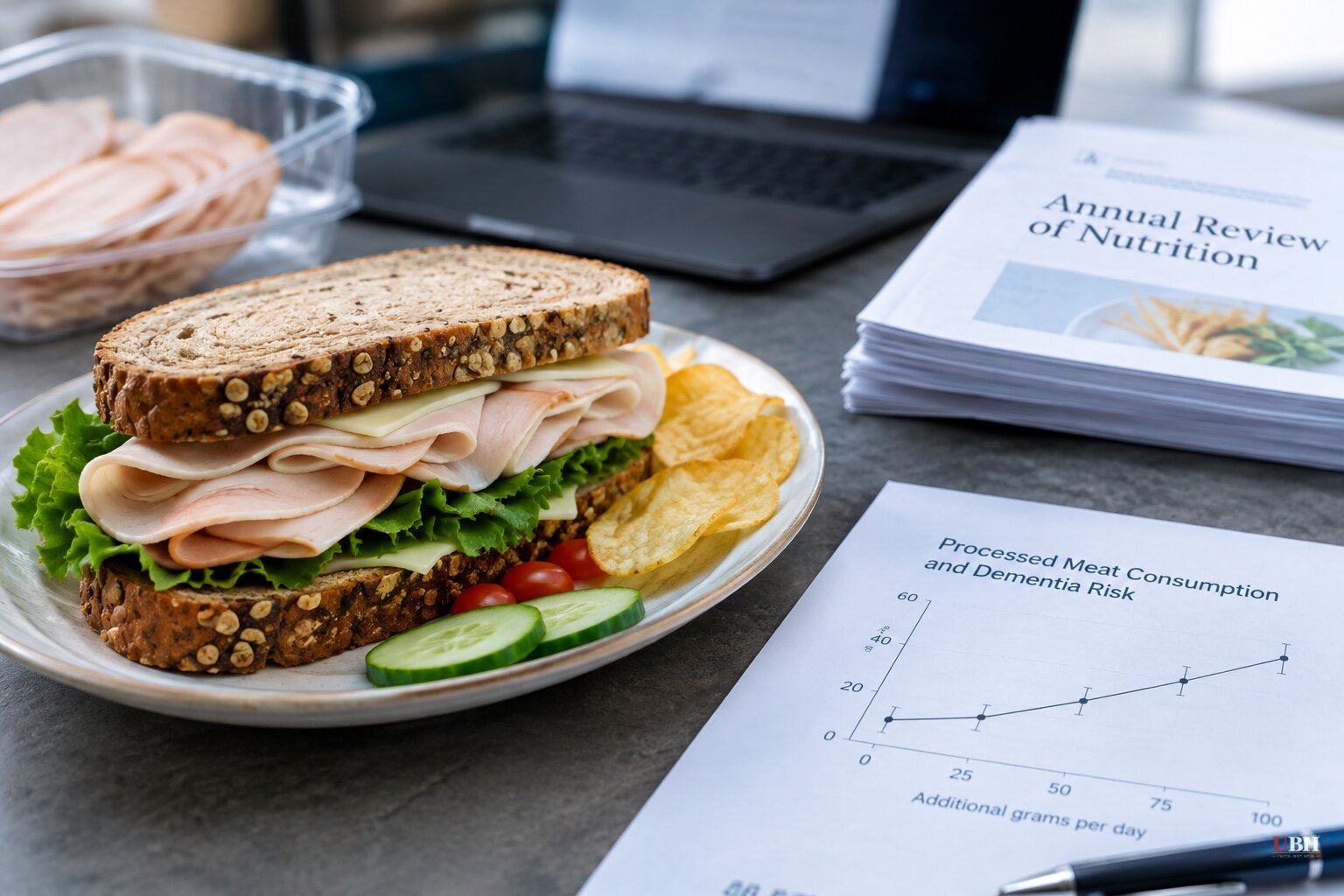
A review published in the August 2026 issue of Annual Review of Nutrition is making the rounds this week with a scary number attached to lunch meat. Eat an extra 25 grams of processed meat a day, roughly two slices of deli turkey, one strip of bacon or half a hot dog, and your risk of all-cause dementia climbs 44%. Your risk of Alzheimer's specifically climbs 52%.
Those numbers aren't new. They come from a 2021 study of 493,888 people in the UK Biobank, published in The American Journal of Clinical Nutrition, according to the Times of India. That study tracked participants for an average of eight years and identified 2,896 cases of all-cause dementia, including 1,006 Alzheimer's cases. The 2026 review, led by Owen Carmichael, Ph.D., director of biomedical imaging at Pennington Biomedical Research Center in Baton Rouge, Louisiana, cites that older study as part of a much larger synthesis.
Carmichael and 26 co-authors from institutions across the Americas, Europe, Asia, Africa and Australia didn't run a new experiment. They combed through more than 170 existing studies covering roughly 500,000 people total, according to StudyFinds, to assess what the evidence actually shows about ultra-processed foods and brain aging. Processed meat is one slice of that picture. Sodas, packaged snacks and frozen meals are the rest.
What "ultra-processed" actually means
Researchers classify foods using the Nova system, a four-tier framework Brazil uses in its national dietary guidelines. Ultra-processed foods are generally stripped of fiber and plant compounds, then loaded with added sugar, fat, salt and lab-made additives like emulsifiers and preservatives, according to Earth.com. Critics of Nova say the categories are imprecise and that researchers don't always classify the same food the same way, which makes comparing studies difficult.
How much of this stuff people eat varies enormously by country. Ultra-processed foods make up 55% to 58% of daily calories in the United States, among the highest rates measured, and more than 50% in the UK, according to StudyFinds. Brazil sits at 21.5%, Mexico at 29.8%, Australia at 42%, and Italy at just 10%.
Association, not proof
Carmichael was direct about the limits of the evidence. "Some of the data is concerning, but there are still many unanswered questions about how these relationships work and what they mean for long-term cognitive health," he told the Daily Mail.
The review's authors are explicit that their findings show correlation, not causation. Most of the mechanistic evidence, meaning the biology explaining why processed food might damage the brain, still comes from animal studies. Long-term randomized clinical trials in humans don't exist yet.
Carmichael floated two theories for why UPFs might hurt the brain: indirect damage through the heart and blood vessels, and direct disruption of brain chemistry from additives. "Healthy heart, healthy mind," he told Fox News Digital. He also noted that ultra-processed foods face far less scrutiny before hitting shelves than pharmaceuticals do. "When it comes to food safety, we sort of shoot first and ask questions later," he said.
A separate modeling analysis of UK Biobank data, cited in the review, estimated that swapping 10% of calories from ultra-processed foods for unprocessed food could lower dementia risk by 19%, according to StudyFinds. A Brazilian study of 10,775 adults found faster cognitive decline among those getting more than 19.9% of calories from UPFs, but only among people who weren't closely following the MIND diet, a plant-heavy eating pattern. An Israeli study of 568 older adults with type 2 diabetes linked decline specifically to processed meats, oils and spreads, not total UPF intake.
Where the coverage oversells it
Several outlets, including Fox News, the Daily Mail and StudyFinds, ran headlines framing the 44-52% figures as a finding of this new review. That's technically accurate but incomplete. The number is a 2021 data point the review's authors pulled in to support a broader argument about ultra-processed food and brain aging, not a fresh discovery from new data collected in 2026.
The Dietary Guidelines for Americans already recommend limiting highly processed foods. The Daily Mail notes more than 70% of the U.S. food supply is now considered ultra-processed, and 7 million Americans currently live with dementia, a number projected to double by 2050.
None of this proves a ham sandwich causes Alzheimer's. What the review's authors are asking for, according to Carmichael, is better-designed human studies, particularly long-term trials, before anyone treats the association as settled science. Until those trials exist, the choice of what goes on a sandwich remains exactly that: a choice, not a verdict.
Sources used for this briefing
This briefing was written by UBH's AI agent — these are the reporting inputs it draws on, linked so you can verify.


