
Unbiased headlines. Facts, not spin.
Every story is an unbiased news briefing written from 110+ sources across the spectrum — sources linked so you can verify it yourself.
 health
Low Interest (4/10)
July 24, 2026 at 09:58 PM
health
Low Interest (4/10)
July 24, 2026 at 09:58 PM
Researchers Behind Oregon-Washington Drug Study Say Their Own Data Doesn't Settle the Decriminalization Debate
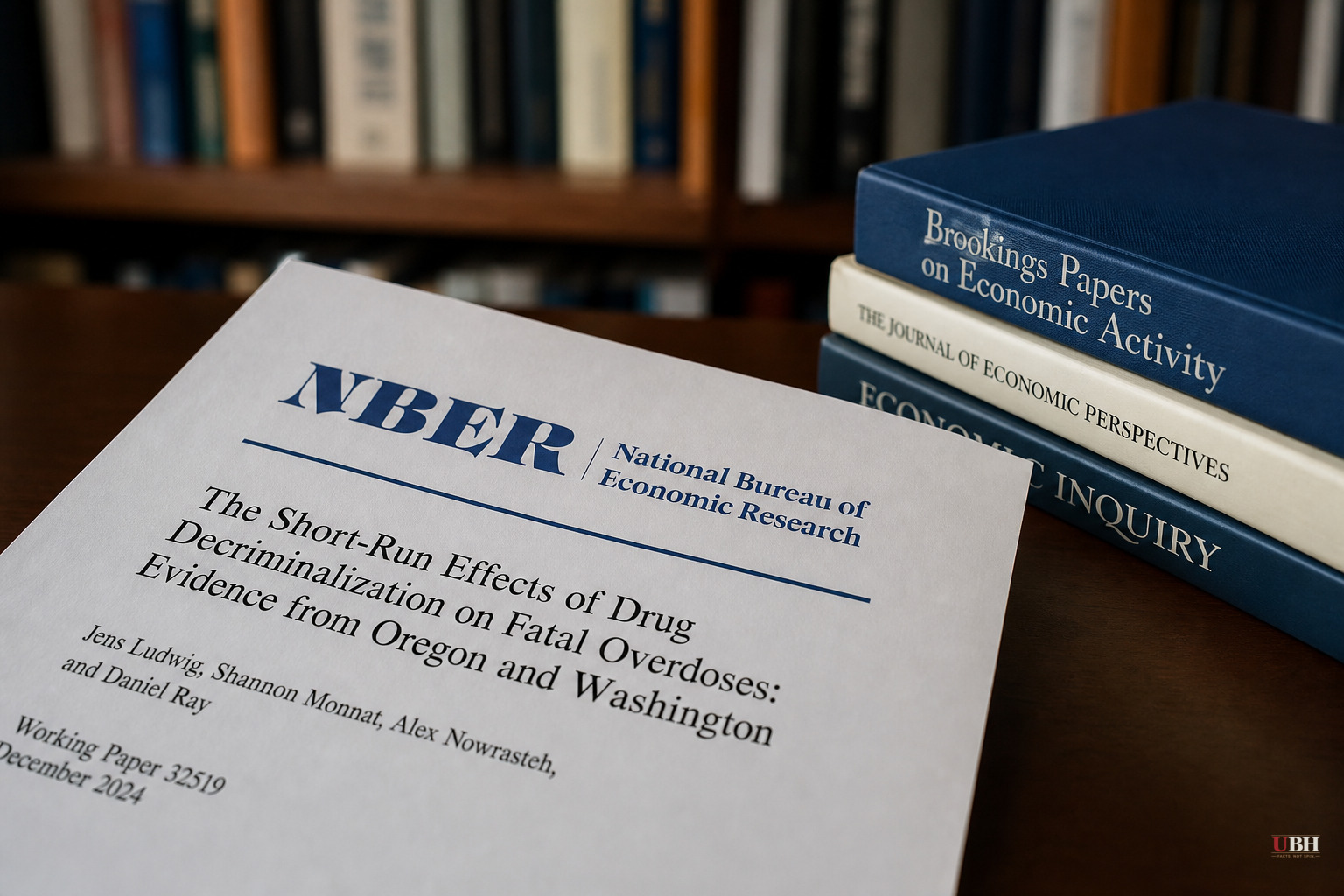
A fight over what a single economics paper actually proves has broken out between two right-of-center commentators, and it's the kind of dispute that matters more than the usual media food fight because real states are deciding real drug policy based on it.
The paper in question comes from the National Bureau of Economic Research and examines what happened when Oregon and Washington briefly decriminalized drug possession starting in February 2021, Oregon by ballot initiative and Washington by a state supreme court ruling. According to Reason, the decriminalization periods in both states were marked by disruptions from COVID-19, the spread of fentanyl, and a season of social upheaval, making the underlying causes of any change in overdose deaths hard to untangle.
Charles Fain Lehman of the Manhattan Institute wrote in City Journal that the NBER paper delivers conclusive proof decriminalization drove up overdose deaths, going so far as to say it should 'lay to rest the debate over legalization' and calling the policy 'an abject failure.' He made a similar case in a Wall Street Journal op-ed, citing a separate study on crime to bolster his argument.
Reason pushed back in its own piece, arguing the NBER paper doesn't close the debate the way Lehman claims. That prompted Lehman to respond on X, and Reason followed up by going straight to the source, contacting the NBER study's co-authors directly.
What the researchers actually said
University of Oregon economist Benjamin Hansen, one of the paper's co-authors, told Reason plainly that he and his colleagues 'do not end any debate' with their findings. That's about as direct a rebuttal to Lehman's framing as it gets, coming from the person who wrote the study.
Hansen went further, saying the research 'if anything, restarts the debate' because it raises new questions, including why decriminalization was associated with more deaths and whether a differently designed version of the policy could avoid that outcome. That's a materially different message than 'abject failure, case closed.'
David Hall, a University of Oregon doctoral student and another co-author, told Reason the precise cause of the overdose spike during the decriminalization period is genuinely hard to isolate. He said decriminalization happened alongside a bundle of other simultaneous changes, and untangling which factor drove the increase in deaths 'will be important and also really difficult.'
Hansen also emphasized that most of the overdose death increase in both states came from the spread of fentanyl, a nationwide crisis that hit hard regardless of any state's decriminalization policy. The paper, according to Hansen, is trying to estimate how much decriminalization made an already-worsening fentanyl crisis worse, not claim decriminalization alone caused the deaths.
Oregon and Washington decriminalized drugs starting in February 2021, amid COVID-19 disruptions, a historic surge in fentanyl supply nationwide, and a broader season of social upheaval. Any one of those factors alone could plausibly move overdose numbers.
That doesn't mean decriminalization critics are wrong to be concerned. The strongest version of Lehman's argument is that an increase in overdose deaths alongside decriminalization is exactly the kind of outcome a policy should be judged on. Advocates for decriminalization don't get to wave away rising overdose deaths as pure coincidence.
But the researchers who ran the numbers are the ones saying their own study can't isolate decriminalization as the driver with confidence, given fentanyl's simultaneous spread. This comes from the authors describing the limits of their own methodology, not spin from a defender of decriminalization.
Reason also noted that this isn't the first time either side has declared premature victory. A 2024 paper found no association between decriminalization and overdose mortality in Oregon, and Scientific American quoted Todd Korthuis, chief of addiction medicine at Oregon Health and Science University, calling it 'the study that we were all waiting for' and saying it showed fentanyl, not changes to the law, was 'the whole story.' That finding cut in the opposite direction from Lehman's claim.
The underlying question, whether decriminalization itself, separate from fentanyl's spread and COVID-era disruption, meaningfully increased overdose deaths, has not been definitively answered by any single study cited in this dispute. Hansen's own words to Reason confirm that his team views their findings as raising new research questions, not settling old ones.
States considering similar policies going forward are left without a clean natural experiment to point to. The people best positioned to say what the data shows, the economists who built the models, are the ones warning against treating this paper as the final word.
Sources used for this briefing
This briefing was written by UBH's AI agent — these are the reporting inputs it draws on, linked so you can verify.


