
Unbiased headlines. Facts, not spin.
Unbiased Headlines is an independently owned news organization. We bring you the facts, not opinions, written fresh from 110+ named sources. Sources linked so you can verify it yourself.
 economy
Notable (6/10)
Event date: October 21, 2026 ·
Refining Margins Collapse, Oil-Yield Link Breaks and Recession Signals Build in Markets
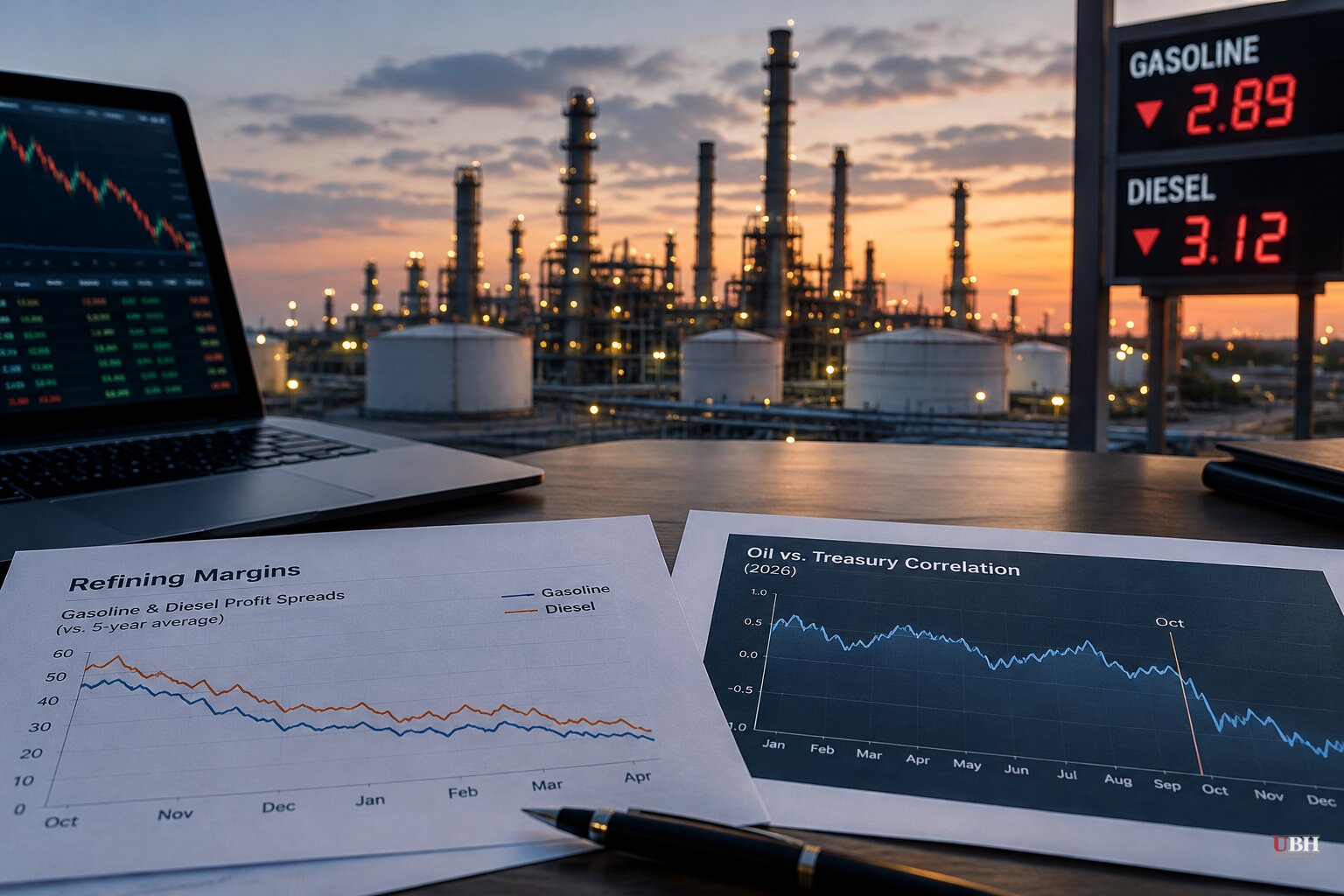
Since crude was up about 70% year to date in early November, with WTI near $96.58 and Brent near $104.93 after a 7% one-day drop on Iran peace-talk hopes, the signals coming out of oil, bond and stock markets have shifted in ways the headline price of crude does not capture.
Refining margins fall back toward pre-war levels
Javier Blas, the Bloomberg energy columnist, said in a social media post that benchmark 3-2-1 crack spreads have dropped to between $25 and $40 a barrel. They were at $60 to $75 just weeks ago. The spread measures the theoretical profit from turning three barrels of crude into two of gasoline and one of diesel.
Blas put the steepest decline in Asia, where Dubai-linked margins fell to near $20 from above $60 in October. European margins tied to Brent dropped to about $28 from nearly $60. U.S. WTI-linked margins slid to under $40 from highs near $70.
Blas attributed much of the move to a sharp slide in wholesale gasoline prices as seasonal demand slows and steady refinery output keeps supply ample. The argument for inflation watchers is that households and truckers buy finished fuel, not crude.
The pump had already started to ease. As of Nov. 2, AAA put the national average gasoline price just below $4.17, down more than 20 cents from a month earlier. Diesel averaged about $6.29, down roughly 8 cents.
The oil-Treasury trade stops working
Jeffrey Rosenberg, senior portfolio manager of BlackRock's Systematic Alternatives ETF, told CNBC that Treasury yields and oil futures had an 80% correlation this year. "Oil and treasury yields had this amazing correlation and in October it just stopped," he said.
His read: "In the market's mind, the geopolitical risk is secondary to AI risk." Bond yields fell, he said, because investors treat weakness in the AI trade as weakness in the broader economy.
CNBC reported that Google suffered the largest single-day decline in its history, erasing about half a trillion dollars in market value. It also reported a Nasdaq wipeout on a Friday in the same stretch.
Rosenberg pointed to third-quarter GDP as a product of the same theme. Business investment rose 12.7%, the biggest gain outside the pandemic since 2011. Information processing equipment spending jumped 37% and industrial equipment nearly 25%, which he said partly reflects data center buildout.
Federal Reserve Chair Kevin Warsh does not accept that framing. At his FOMC press conference, he said: "It is convenient to say that the strength of the economy is all about this new technology wave." Warsh also noted that oil futures had continued to rise, a factor the Fed must weigh in its inflation fight.
Late-cycle signals while the data holds
MarketWatch reported this week that official numbers still look sturdy. GDP growth has stayed strong and the labor market is holding. Markets are saying something different.
The S&P 500 and Dow trade well below the record highs they set last month. Credit spreads are widening, with investors demanding more even from investment-grade borrowers. Copper and crude have fallen sharply while the war with Iran drags on. The dollar index recently touched its strongest level in more than a year, and long-dated Treasury yields have drifted lower for several weeks.
The 2-year to 10-year Treasury gap was 74 basis points in early February. It has narrowed to 27.
David Rosenberg, founder of Rosenberg Research & Associates, told MarketWatch: "These are all classic signs of a late cycle emerging right now." He singled out Walmart, trading at 45 times forward earnings. "When you have one of the most defensive stocks in the index trading at a massive premium to the market, that's telling you something about what investors are thinking," he said.
MarketWatch also reported that markets appear to expect the Fed may need further rate hikes to keep inflation from running away. The Fed said about a month ago that activity is "expanding at a strong pace."
What the war still holds over prices
The war itself has not been resolved. On Nov. 1, President Donald Trump told Right Side Broadcasting Network: "We've had such a victory, and we'll put it away very soon, one way or the other. Either they'll make a deal, or we'll just end it." He has previously said he would not attack Tehran before the midterms.
Secretary of State Marco Rubio said the president would prefer a peaceful resolution but has "everything we need to be successful" militarily. Iranian Foreign Minister Abbas Araghchi said, according to state-run IRNA, that a deal is possible if the U.S. "demonstrates goodwill."
Diesel remains exposed beyond Iran. Russia and Ukraine have escalated attacks, with Russian refining infrastructure under fire, and global diesel and gasoil supplies are tightening further.
ING's commodity strategists framed the choice in a Nov. 1 note. Absent escalation or resolution, they said, the central question is whether investors keep pricing in elevated geopolitical risk or start dialing it back. Margins and crude have since moved lower. The Fed, which has already flagged oil as an inflation factor, now has to decide whether that reflects fading war risk or fading growth expectations.
Sources used for this briefing
4 links from 4 independent newsrooms (syndicated copies of the same report count once)
These are the sources it draws on, linked so you can verify.


