
Unbiased headlines. Facts, not spin.
Unbiased Headlines is an independently owned news organization. We bring you the facts, not opinions, written fresh from 110+ named sources. Sources linked so you can verify it yourself.
 economy
Notable (5/10)
27% of Americans Aged 60 to 75 Say They Can't Afford to Retire, Resume Builder Poll Finds
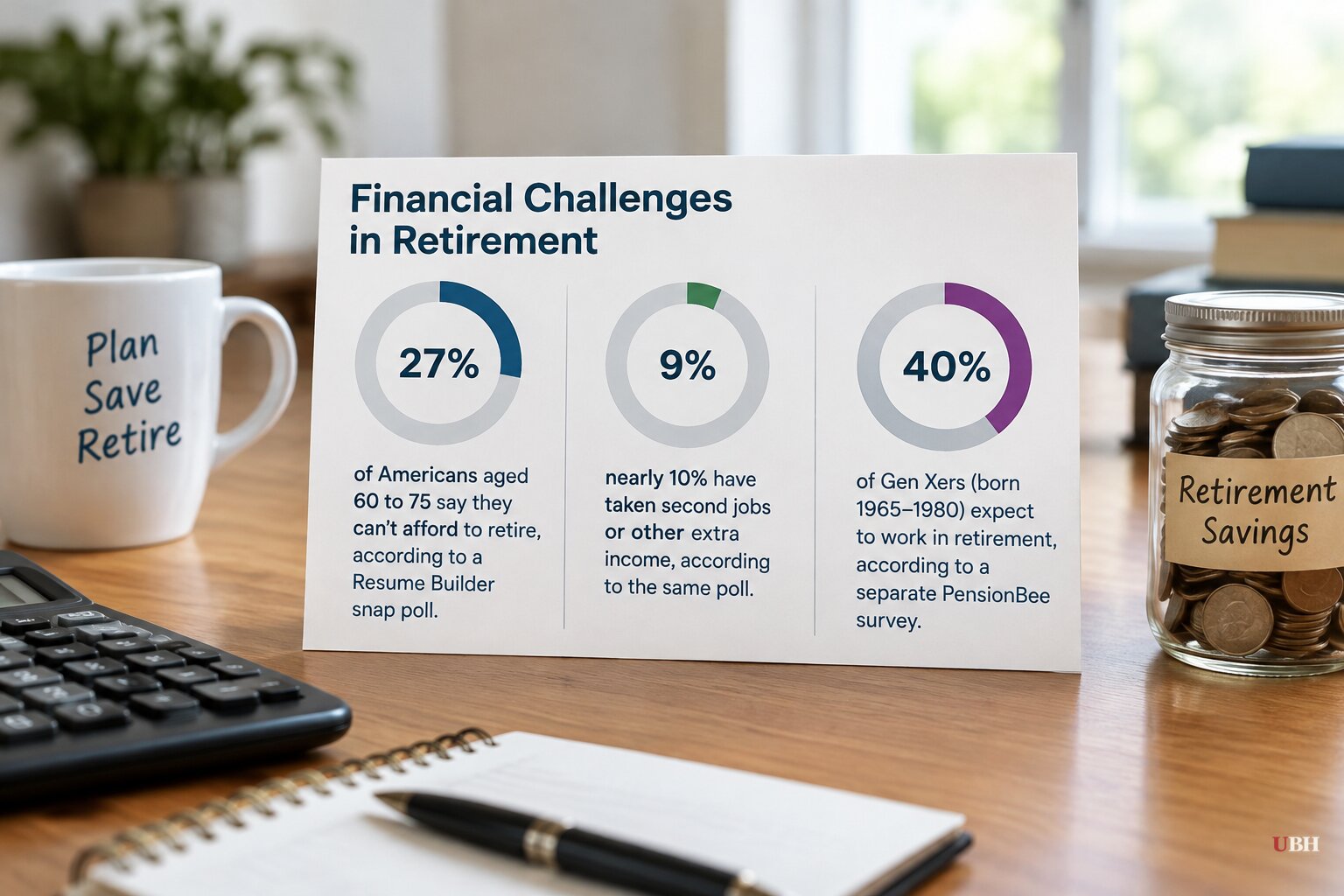
More than one in four Americans between 60 and 75 say they cannot afford to retire, according to a new snap poll from Resume Builder, an online resume-writing and career services company.
Nearly 10% of respondents have picked up a second job or another income stream. Another 12% who are already retired say they are considering a return to work.
What the poll found
Among those still working, looking for work or weighing a comeback, 28% named the high cost of living as their main reason.
The savings picture is mixed. Nearly 20% of respondents have no retirement savings at all. Just 15% say they haven't saved enough, and more than half say they have not tapped their retirement accounts early.
Still, 37% say they lack the money to keep an "acceptable standard of living" if they quit today.
Fear of what's ahead also plays a role. Some 17% worry Social Security will change, and 16% worry healthcare costs will rise.
This is a self-reported snap poll. It does not provide a sample size or margin of error, and it does not compare today's figures with earlier years. It cannot say whether the share of older Americans unable to retire is growing.
Not everyone is working out of need
The poll also found that 18% of the older workers surveyed are on the job because they want to. They cited company, purpose or extra spending money.
That matters for reading the headline number. Working past 65 is not automatically a sign of hardship.
The longer trend
The longer-term data points the same direction. The Pew Research Center has found that the number of people still working past 65 has quadrupled since the 1980s. Almost 20% of Americans 65 and older are now employed, nearly double the share 35 years ago.
That shift stretches back decades, to the 1980s, and the Resume Builder poll points to cost pressures as one continuing driver. The poll does not test other possible explanations.
A second survey, a different mood
A PensionBee survey of 1,000 U.S. retirement savers, released Nov. 19, 2026, adds a harder number. Forty percent of Gen X and Baby Boomer savers said they couldn't last more than two years if they stopped working tomorrow. Only 17% believe their savings would last a decade or more.
Government data shows Americans who reach 65 live about 20 more years on average. Nearly half of retirees told PensionBee they entered retirement earlier than they planned.
Yet the same survey found retirement optimism at its highest since PensionBee began tracking it in May 2025. Sixty percent of savers feel positive about retirement, up from 50% in the first Happy Retirement Report.
PensionBee CEO Romi Savova argued that confidence tracks planning more than balances. "Feeling good about retirement and being ready for it aren't always the same thing," she said. "Savers who feel best are the ones who know what they're aiming for."
The survey backs her up on one point. Savers who know how much they need are about twice as likely to feel positive (75% versus 40%).
Money still shapes the mood. Only 36% of savers with less than $25,000 feel positive, versus 86% of those with $500,000 or more.
How people save matters too. Seventy percent of savers who combine a workplace plan like a 401(k) with an IRA feel positive. That compares with 57% for a workplace plan alone and 52% for those relying only on a savings account.
PensionBee is a retirement savings provider, so its findings come from a company that sells a product in this space. Its survey was conducted between October 28 and November 2, 2026, with a margin of error of plus or minus 3.1 percentage points for all respondents. Results for Gen X and Baby Boomers are based on 459 respondents, with a margin of error of plus or minus 4.6 percentage points. All figures are self-reported.
Work is not always a choice, or an easy one
For some older workers, staying on the job carries its own costs. The Bureau of Labor Statistics counted 824 fatal workplace injuries among workers 65 and older in 2024, the most of any age group that year. Their fatal injury rate was 9.1 deaths per 100,000 full-time workers, more than double the rate for workers 55 to 64.
A 2025 AARP survey found 64% of workers 50 and older have seen or experienced age discrimination at work. Twenty-two percent said they felt pushed out because of their age.
What's unresolved
The two surveys describe a gap between how people feel and what they have in the bank. The Resume Builder poll shows roughly one in four older Americans saying they can't afford to retire. The PensionBee survey shows 40% of Gen X and Boomer savers with under two years of runway, against about 20 years of expected life after 65.
Neither survey says how many of those households have Social Security or other income to fill the gap. Both leave open whether the trend is worsening or has simply held steady.
Sources used for this briefing
5 links from 5 independent newsrooms (syndicated copies of the same report count once)
These are the sources it draws on, linked so you can verify.


