
Unbiased headlines. Facts, not spin.
Every story is an unbiased news briefing written from 110+ sources across the spectrum — sources linked so you can verify it yourself.
 health
Notable (5/10)
July 30, 2026 at 06:01 AM
health
Notable (5/10)
July 30, 2026 at 06:01 AM
Rand Paul and Fauci Clash Again in Senate Over COVID Origins, Science Still Points to Animal Spillover
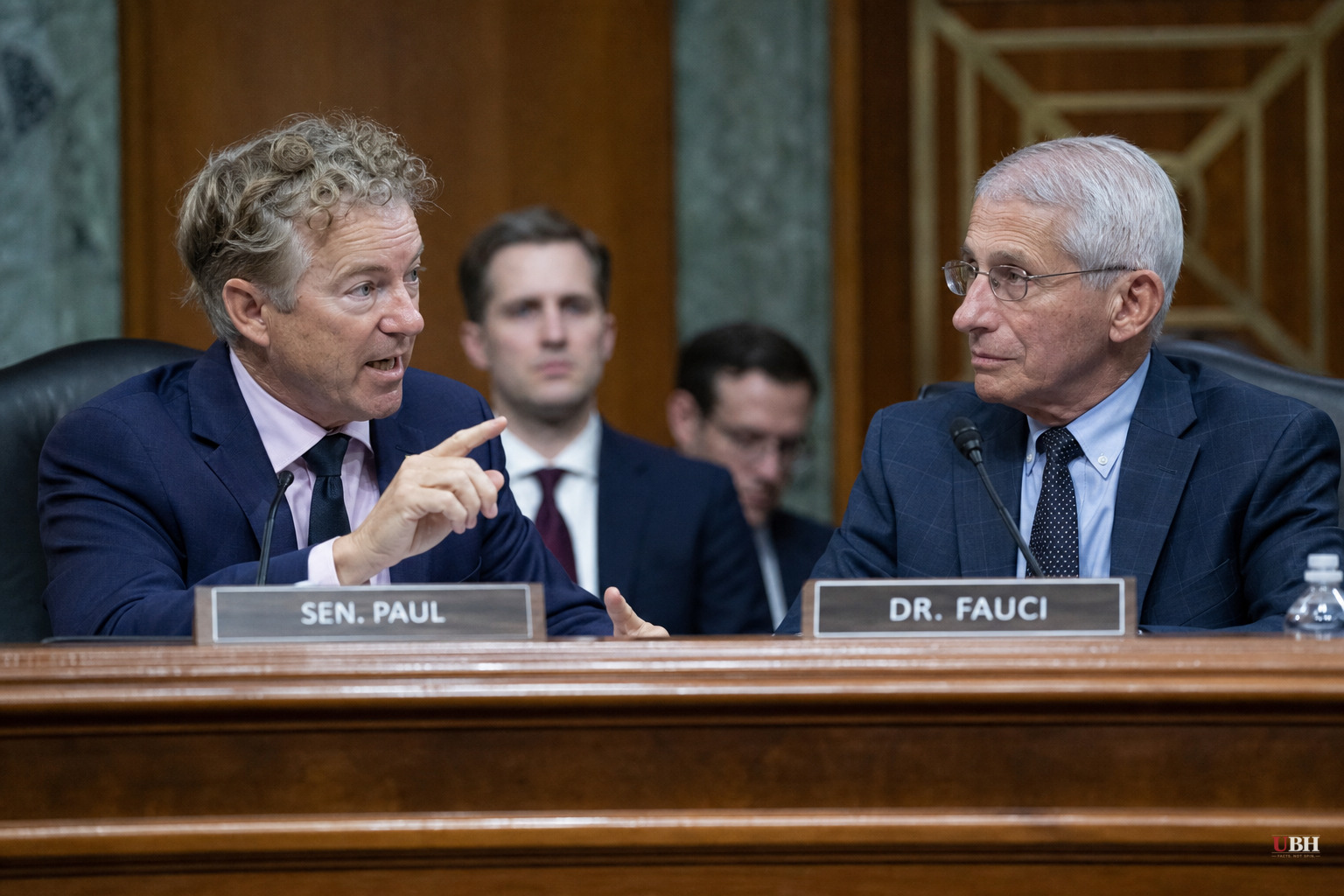
Sen. Rand Paul, R-Ky., and Dr. Anthony Fauci squared off again this week in a Senate hearing, reviving a fight that's been running since 2020: did COVID-19 come from an animal market or a Chinese lab.
Fauci, who ran the National Institute of Allergy and Infectious Diseases from 1984 until 2022, has consistently backed the animal-spillover theory. Paul, who has spent years accusing Fauci of funding risky virus research in Wuhan through NIH grants, pushed the lab leak theory again on the record.
This isn't new ground for either man. What's changed is the political weight behind the lab leak position. The Trump administration has now built its official stance around it. In 2025, the administration took down existing government COVID information pages and replaced them with one titled "LAB LEAK: The True Origins of COVID-19," according to NPR.
Some U.S. intelligence agencies have expressed low-to-moderate confidence in the accidental lab leak theory, according to NPR. Multiple agencies have not ruled out a lab origin and some lean toward it, even if their confidence level is modest.
The core of the lab leak argument that a fair-minded person should take seriously includes this: the Wuhan Institute of Virology sits in the exact city where the outbreak started, it was known to conduct coronavirus research, and the Chinese government has never handed over complete raw data to independent investigators. No animal at the Wuhan market has ever tested positive for SARS-CoV-2 itself, only for related genetic traces in environmental samples. Supporters of the lab leak theory say that missing "smoking gun" — an actually infected animal — is a serious gap, not a technicality.
On the other side, the scientists who specialize in tracking pathogen origins are far less split than the intelligence agencies. They describe the evidence for animal spillover as "very convincing" and "overwhelming," according to NPR.
The World Health Organization's Scientific Advisory Group for the Origins of Novel Pathogens, a 27-member panel, spent three years on the question. Its June 2025 report concluded "the weight of available evidence... suggests zoonotic spillover... either directly from bats or through an intermediate host," according to NPR.
A 2024 study in the peer-reviewed journal Cell, led by researchers including Michael Worobey and Angela Rasmussen, mapped the earliest known cases with what NPR described as unprecedented granularity. The study found coronavirus-susceptible wildlife, the virus, and infected people were all concentrated in one specific section of the Huanan Seafood Wholesale Market in Wuhan. Two earlier peer-reviewed studies in Science, published in 2022, reached similar conclusions by mapping the geographic clustering of the first cases around that same market.
Both sides are working with a dataset that Beijing controls and has never fully opened up. China's government restricted access to early samples, delayed international investigators, and has not released complete records from the Wuhan Institute of Virology's databases. That's a documented fact, not a conspiracy claim, and it's the single biggest reason this argument hasn't died after six years.
The lack of a definitively identified infected animal doesn't prove a lab leak. Plenty of zoonotic outbreaks, including the original 2002-2003 SARS outbreak, took years to trace back to a specific animal host, and some were never nailed down completely. Absence of proof isn't proof of absence. But it also means the animal-origin case, while backed by "overwhelming" evidence in the eyes of most specialist virologists, isn't airtight enough to fully close the door that Paul and others are pushing on.
Fauci has denied that NIH funding supported gain-of-function research at the Wuhan lab in the way critics allege, a position he has repeated under oath in prior congressional appearances. Paul disputes that characterization and has pressed for full transparency on NIH's grant-making through EcoHealth Alliance, the nonprofit that funneled U.S. funds to the Wuhan lab.
No criminal charges, formal indictment, or congressional finding of wrongdoing has been issued against Fauci over the origin question. The dispute remains a scientific and political argument, not a legal one.
The next flashpoint will likely be whatever additional intelligence assessments or Chinese data, if any, surface publicly. Until Beijing releases the raw virological samples and hospital records from late 2019, neither side has the smoking gun to end the argument for good.
Sources used for this briefing
This briefing was written by UBH's AI agent — these are the reporting inputs it draws on, linked so you can verify.


