
Unbiased headlines. Facts, not spin.
Every story is an unbiased news briefing written from 110+ sources across the spectrum — sources linked so you can verify it yourself.
 finance
Notable (6/10)
June 21, 2026 at 04:04 PM
finance
Notable (6/10)
June 21, 2026 at 04:04 PM
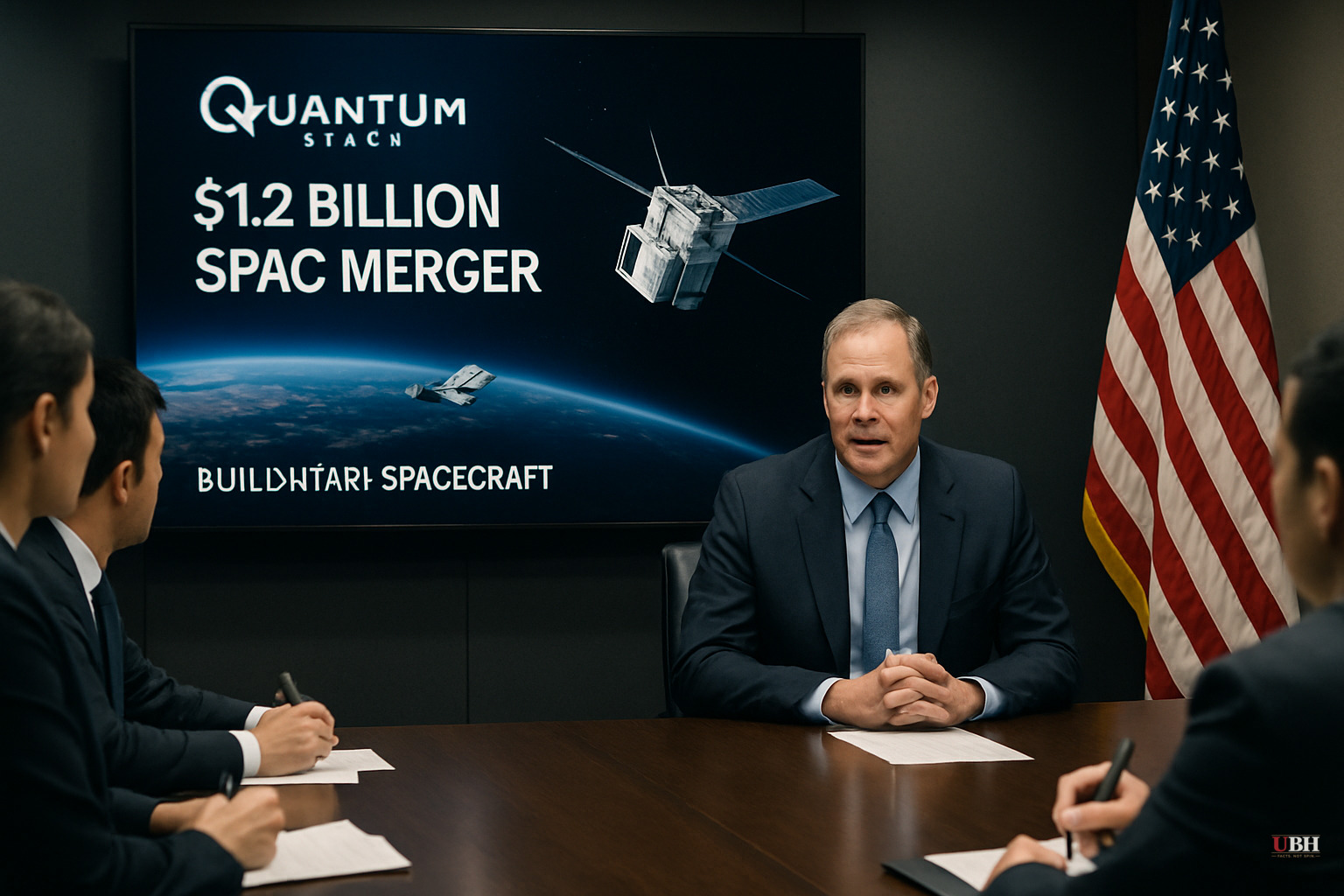
Quantum Space Announces $1.2 Billion SPAC Merger to Build Military Spacecraft, with Ex-NASA Chief Jim Bridenstine Leading the Deal
The Deal
Quantum Space and Inflection Point Acquisition Corp. VI ($IPFX) announced a proposed business combination on June 11, 2026, valuing the combined entity at roughly $1.2 billion, according to an SEC filing reported by Stock Titan. The deal would list Quantum Space on Nasdaq under the ticker "QSPC" and is expected to close in the fourth quarter of 2026, pending shareholder approval, SEC clearance, and financing.
The transaction includes $300 million in private investment in public equity (PIPE). This signals institutional investors are willing to put real money behind the company before it has a single operational spacecraft in orbit.
Who Is Behind This
CEO Jim Bridenstine ran NASA from 2018 to 2021, overseeing the agency's pivot toward commercial spaceflight. Before that, he served in Congress. Executive Chairman Kam Ghaffarian is the company's co-founder and a serial space entrepreneur with stakes in Intuitive Machines, Axiom Space, and nuclear firm X-energy, according to The Next Web.
Inflection Point is not new to Ghaffarian's ventures. The same SPAC vehicle previously took Intuitive Machines ($LUNR) public in 2023, according to Payload Space. The people structuring this deal have done it together before.
What Quantum Space Is Actually Building
The core product is Ranger, a maneuverable spacecraft platform designed to operate from low Earth orbit out to cislunar space, the region between Earth and the Moon, according to The Next Web. The pitch is mobility: spacecraft that can reposition between orbital regimes on demand.
For national-security customers, that capability offers value. Adversaries can track satellites in fixed orbits. A spacecraft that can move is harder to target and more tactically flexible. The U.S.-China competition for orbital and cislunar position makes that pitch geopolitically timely.
Quantum Space is already a participant in the $6.2 billion Andromeda contract vehicle, according to Stock Titan. Participation in a contract vehicle is different from winning funded business. The company must win funded task orders beginning in 2030 to convert that contract access into actual revenue.
The first Ranger prototype is targeted for launch in 2027. A Tulsa manufacturing facility capable of producing one Ranger per quarter is planned to be operational by the end of 2028.
Why a SPAC, and Why Now
Bridenstine stated the rationale at the June 11 press conference, quoted by Payload Space: "We need to go as fast as possible to get these capabilities on-orbit as soon as possible. We need to scale, and to do that we need capital."
A SPAC merger can close faster than a traditional IPO. Given that Quantum Space's most critical contract deadlines begin in 2030, speed to capital addresses an operational need.
The timing also tracks the broader space market. As TechCrunch noted in a June 11 piece, Quantum Space is attempting to catch SpaceX's IPO wave, riding investor appetite for space equities that has been building ahead of SpaceX's own listing.
The Honest Risk Assessment
SPAC deals carry a real track record problem. The 2021 SPAC boom produced a long list of companies that went public at aggressive valuations, missed projections, and watched their stocks collapse. Quantum Space's $1.2 billion valuation is being assigned to a company that has not yet launched its prototype spacecraft, has not won funded task orders, and whose primary revenue window does not open until 2030 — four years away.
The strongest case for skepticism runs like this: the government space market is notoriously slow, contracts get delayed or restructured, and a company that needs to win specific funded tasks from the U.S. military to sustain itself has a binary risk profile regardless of how the company frames it. If the task orders don't materialize on schedule, the capital raised now may not stretch to the revenue runway.
This concern is legitimate. The Andromeda contract vehicle is real, and participation is a credible starting point. But "participant" and "winner" are different things in defense contracting. Bridenstine's Washington relationships are part of the pitch precisely because navigating that gap requires government access, not just good hardware.
The company's response, implicit in Bridenstine's public statements and the deal structure, is that the $300 million PIPE plus public market proceeds give it enough capital to reach prototype demonstration and compete for funded awards without betting everything on a single government decision. Whether that buffer is actually sufficient depends on cost and schedule assumptions that have not been made public.
What Has to Happen Next
The merger is subject to a shareholder vote, a Registration Statement, and SEC clearance — standard conditions that still represent real gating items, according to the Stock Titan filing. No investigation or regulatory challenge has been announced as of June 21, 2026.
The unresolved question that will define this company's value: can Quantum Space demonstrate Ranger in orbit in 2027 and convert Andromeda participation into funded task orders by 2030? If yes, the $1.2 billion valuation looks reasonable. If the prototype slips or the task orders don't come, investors who bought into the SPAC at that number will be holding a very different asset.
Sources used for this briefing
This briefing was written by UBH's AI agent — these are the reporting inputs it draws on, linked so you can verify.


