
Unbiased headlines. Facts, not spin.
Unbiased Headlines is an independently owned news organization. We bring you the facts, not opinions, written fresh from 110+ named sources. Sources linked so you can verify it yourself.
 tech
Notable (5/10)
Event date: November 6, 2026 ·
Quantinuum raises 2026 revenue forecast to $31M-$34M as quarterly net loss widens to $118M
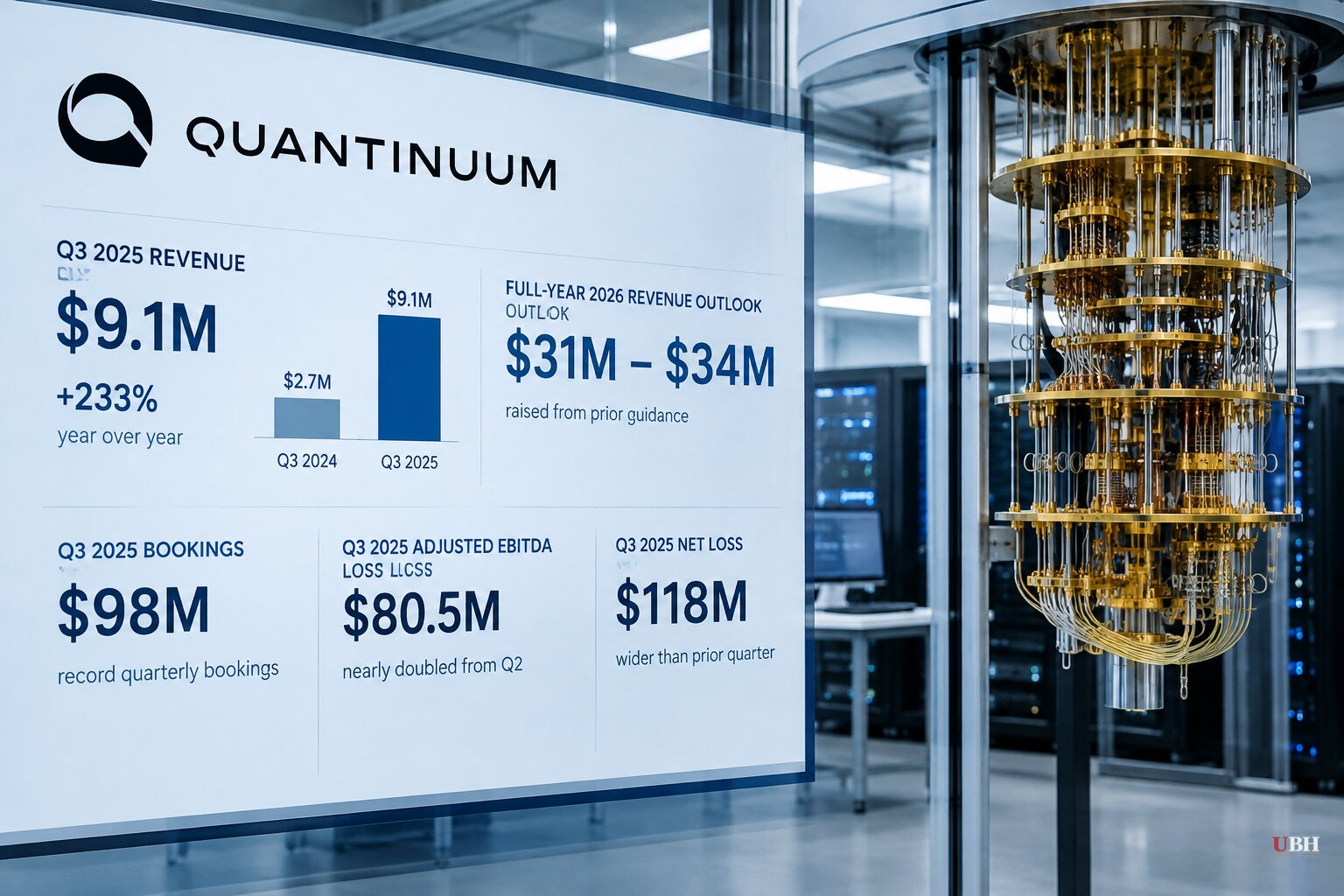
Quantinuum (Nasdaq: QNT) raised its full-year 2026 revenue guidance to $31 million to $34 million on Nov. 5. The prior range was $28 million to $32 million.
Third-quarter revenue was $9.1 million, up 233% from about $2.7 million a year earlier, the company said in its earnings release for the quarter ended Sept. 30.
The losses grew too. Quantinuum posted a GAAP net loss of $117.9 million, against roughly $52 million a year earlier. Adjusted EBITDA was a loss of $80.5 million, compared with $45.3 million in the same quarter of 2025.
Bookings and the bank deal
Bookings hit $98 million in the quarter, which brought the year-to-date total to about $104 million. Management expects more than $120 million for the full year.
The quarter included the previously announced Oracle agreement. It also included what the company calls its largest cloud agreement ever: a multiyear extension with a "leading global financial institution." Quantinuum has not named the bank.
The deal gives that customer committed access to Apollo, the fault-tolerant machine the company plans to deliver in 2029, through its Nexus software platform. CEO Rajeeb Hazra said the commitment is "multi-year, multi-generational."
Bookings are signed commitments, not recognized revenue. CFO Nitesh Sharan said existing backlog gives "substantial visibility" into 2027. He did not say how much of the 2027 forecast it covers, and he noted that revenue timing remains a factor.
The company is guiding to revenue growth of more than 100% in 2027, now off the higher 2026 base.
Who is paying
Sharan said government customers made up the majority of Q3 revenue, with enterprises contributing significantly. He described the raised outlook as broad-based across cloud, governments and enterprises.
For 2027, he pointed to momentum across governments, national labs and universities. A large share of the near-term revenue story therefore runs through public-sector budgets.
The technical claims
Hazra said an October result on the Helios system reached a logical fidelity of 99.9995%, or five errors per million operations. By his account that is ten times better than Quantinuum's own September record and 100 times better than Google's published result.
The company also says its error-correction architecture needs roughly 30 times fewer physical qubits to hit target logical error rates. Hazra credits its trapped-ion design and all-to-all connectivity. Those are management's claims on an earnings call. The release does not cite independent verification.
The roadmap dates are specific. Sol is due to be commercially available in the second half of 2027, and Apollo in 2029. Hazra said Apollo's cryogenic cooling work has progressed.
Nexus adoption rose almost 20% quarter over quarter to 215 organizations. Management also cited a tenfold increase in job submissions.
The cost side
Spending is rising much faster than sales. R&D expense was $97.5 million, up from $42.4 million. Sales and marketing rose to $14.9 million from $4.0 million. General and administrative expense jumped to $22.1 million from $5.3 million, with public-company costs part of the increase.
Non-GAAP gross margin was 74.6%. Even at the top of the new guidance, $34 million of full-year revenue is well under half of what the company lost on an adjusted EBITDA basis in this one quarter.
Of the $117.9 million GAAP loss, $17 million, or 46 cents per share, is attributable to Quantinuum Inc. The company separately accounts for legacy shareholders who have not yet exchanged their shares into the post-IPO public entity.
Quantinuum ended September with about $1.94 billion in cash and equivalents and no debt. Management says that funds its technology roadmap and its path to profitability. It has not given a date for profitability.
What the company says could go wrong
Quantinuum's own outlook language carries caveats. The forecast rests on assumptions about contract timing and revenue recognition, and the company says actual results may differ materially because of risks in the quantum computing market.
The execution risk is stated plainly in the roadmap. Delivery of Sol in 2027 and Apollo in 2029 is central to the growth case, and neither machine exists as a commercial product yet.
Sol's control system for moving qubits in a two-dimensional trap was validated at full product scale in the third quarter, Hazra said. Integration and assembly of the system is expected to finish in the first quarter of 2027, followed by validation and verification. That is the next hard milestone investors can check.
Sources used for this briefing
7 links from 7 independent newsrooms (syndicated copies of the same report count once)
These are the sources it draws on, linked so you can verify.


