
Unbiased headlines. Facts, not spin.
Unbiased Headlines is an independently owned news organization. We bring you the facts, not opinions, written fresh from 110+ named sources. Sources linked so you can verify it yourself.
 tech
Notable (6/10)
Event date: November 5, 2026 ·
Envision hands first 200 MW phase of Inner Mongolia AI campus to Chinese tech customer, targets 3 GW by 2028
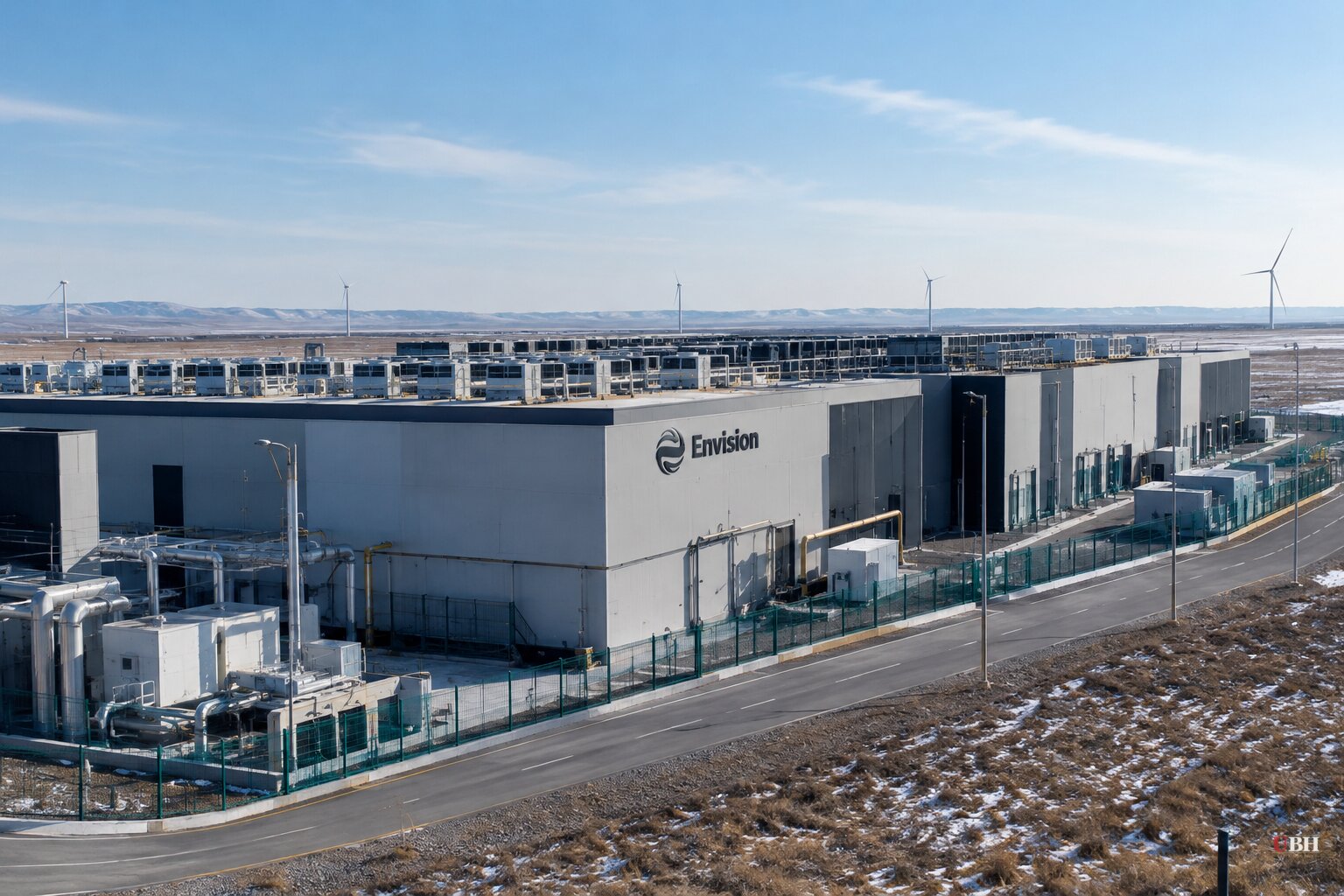
Envision Group, the Chinese renewable-energy company, has handed over the first 200-megawatt phase of its Galaxy AI data center campus in Ulanqab, Inner Mongolia. Zheng Zihao, general manager of Envision's AI data center business, told Caixin the customer is a Chinese internet giant and the handover came in late October. A second 200 MW phase is expected to begin operating in the second quarter of 2027, he said.
Envision says Galaxy began commercial operations in August 2026. The company's stated long-term target is 3 gigawatts of capacity by the end of 2028.
What the site looked like in September
Research firm SemiAnalysis toured the campus in September and published its account today, Nov. 7. Its team, including Dylan Patel, called the speed, scale, ultra-low cost and vertical integration "astonishing."
At that point the rest of the campus was "still a busy construction site," SemiAnalysis said. It describes Galaxy as planned for up to 800 MW of IT capacity, about the size of the core campus at Stargate Abilene, the OpenAI-linked project in Texas.
SemiAnalysis says the first 120 MW phase was delivered within a year at a fifth of U.S. costs. It also says all four phases are built-to-suit for two internet companies. Neither the cost comparison nor the customers' names have been independently confirmed.
The surrounding Chahar High-tech Zone had nearly 30,000 construction workers across 22 datacenter projects, according to a local report cited by SemiAnalysis.
Why the numbers don't match
The 800 MW and 3 GW figures are not the same measure. SemiAnalysis's 800 MW refers to IT capacity at the campus. The 3 GW figure is Envision's longer-range build-out target. Envision also says the full campus is designed to hold up to 1 million AI accelerators in a 120,000-square-meter main building.
Those are company targets, not delivered capacity. What is confirmed so far is the August start of commercial operations, roughly 120 MW of early capacity and the 200 MW handover in October.
Power, and the 800V claim
Envision owns the energy side of the project. SemiAnalysis says the company has more than 100 GW of wind turbines installed worldwide. It builds its own wind farms and a dedicated power line for the campus. Its blade factory sits across the road from the site. It also makes the battery storage that smooths the load.
Envision says more than 80% of the campus's power will come from direct renewable connections.
On Nov. 3, Envision said it had completed the world's first commercial deployment of an integrated 800-volt DC power system in a large data center. Solid-state transformers convert 10-kilovolt AC straight to an 800V DC bus. That removes several conversion stages between the grid and the racks. Envision's Dubhe Controller matches incoming power to computing demand, with batteries absorbing sudden GPU load swings. The company has been testing it at Galaxy since August.
Kevin Huang, senior vice president of Envision Energy, said the system "is now powering live computing workloads." He said it cuts equipment footprint, cabling and copper use and allows higher computing density.
The "world's first" label is Envision's own. SemiAnalysis saw the architecture running in one 5 MW hall, not across the campus. It notes that the same design is still on the U.S. roadmap. It adds that Chinese data centers have run on DC power for almost two decades, starting with China Telecom's 240V DC pilots in 2007.
The contrast with Texas
SemiAnalysis frames Inner Mongolia as the "West Texas" of China. It says Texas faces its highest-ever level of anti-datacenter sentiment while Inner Mongolia is accelerating with no comparable backlash. The region offers abundant renewable resources and a climate that helps with cooling. SemiAnalysis also says the campus's cooling design uses no central chillers.
Envision says Galaxy is the flagship of Mission Gobi, a program that targets 5 GW of green AI data center capacity in desert regions worldwide by 2030. The company says it plans to roll out its 800V DC system there too.
Envision has secured offtake agreements running through 2029 and 2030, with customers in areas such as autonomous driving and content generation. Envision has not named its tenants.
What comes next
The 120 MW built within a year and the 200 MW handed over in October are real milestones. The 2028 target of 3 GW is a plan. The second 200 MW phase, due in the second quarter of 2027, is the next checkpoint for whether Envision can hold its pace.
Sources used for this briefing
7 links from 7 independent newsrooms (syndicated copies of the same report count once)
These are the sources it draws on, linked so you can verify.


