
Unbiased headlines. Facts, not spin.
Unbiased Headlines is an independently owned news organization. We bring you the facts, not opinions, written fresh from 110+ named sources. Sources linked so you can verify it yourself.
 tech
Notable (5/10)
Event date: November 3, 2026 ·
GPU Prices Rose Again in October as RTX 5090 Supply Tightens and Memory Stays Scarce
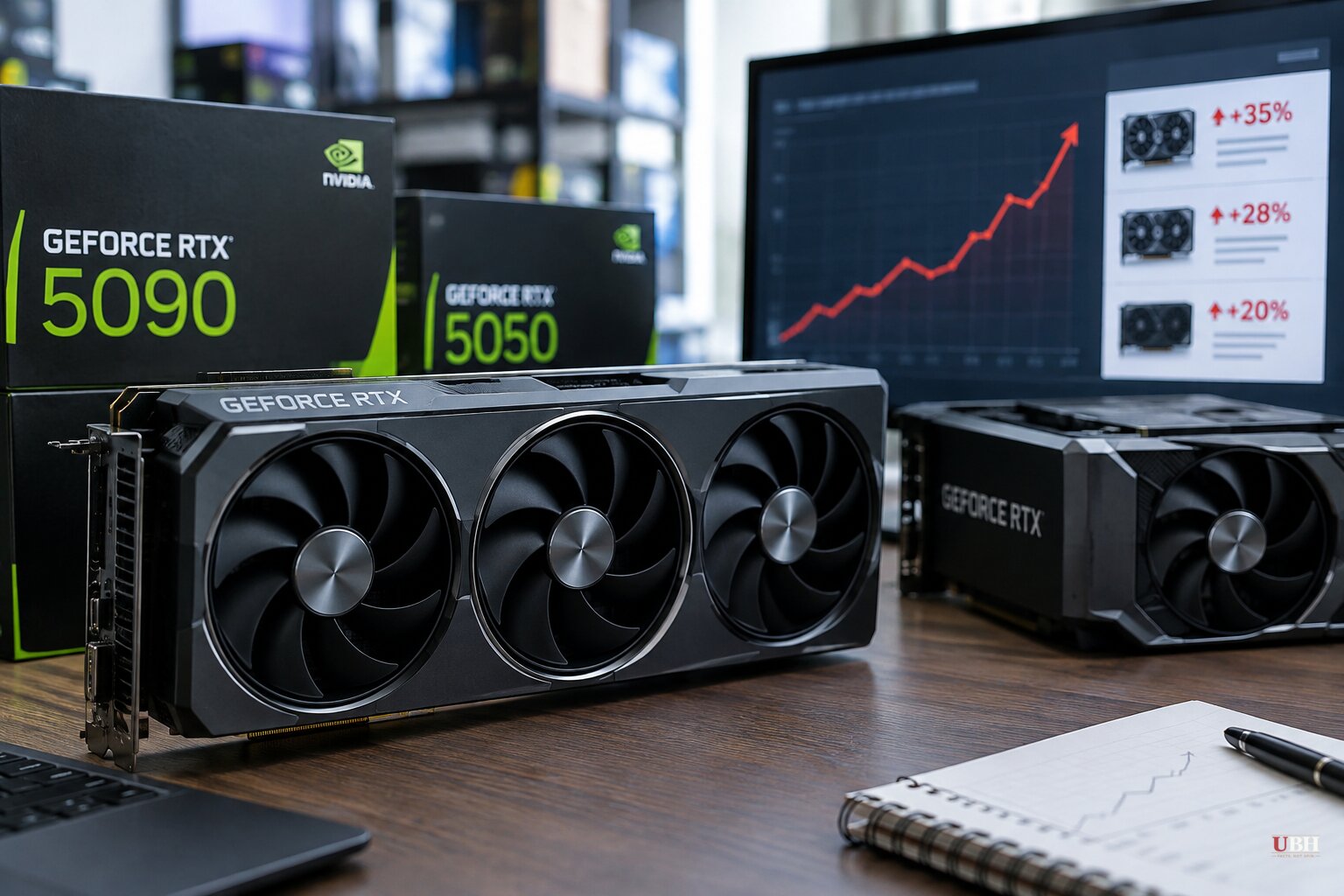
Graphics card prices climbed again in October, extending a run that has made 2026 a miserable year to build a PC.
TechSpot's Q4 update, which tracks the lowest in-stock price for each card across 10 countries, follows a 7% month-over-month increase it recorded in September. The site said it had hoped for at least a pause heading into the holidays. It did not get one.
Entry-level cards took the biggest US hit
The GeForce RTX 5050 is the clearest example. In the US, it started at $310 last month and now starts at $420, a 35% jump.
Across all 10 countries, the RTX 5050 sits 41% above its local MSRP. In the US it is 68% above. Excluding the US, the card rose 6% month over month; with the US included, the increase was 9%.
The RTX 5060 rose 6% on average across the 10 countries and is running about 40% above MSRP globally. Some regions, including the US and Australia, saw no movement on that card.
TechSpot notes its figures are the cheapest available model, often a base card sold at a single retailer. Buyers who want a premium variant will pay more.
RTX 5090 ordering reportedly dries up
At the top end, German overclocker Roman "der8auer" Hartung says an unnamed Nvidia board partner can no longer order the Blackwell GB202 GPU bundled with 32 GB of GDDR7 memory, the kit used to build the RTX 5090. Backorders are reportedly unavailable too. In earlier shortages, Hartung says, the manufacturer could place an order and wait for stock.
Hartung also spoke with a cooling-system supplier. That supplier said two board partners had substantially cut projected RTX 5090 cooler orders for the first quarter of 2027 compared with the third quarter of 2026, and that it has received no RTX 5090 cooler orders for the second quarter of 2027.
The card is absent from Nvidia's US Marketplace, and Micro Center lists it as "Not Carried."
Nvidia's position is different. The company told Hartung the RTX 5090 has not been discontinued, though production capacity remains constrained. Nvidia executive Jeff Fisher made similar comments earlier this month. The board partner said it received no end-of-life notice.
The ordering restrictions do not by themselves show that production has stopped. It is also unknown whether they apply to all board partners or only the one Hartung contacted.
With the flagship scarce, TechSpot says the RTX 5080 has effectively become Nvidia's top gaming option, and its pricing has been pushed up as well.
The memory squeeze behind it
The underlying problem is memory. A JP Morgan report projects DRAM prices will be 400% higher by the end of 2026 than in 2024.
AI data centers need high-bandwidth memory, or HBM, which competes for the same wafer capacity as standard DRAM. Suppliers have moved production toward HBM, which sells for roughly 30% more than conventional DRAM. The shift to newer HBM4 and HBM4E generations is tightening supply further.
The RTX 5090 launched in January 2025 at $1,999. Tom's Hardware's chip tracker now shows it retailing for thousands of dollars more.
The damage has spread beyond graphics cards. JP Morgan says the Consumer Price Index for software and accessories is up nearly a quarter over two years. The Economist found similar increases in game consoles and laptops, and PC shipments have fallen. GameStop is listing the PlayStation 5 Pro roughly $500 above MSRP.
Many chip producers have already sold much of their 2027 supply, and some are now focused on selling 2028 and beyond, according to Engadget's reporting.
Workarounds and a Chinese order that can't be filled
Chinese GPU makers have reportedly told distributors to push older RTX 3060 and RTX 3050 cards to fill the gap left by scarce RTX 50-series hardware, according to a trade report relayed by Wccftech. Those cards use different manufacturing nodes and memory types, so they can be built without cutting into RTX 50 supply. They are not selling cheaper than they did as current-generation parts.
A separate report, which cites unnamed sources, says Nvidia can deliver only about 1% of a $70 billion order from ByteDance, Alibaba and Tencent. The order was for the RTX Pro 5500, a workstation card with 84 GB of GDDR7 that complies with US export restrictions. Of roughly 6 million units ordered, only tens of thousands would ship in the coming months, according to the report. Neither Nvidia nor the three companies have publicly confirmed those figures.
The report attributes the shortfall to manufacturing limits and component shortages, not export rules. If it holds, it could push Chinese firms toward domestic accelerators from Huawei and Cambricon.
What to watch
The open question is the RTX 5090. Nvidia says the card is still shipping, yet one board partner says it cannot order kits and does not know whether Nvidia will ever accept orders again. The cooler supplier's empty second-quarter 2027 order book will show whether other partners are planning around the same gap.
TechSpot's next monthly update will show whether consumers get any relief before the end of the year.
Sources used for this briefing
5 links from 5 independent newsrooms (syndicated copies of the same report count once)
These are the sources it draws on, linked so you can verify.


