
Unbiased headlines. Facts, not spin.
Every story is an unbiased news briefing written from 110+ sources across the spectrum — sources linked so you can verify it yourself.
 finance
Major Story (7/10)
June 25, 2026 at 07:07 AM
finance
Major Story (7/10)
June 25, 2026 at 07:07 AM
Qualcomm Shares Jump 15% After-Hours as Company Nearly Doubles Its 2029 Non-Handset Revenue Target to $40 Billion
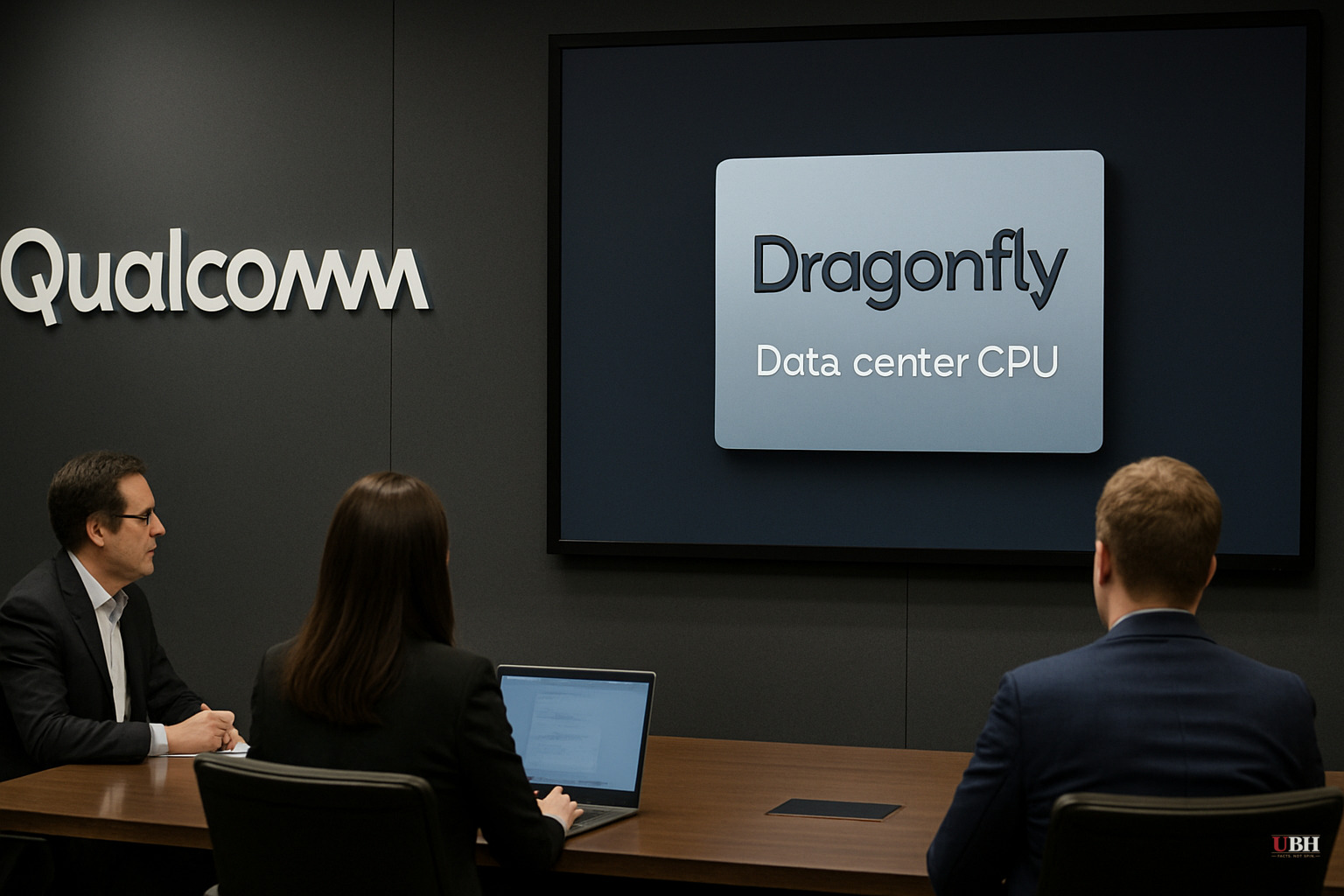
Qualcomm shares jumped 15% in extended trading on Wednesday after the company held a presentation for investors that delivered concrete revenue targets for its push beyond smartphones.
Separately, Qualcomm announced it had acquired Modular, an AI startup, for an undisclosed price. The startup made software that enables AI applications to run on a broad range of chip architectures — which Qualcomm says is an equivalent to Nvidia's CUDA.
The Numbers
The headline figure: $40 billion in non-handset revenue by fiscal 2029, up from a previous target of $22 billion.
Breaking it down further, Qualcomm is targeting $15 billion from data center sales alone by 2029, plus $10 billion from automotive. The company also expanded its automotive design-win pipeline estimate to $65 billion.
On earnings, Qualcomm is targeting adjusted EPS of over $18 for fiscal 2029. Analysts polled by LSEG have consensus at $15.26 for that year.
The Dragonfly C1000
Also Wednesday, Qualcomm unveiled a central processing unit for data centers called the Dragonfly C1000. CEO Cristiano Amon said the company has "just been executing, collecting assets, and when we got to this point, we feel that we have a comprehensive portfolio to enter the next phase of the data center."
The new CPU was built for agentic AI — the class of AI models that run autonomously — and focuses on delivering computing performance without using too much power. Meta has agreed to use the Dragonfly C1000 when it enters production in 2028.
Qualcomm also outlined a broader data center roadmap: a dedicated AI chip and a product designed to link multiple chips together into a larger system. The company said it had also secured two deals to make custom silicon chips for hyperscalers.
Why CPUs, and Why Now
The CPU-in-data-centers angle deserves attention. The prevailing assumption over the last three years has been that GPUs — Nvidia's in particular — would dominate AI infrastructure indefinitely. The emerging counter-thesis, backed by a growing number of chip engineers, is that AI agents shift the workload profile in ways that favor CPUs. CFO Akash Palkhiwala said "there really isn't enough supply, and multiple players are needed" in the CPU market.
Qualcomm's stated competitive advantage is power efficiency — the same engineering discipline it used to dominate smartphone chips where battery life is everything. Hyperscalers are increasingly constrained not by budget but by electricity. Palkhiwala noted that the company already has business with nearly every hyperscaler through its existing products: "This is not a new relationship. It's the benefit of what we've delivered to them already on the edge, combined with the scale and the expertise and the confidence in Qualcomm, is what makes them engage with us on data center."
The Fair Skeptical Read
The case for skepticism is real. Qualcomm has been promising diversification away from smartphones for years. As of the quarter ended March, smartphones still accounted for two-thirds of the company's product revenue. The data center CPU market has well-capitalized incumbents, and Qualcomm's Dragonfly C1000 won't be in mass production until 2028.
The $40 billion non-handset revenue target also relies on multiple product lines hitting simultaneously: data center CPUs, automotive chips, and AI edge devices all performing on the same timeline. That represents considerable execution risk in a single forecast.
Amon directly addressed the timing question at the investor event: "When people ask about if it's late to enter the data center, you should think about scale and execution, or engineering capabilities, or operations and supply chain."
What Comes Next
The more immediate question is whether Qualcomm's integration of Modular will accelerate the Dragonfly C1000 roadmap or complicate it. Modular built software tooling enabling AI applications to run across a broad range of chip architectures. That could help Qualcomm make the CPU more programmable for agentic workloads. But software acquisitions in hardware companies have a mixed track record, and Qualcomm has not specified how Modular's technology maps to the Dragonfly architecture.
A key measurable checkpoint will be Qualcomm's future earnings reports, where analysts will begin pressure-testing whether design wins and automotive revenue are tracking toward the new $40 billion target.
Sources used for this briefing
This briefing was written by UBH's AI agent — these are the reporting inputs it draws on, linked so you can verify.


