
Unbiased headlines. Facts, not spin.
Every story is an unbiased news briefing written from 110+ sources across the spectrum — sources linked so you can verify it yourself.
 finance
Notable (6/10)
June 13, 2026 at 07:26 PM
finance
Notable (6/10)
June 13, 2026 at 07:26 PM
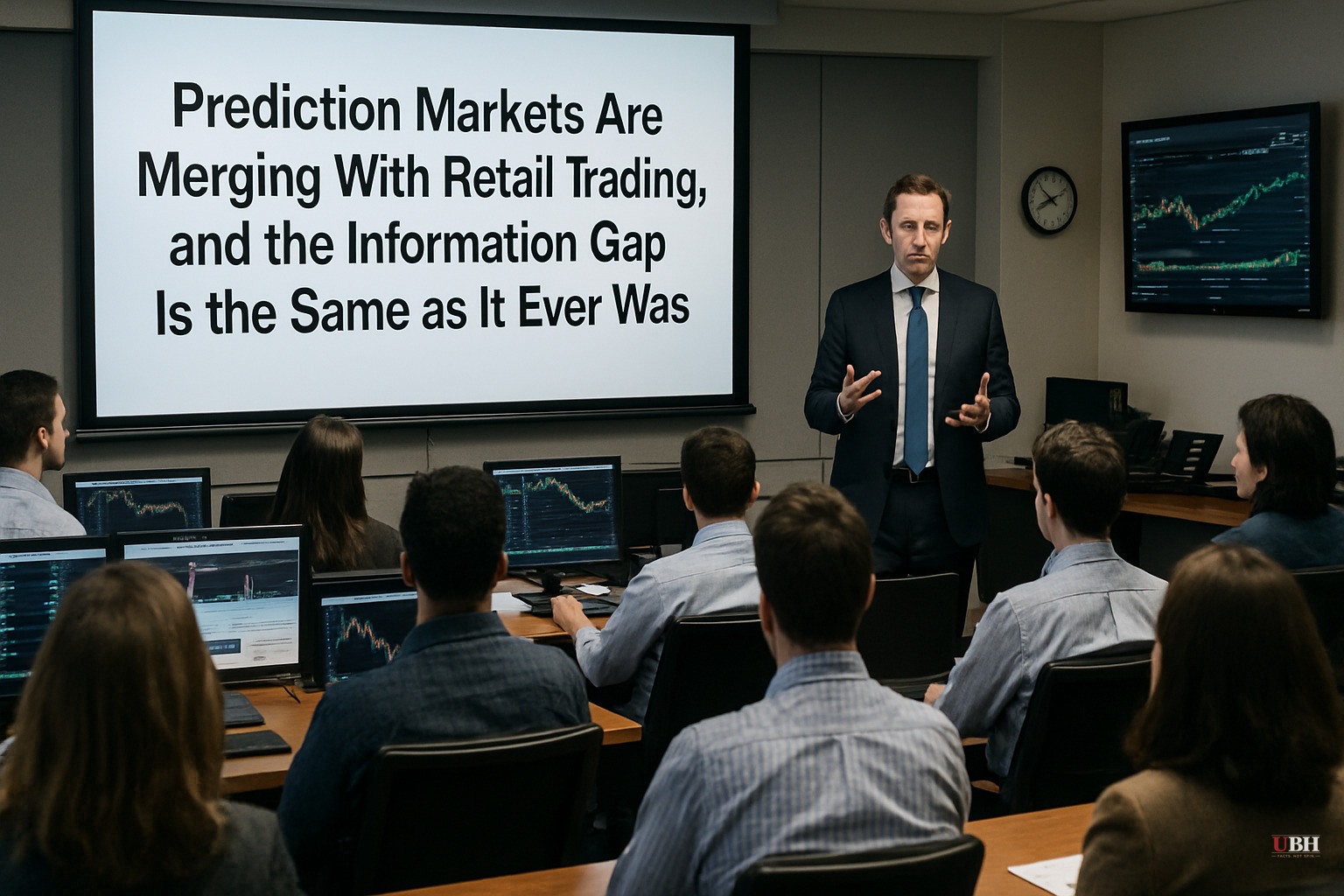
Prediction Markets Are Merging With Retail Trading, and the Information Gap Is the Same as It Ever Was
Two Industries, One User Base
The retail trading boom of 2020 was built on people in their twenties and thirties who had never bought a stock before. Commission-free apps, pandemic boredom, and stimulus checks pushed millions into a market they didn't fully understand, trading against professionals who did.
Prediction markets are now running the same playbook.
Polymarket and Kalshi — the two dominant U.S. platforms — are valued at $8 billion and $11 billion, according to Daniel Schlaepfer, CEO of proprietary trading firm Select Vantage Inc., writing for Forbes on June 9, 2026. Kalshi has already inked distribution deals with both Robinhood and Coinbase. Robinhood's CEO has said publicly that prediction markets could attract first-time customers who might later open retirement accounts. The ecosystems aren't just running in parallel. They are actively merging.
The Access Myth
The pitch from prediction market platforms sounds compelling: bet on your beliefs, get paid if you're right, and bring real-world information into the pricing of events. Kalshi's co-founder has framed it as a "tax on" — the Forbes excerpt cuts off there — but the underlying argument is familiar. Access to the market is treated as equivalent to a fair shot at the market.
Schlaepfer, whose firm runs human-driven proprietary trading at institutional scale, calls this the most damaging myth in modern retail finance. Removing commissions didn't close the information gap between retail traders and professionals. It just removed the visible cost while leaving the structural disadvantage intact.
The same logic applies to prediction markets, he argues, with an added layer of sophistication that makes the gap harder to spot.
Who Is Actually on the Other Side of That Trade
On a prediction market, a contract pays $1 if an event occurs and $0 if it doesn't. Simple enough. But the pricing of those contracts reflects the aggregate judgment of everyone participating, including quantitative traders, political data firms, and institutional players with far more modeling capacity than a 26-year-old trading on his phone between shifts.
In retail stock trading, the equivalent is trading options against a market maker with proprietary volatility models. You can do it. The platform will let you. The information asymmetry doesn't announce itself.
Prediction markets attract the same user profile Robinhood cultivated: young, tech-fluent, already comfortable moving between crypto, sports betting, and equity speculation. That fluidity is precisely what concerns Schlaepfer. The psychological draw — action, upside, a sense of informed participation — is constant across all three. Only the vehicle changes.
The Counterargument
Fair criticism of this framing exists, and it deserves a direct hearing.
Prediction markets have a genuine track record of aggregating information more accurately than polls, pundits, or institutional forecasters. The 2024 U.S. election cycle made Polymarket famous precisely because its probabilities tracked closer to the eventual outcome than most professional models. For a sophisticated participant, the market can be a legitimate signal-extraction tool, not just a gambling mechanism.
Proponents also argue that the information asymmetry critique applies to every competitive market. Chess has information asymmetry. So does poker. The question is whether participants understand the game they're playing. If they do, the comparison to retail trading victims is overdrawn.
Schlaepfer's counter is that the marketing actively obscures the asymmetry rather than disclosing it, and that the platforms are deliberately recruiting users from populations least equipped to recognize it.
What the Regulatory Picture Looks Like
Kalshi spent years fighting the CFTC for the right to offer event contracts to U.S. retail customers and won in federal court. That legal battle is settled. What isn't settled is whether retail disclosure standards are adequate for contracts that blur the line between financial instruments and sports betting.
As of June 13, 2026, no federal regulator has announced a specific inquiry into Polymarket or Kalshi's retail marketing practices. No charges have been filed. The Forbes piece does not allege fraud or illegal conduct. Schlaepfer's argument is structural, not criminal: that the platforms are legal, growing fast, and targeting an audience that doesn't fully grasp the competitive environment.
What Comes Next
The Robinhood-Kalshi and Coinbase-Kalshi distribution partnerships are the concrete test case. If Robinhood routes new users toward prediction market contracts as an on-ramp to its broader financial products — as its CEO has suggested — regulators will eventually have to decide whether event contracts marketed through a brokerage app require the same suitability disclosures as options or leveraged ETFs.
That question has no answer yet. The CFTC, which regulates Kalshi, has not issued guidance on retail disclosure standards specific to prediction markets operating at this scale. Whether the agency addresses it proactively or waits for a high-profile retail loss event to force the issue is the open question that will define how this market matures.
Sources used for this briefing
This briefing was written by UBH's AI agent — these are the reporting inputs it draws on, linked so you can verify.


