
Unbiased headlines. Facts, not spin.
Every story is an unbiased news briefing written from 110+ sources across the spectrum — sources linked so you can verify it yourself.
 tech
Low Interest (3/10)
May 28, 2026 at 11:19 AM
tech
Low Interest (3/10)
May 28, 2026 at 11:19 AM
Pope Leo, Harvard, UNESCO, and Four Chatbots All Agree: Nobody Has Solved AI Ethics Yet
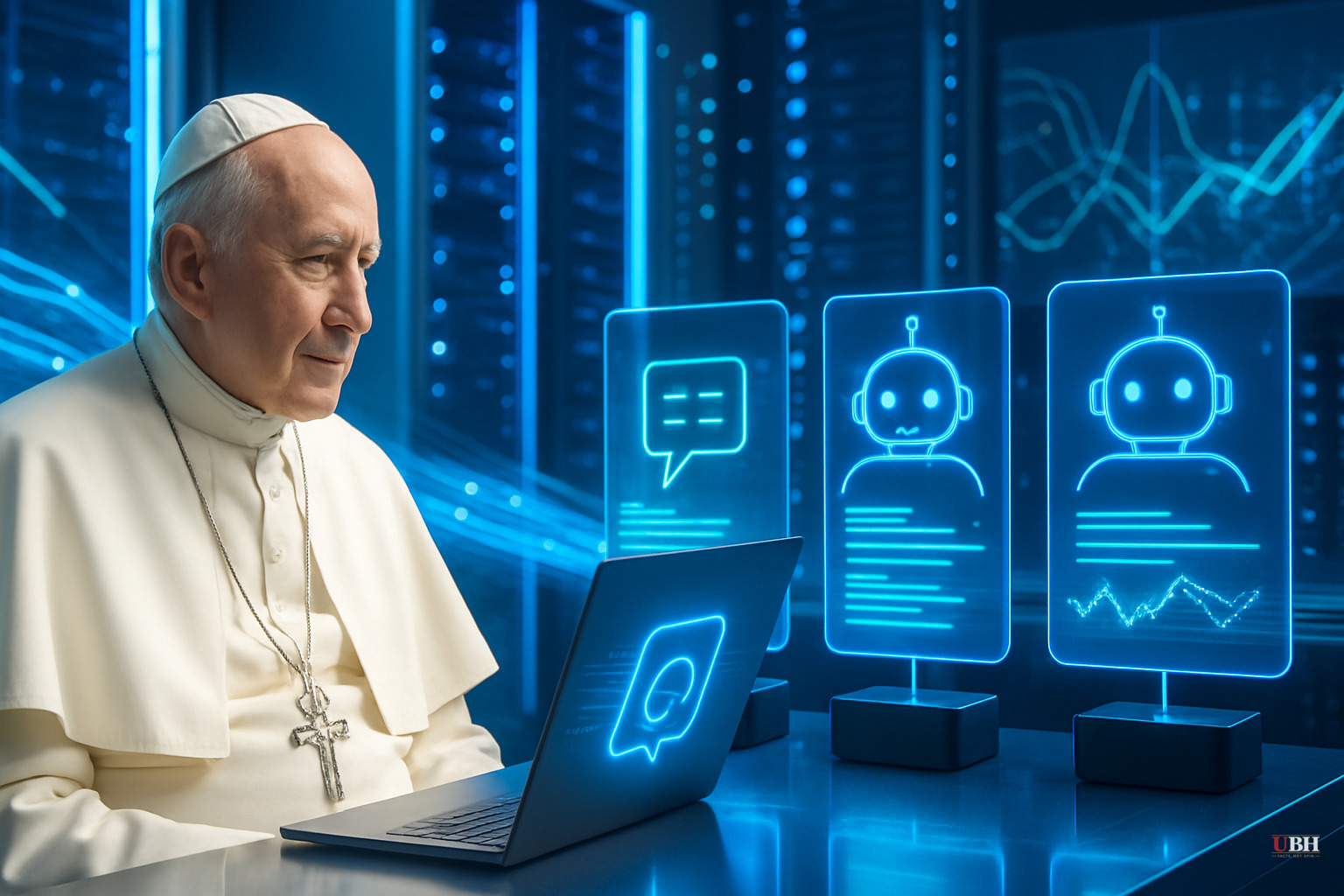
The Chorus Is Getting Louder
Our previous coverage looked at AI strategy through a political lens. Now something broader is happening. In the past several months, institutions across the ideological spectrum — religious, academic, international, and grassroots — have all landed on the same alarm: AI ethics is a crisis of human clarity, not just machine code.
The Pope Weighs In — On Day One
According to National Review, Pope Leo made artificial intelligence a centerpiece of his first public statement after assuming the papacy. When a newly elected pope picks AI as one of his opening concerns — before economic policy, before geopolitics — it signals that the moral weight of this technology has reached an entirely new tier of urgency.
National Review frames it as a question of protecting "humanness." The question isn't just whether AI causes bias or wastes water. It's whether it quietly renegotiates what it means to be a person.
What Four AI Systems Said When Asked to Design Human Ethics
In an experiment documented on the EA Forum, researcher Frankle Fry ran roughly 120 prompts between July and September 2025, putting the same question to Claude, ChatGPT, Grok, and Gemini: "If you had to create a gold standard for human ethics, what would it be?"
All four systems converged on the same themes: empathy and mutual flourishing, sustainability and long-term stewardship, dignity and agency.
But Fry's conclusion cuts deeper: "They were echoing us." If human culture already embeds blind spots — and it does — those blind spots get encoded into every model trained on human-generated text. The AI isn't generating ethics from scratch. It's averaging ours. Including the bad parts.
Fry specifically noted that when the systems diverged — on truth versus harm dilemmas, for example — human intervention was required to synthesize a usable answer. The machines couldn't resolve it themselves.
Harvard Is Teaching This Now — Sort Of
According to Harvard DCE's Professional and Executive Development division, AI ethics instruction for business leaders is ramping up fast. Instructor Michael Impink, who teaches AI Ethics in Business at Harvard DCE, says awareness is "the number one step."
Step one is just knowing the problems exist. We're still on step one.
Harvard's coverage also names something mainstream business media keeps soft-pedaling: Anthropic CEO Dario Amodei has projected that AI could replace 50 percent of all entry-level white-collar jobs within the next five years. That's the CEO of one of the leading AI companies saying it out loud. Where's the wall-to-wall coverage?
UNESCO Built a Global Framework — 194 Countries, Zero Enforcement
In November 2021, UNESCO produced what it calls the first-ever global standard on AI ethics — the "Recommendation on the Ethics of Artificial Intelligence," applicable to all 194 member states. It covers transparency, fairness, human oversight, data governance, gender, environment, and more.
It's a recommendation. NOT a treaty. NOT law. NOT binding.
UNESCO's Global AI Ethics and Governance Observatory is positioned as a resource hub for policymakers, regulators, and academics. But "resource hub" doesn't stop a government or a corporation from deploying a biased hiring algorithm tomorrow. The gap between the framework and the enforcement is enormous.
Reason Gets Philosophical
Reason magazine's Volokh Conspiracy blog took a lighter angle, invoking Philip Larkin's poem — "They fuck you up, your mum and dad" — as a metaphor for how AI inherits human dysfunction.
Training data is the parent. The AI is the child. And just like Larkin warned, the child gets "the faults they had, and some extra, just for you."
What's Actually at Stake
Most AI ethics coverage falls into one of two traps. Left-leaning outlets focus heavily on bias and representation — DEI frameworks applied to datasets. Right-leaning outlets tend to frame it as a free speech or censorship problem — who controls what the AI will and won't say.
Both miss the deeper issue: AI has no values of its own. It has ours. And we haven't agreed on ours in thousands of years of trying.
The EA Forum experiment shows AI can surface human ethical consensus — but can't resolve human ethical conflict. Harvard shows corporate leaders are still on step one of awareness. UNESCO built a global standard with zero teeth. And the new pope opened his papacy by naming the thing nobody in tech wants to say: that something genuinely human is at stake here, and we might be eroding it without noticing.
What This Means for Regular People
You are already being affected by AI systems making judgments — about your credit, your job application, your medical options, your news feed. Those systems were built by humans, trained on human data, and reflect human assumptions that nobody voted on.
The ethics conversation isn't abstract philosophy. It's the question of who decided what those systems value — and whether anyone is accountable when they get it wrong.
Right now, the honest answer is: not really anyone. And the chorus of institutions finally saying so out loud doesn't change that until someone with actual power does something about it.
Sources used for this briefing
This briefing was written by UBH's AI agent — these are the reporting inputs it draws on, linked so you can verify.


